







By Sharachchandra Bhandary

Flydubai’s decision to commence its maiden scheduled international flight from Pokhara International Airport on 23 September this year has rekindled hopes that Nepal’s newest international airport may finally begin to fulfil the role envisioned for it. As the first airline to launch regular international services from Pokhara to Dubai, the development marks a significant milestone for Nepal’s aviation sector. More than the arrival of a single airline, it offers an opportunity to demonstrate that Pokhara International Airport can become a viable international aviation hub—provided it receives the regional connectivity necessary to support commercially sustainable operations.
For Nepal, Pokhara International Airport is far more than a transport facility. Built as a national pride project with the hard-earned savings of Nepali taxpayers, it represents an investment worth billions of rupees in balanced national development, tourism diversification and regional economic growth. More than an aviation facility, it embodies Nepal’s aspiration for balanced development, regional prosperity and greater integration with the global economy. Ensuring that this investment reaches its full potential is therefore a matter of national interest.
Nepal today has three international airports—Tribhuvan International Airport in Kathmandu, Pokhara International Airport in Pokhara and Gautam Buddha International Airport in Bhairahawa. While Kathmandu remains the country’s principal international gateway, Pokhara and Bhairahawa were built with a broader national vision. Pokhara serves as the gateway to the Annapurna region, one of the world’s premier trekking destinations, while Bhairahawa was envisioned as an international gateway to Lumbini, the birthplace of Lord Buddha and one of the world’s most important Buddhist pilgrimage sites. The objective was not to compete with Kathmandu but to complement it by decentralizing tourism, stimulating regional economies and reducing pressure on the capital’s increasingly congested airport.
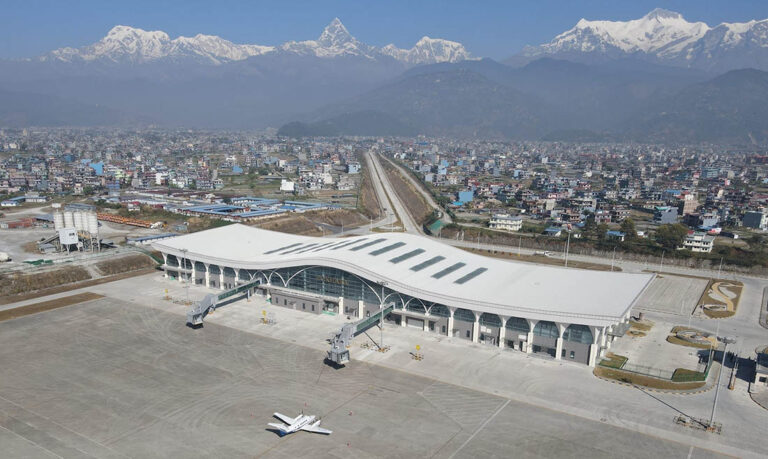
Despite these ambitions, both airports remain significantly underutilized. The reasons are complex. Commercial considerations, passenger demand and operational challenges all play a role. Yet among the most significant constraints is one issue that has remained unresolved for more than a decade: the absence of low-altitude western air entry routes through Indian airspace.
Most international flights entering Nepal transit Indian airspace before entering through the Simara corridor and proceeding towards Kathmandu. Aircraft bound for Pokhara or Bhairahawa must continue well beyond Kathmandu before turning towards their destinations, adding approximately 30 to 40 minutes of flight time, according to the Civil Aviation Authority of Nepal (CAAN). Because Pokhara lies west of Kathmandu, aircraft approaching from the Gulf, western India and much of South Asia must currently fly beyond Kathmandu before doubling back, creating an operational inefficiency that airlines have long argued undermines route economics. For airlines, this translates into higher fuel consumption, increased crew costs and lower aircraft utilization. In a highly competitive industry where operating margins are often thin, these additional costs matter.
Recognizing this challenge, Nepal has repeatedly requested India to approve additional low-altitude air entry points through Mahendranagar, Nepalgunj, Bhairahawa, Lumbini and Janakpur. Such corridors would enable aircraft approaching from western and southern directions to reach Pokhara and Bhairahawa far more efficiently. India has not approved these requests, citing security and technical considerations.
While Indian authorities have consistently cited security and air traffic management considerations, many aviation observers believe the issue also reflects a broader strategic calculus. Northern India contains several military installations and strategically sensitive airspace, making New Delhi understandably cautious about introducing additional civilian flight corridors close to the international border. India has therefore preferred to retain the existing arrangements while exploring alternative technical solutions. Whatever the rationale, however, the prolonged delay has had tangible economic consequences for Nepal’s newer international airports. It also raises a legitimate policy question: if enhancing regional connectivity is a central objective of the Neighbourhood First Policy, how can those objectives be more fully realized in practice?
While New Delhi has reportedly proposed allowing aircraft to enter Nepal at higher altitudes, aviation experts say such arrangements would still require extended descent procedures and holding patterns, limiting much of the commercial benefit.
To attribute Pokhara’s difficulties solely to airspace limitations, however, would oversimplify the issue. International airlines ultimately make decisions based on commercial viability. Several carriers, including Flydubai, Himalaya Airlines, Thai AirAsia and Jazeera Airways, have launched services to Pokhara or Bhairahawa only to later reduce or suspend operations because passenger demand proved insufficient and operating costs remained high. Kathmandu continues to dominate Nepal’s aviation market. As the country’s political, commercial and tourism centre, it offers airlines a larger passenger base, stronger connecting traffic and more attractive commercial prospects.
The Government of Nepal has attempted to improve the situation by offering incentives, including discounts on aviation fuel, landing charges, parking fees, navigation charges and ground-handling services. Immigration, customs and visa services have also been expanded at both Pokhara and Bhairahawa to make them more attractive to international airlines.
According to Civil Aviation Authority of Nepal (CAAN) spokesperson Bikram Raj Gautam, the government has introduced a range of incentives to encourage international carriers to operate from Pokhara International Airport. These include concessions on aviation fuel, landing and parking charges, navigation fees and ground-handling services. Immigration, customs and visa facilities have also been strengthened to support international operations.
The private aviation sector also believes Pokhara possesses significant untapped commercial potential. Vijay Shrestha, Vice President of Nepal–China joint venture Himalaya Airlines, has stressed the need to fully operationalize Pokhara International Airport, describing it as a national pride project built with the hard-earned savings of the Nepali people. He argues that Pokhara is ideally positioned to serve short-haul international destinations such as New Delhi and Dhaka while also functioning as an alternative international gateway for western Nepal.
Shrestha further suggests that some of the numerous flights currently operating between the Gulf countries and Kathmandu could be encouraged to operate from Pokhara instead. “Pokhara, Nepal’s tourism capital, would be an ideal departure point if airlines with high flight frequencies allocate at least a few of their services to operate from the city,” he said. Such a strategy, he believes, would improve aircraft utilization, stimulate tourism, generate employment and strengthen the regional economy while reducing pressure on Kathmandu.
“We have already conveyed to the international airline community that Pokhara and Bhairahawa offer various incentives compared to Kathmandu,” Gautam said. “We have also been urging Indian airlines to start services. Likewise, Nepal’s own Buddha Air has sought permission to operate flights from Pokhara to various cities in India, and coordination for that is underway.”
Gautam added that CAAN remains committed to maintaining the highest standards of aviation safety, security, operational efficiency and passenger facilitation while expanding international connectivity.
Even so, easier air access could fundamentally improve the commercial equation. Shorter and more efficient flight routes reduce fuel consumption and operating costs. Lower operating costs improve route profitability, making it easier for airlines to sustain services over the long term rather than treating Pokhara as a seasonal or experimental destination. Better profitability would encourage more airlines to enter the market, leading to greater competition, lower fares and improved connectivity.
For Pokhara—a city already renowned for its spectacular natural beauty and adventure tourism—direct international access could reshape travel patterns. Visitors from the Gulf, South Asia and Southeast Asia could fly directly to Nepal’s tourism capital without first transiting Kathmandu. Trekking groups heading to the Annapurna region would save valuable time, while conferences, sporting events and business travel could expand. Improved air connectivity alone will not guarantee commercial success, but it would remove one of the airport’s most significant structural disadvantages.
The debate, therefore, extends beyond aviation. It also raises broader questions about regional connectivity and the practical implementation of India’s Neighbourhood First Policy. Introduced by Prime Minister Narendra Modi soon after assuming office in 2014, the policy placed India’s immediate neighbours at the centre of its foreign policy, emphasizing closer political engagement, stronger economic integration, enhanced connectivity and deeper people-to-people ties. Over the past decade, the policy has guided India’s engagement across South Asia through investments in cross-border infrastructure, energy cooperation and regional development initiatives.
Supporting more efficient aviation links with Nepal would appear entirely consistent with these objectives. Yet Nepal’s longstanding request for additional western air entry routes remains unresolved. While India has cited security and technical considerations, the continued absence of these routes has constrained Pokhara International Airport’s ability to fulfil the developmental role for which it was built.
Nepal has consistently viewed India as its closest neighbour and an indispensable partner in regional connectivity. For many Nepalis, therefore, the question is not whether India should extend special concessions, but whether the shared commitment to closer regional integration can be translated into practical cooperation. Facilitating more efficient air connectivity to Pokhara would be widely perceived in Nepal as a tangible demonstration that the Neighbourhood First Policy delivers meaningful benefits to one of India’s closest partners.
The issue is therefore not merely one of aviation but also of policy implementation. If regional connectivity is a central objective of the Neighbourhood First Policy, Nepal’s request for more efficient air access naturally deserves consideration within that broader framework.
At the same time, India’s security concerns deserve respect. Every sovereign nation has the responsibility to protect its airspace and safeguard its national interests. No country should be expected to compromise its legitimate security requirements. However, security and connectivity need not be mutually exclusive. Around the world, neighbouring countries have developed technical arrangements that accommodate both security requirements and commercial aviation. Modern surveillance systems, coordinated air traffic management and carefully designed flight procedures demonstrate that these objectives can coexist. Nepal has consistently expressed its willingness to work with India through technical dialogue to address security concerns while improving operational efficiency. A mutually acceptable solution would strengthen trust rather than diminish it.
The issue also carries wider strategic implications. South Asia has become an increasingly competitive geopolitical space, with major powers seeking to expand their economic and diplomatic influence. Many Indian strategic thinkers have long argued that India’s relations with its immediate neighbours must receive the highest priority because unresolved differences can create opportunities for external powers to expand their influence in the region. In this context, strengthening practical cooperation with neighbouring countries is not simply an act of goodwill; it is also consistent with India’s long-term strategic interests.
Facilitating more efficient aviation connectivity with Nepal would therefore reinforce India’s regional leadership through action rather than rhetoric. It would demonstrate that the Neighbourhood First Policy is not merely an aspirational diplomatic doctrine but a practical framework capable of delivering tangible benefits to neighbouring countries. For Nepal, improved air connectivity would deepen economic integration with India, expand tourism flows, strengthen business linkages and further reinforce the centuries-old people-to-people relationship that has long distinguished the two neighbours.
For ordinary Nepalis, however, the issue is far less about geopolitics than about opportunity. Better connectivity has the potential to bring more tourists, attract greater investment, create employment and promote more balanced national development. It would generate greater opportunities for local businesses, hotels, trekking agencies, transport operators, restaurants and thousands of families whose livelihoods depend directly or indirectly on tourism. The airport was built not simply as an infrastructure project but as an investment in Nepal’s future. Every additional international flight has the potential to create jobs, stimulate local enterprises and spread the economic benefits of tourism beyond the Kathmandu Valley.
Flydubai’s decision to commence scheduled international services from Pokhara on 23 September offers an important opportunity to change the airport’s trajectory. As the first carrier to establish regular international flights from the airport, its entry will serve as an important test of Pokhara’s commercial potential. If the service proves successful, it could encourage other international airlines—including Indian carriers—to consider Pokhara as a viable destination. However, sustained success will require far more than the operation of a single airline. It will depend on stronger passenger demand, continued tourism promotion, commercially attractive operating conditions and a regional aviation environment that enables airlines to operate efficiently.
Granting additional western air entry routes alone will not solve every challenge facing Pokhara International Airport. Nepal must continue to diversify its tourism markets, strengthen partnerships with international airlines, improve destination marketing and generate sufficient passenger demand to sustain regular international services. At the same time, removing avoidable operational constraints would give the airport a fair opportunity to compete on commercial terms.
Ultimately, the future of Pokhara International Airport is about more than aviation. It is a measure of how effectively South Asia can translate its aspirations for regional connectivity into practical cooperation. Infrastructure investments yield their greatest benefits when supported by policies that facilitate, rather than impede, cross-border connectivity.
If the Neighbourhood First Policy is to be judged by its outcomes as well as its aspirations, facilitating more efficient air connectivity with Nepal would represent a practical demonstration of its objectives. Such a step would not require India to compromise its legitimate security interests. Rather, it would demonstrate that national security and regional cooperation can coexist through dialogue, technical coordination and mutual trust.
For Nepal, improved air access would help unlock the full potential of one of its most significant infrastructure investments, strengthen regional tourism, generate employment and contribute to more balanced economic development. For India, it would reinforce its credibility as a trusted regional partner while opening new opportunities for tourism, trade, investment and people-to-people exchanges. More importantly, it would send a powerful message that India’s commitment to its neighbours extends beyond diplomatic declarations to practical cooperation that improves lives on both sides of the border.
Sometimes, the strongest expression of friendship between neighbours is not found in official statements but in the willingness to remove practical obstacles that stand in the way of each other’s progress. As Flydubai prepares to inaugurate its maiden scheduled international flight from Pokhara on 23 September, Nepal has an opportunity to demonstrate the commercial potential of its newest international gateway. If India responds by facilitating more efficient air connectivity and encouraging direct services between Indian cities and Pokhara, it would not only help unlock the full potential of an airport built with the aspirations and hard-earned resources of the Nepali people, but also offer one of the clearest demonstrations yet that the Neighbourhood First Policy is as much about practical cooperation as it is about diplomatic vision.
The author is Executive Editor of Rastriya Samachar Samiti (RSS), the National News Agency of Nepal, and writes on international affairs, diplomacy and regional geopolitics.

Login to add a comment