







By Our Reporter
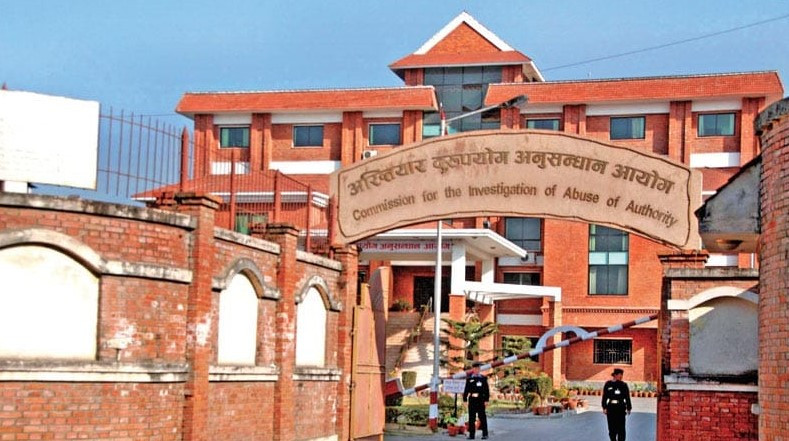
The reported nine-hour detention of the entire leadership and investigative team of the Commission for the Investigation of Abuse of Authority (CIAA) inside the Prime Minister’s Office over the e-passport procurement case marks one of the most troubling episodes in Nepal’s recent governance history. If accounts from officials and sources involved are accurate, the incident goes far beyond a dispute over a government contract. It raises serious questions about the relationship between constitutional bodies and the executive branch, the limits of political authority, and the future of institutional independence in Nepal.
At the center of the controversy is the procurement of 6.4 million e-passport booklets and associated biometric systems. The contract, worth about Rs 7.66 billion, was awarded to two German companies after an international bidding process. The decision survived scrutiny from the Public Procurement Review Committee and also withstood an attempt to secure a court stay order. Despite these reviews, concerns persisted, prompting fresh interest from the Prime Minister’s Office.
What transformed a procurement dispute into a constitutional controversy was the alleged treatment of both diplomats and anti-corruption officials. Reports suggest German Ambassador Udo Volz was kept waiting and denied meaningful engagement while seeking clarification on issues affecting German firms. More alarming are allegations that CIAA commissioners, investigators and senior officials were summoned to the Prime Minister’s Office and subjected to hours of questioning and pressure to issue arrest warrants immediately. The arrests of two passport department officials later that evening have only intensified scrutiny over what happened behind closed doors.
The most important issue is not whether corruption occurred in the passport procurement process. If wrongdoing exists, it must be investigated thoroughly and those responsible must face legal consequences. No public official should be beyond scrutiny. The real concern lies in who decides when and how investigations proceed.
The CIAA is not a department under the Prime Minister. It is a constitutional body created specifically to investigate corruption without political interference. Its independence exists for a reason. Governments change, political interests shift, and rival factions emerge. An anti -corruption agency can function credibly only if it operates according to evidence, legal procedures and institutional judgment rather than the demands of those in power.
Any attempt by the executive branch to pressure the CIAA into making arrests undermines that principle. Once such intervention becomes acceptable, future governments may use the same tactics against political opponents, bureaucrats or business interests. The issue extends beyond this particular case. It concerns the rules that govern the state itself.
Equally troubling are remarks attributed to Prime Minister Balen Shah suggesting that, in the name of controlling corruption, the government could detain CIAA officials for years if necessary. Such statements reveal a deeply flawed understanding of constitutional governance. Fighting corruption is a legitimate objective. Suspending constitutional safeguards in pursuit of that objective is not.
History offers many examples of leaders who justified extraordinary powers by claiming they were acting against corruption, inefficiency or national decline. The result is often the same: institutions weaken, decision making becomes concentrated in a small circle, and accountability disappears. Strong institutions are built by respecting procedures, not bypassing them.
The behavior reportedly displayed by members of the Prime Minister’s inner circle also reflects a broader pattern. Since coming to power, Balen Shah has cultivated an image as a leader willing to move fast, challenge established interests and cut through bureaucracy. That message resonates with citizens frustrated by corruption and government inaction. Yet impatience with institutions can easily evolve into hostility toward institutions.
The belief that elected leaders possess superior moral authority often creates a dangerous temptation. Advisers begin viewing constitutional checks as obstacles rather than safeguards. Independent agencies are expected to validate political priorities instead of exercising independent judgment. Critics are portrayed as defenders of the status quo. Over time, the distinction between decisive leadership and executive overreach becomes blurred.
The e-passport episode illustrates precisely why constitutional boundaries matter. If the Prime Minister’s Office possessed compelling new evidence, it should have formally submitted that information to the CIAA and allowed investigators to proceed according to law. That approach would have strengthened both accountability and institutional legitimacy. Allegedly coercing investigators achieves the opposite.
Nepal’s democratic system depends not on the intentions of individual leaders but on respect for constitutional rules. A government committed to fighting corruption should be the first to defend the independence of anti-corruption institutions. Any other approach risks replacing one problem with another.
The passport investigation should continue wherever the evidence leads. At the same time, allegations surrounding the treatment of CIAA officials and diplomatic representatives deserve independent scrutiny. A state governed by law cannot allow constitutional bodies to operate under political pressure. Once that line is crossed, the damage extends far beyond a single case or a single government.

Login to add a comment