







By Our Reporter
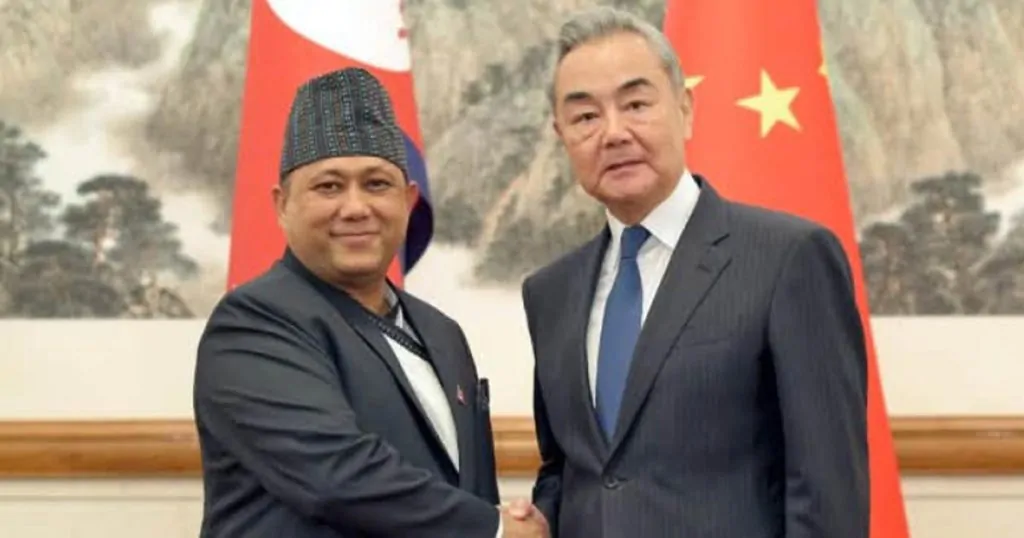
Foreign Minister Shishir Khanal’s visit to Beijing revealed an important reality in Nepal-China relations. Despite repeated declarations of friendship and cooperation, China is increasingly uneasy about developments inside Nepal. The concerns expressed by Chinese leaders during the visit were not limited to a single issue. They touched on investment security, geopolitical competition, anti-China activities, and the future direction of Nepal’s foreign policy.
The message from Beijing was clear: China wants assurances that its strategic and economic interests in Nepal will remain protected amid a rapidly changing political environment.
For years, Nepal occupied a relatively stable place in China’s neighborhood policy. Beijing viewed Nepal as a friendly country that firmly adhered to the One China policy and maintained a balanced approach in regional affairs. That perception has become more complicated in recent years.
One reason is the growing presence of external powers in Nepal. Chinese officials continue to closely watch American engagement through initiatives such as the Millennium Challenge Corporation (MCC). While Nepal insists that development assistance is purely economic, China often views regional developments through a strategic lens. Beijing remains sensitive to any activity it believes could strengthen the influence of rival powers in countries along its periphery.
This explains why Chinese Foreign Minister Wang Yi highlighted the importance of close neighbors over distant partners. The statement was diplomatic, but the underlying message was unmistakable. China wants Nepal to remain within a stable sphere of friendly relations and avoid becoming an arena for geopolitical competition.
Investment security is another major concern. China has invested heavily in infrastructure projects across Nepal. Roads, airports, energy projects and connectivity initiatives have become important symbols of bilateral cooperation. Yet several Chinese funded projects have become controversial. The corruption investigation involving the contractor of Pokhara Regional International Airport has particularly attracted Beijing’s attention.
From China’s perspective, legal scrutiny of contractors creates uncertainty for companies considering future investments. Chinese officials appear concerned that political changes, public controversies or administrative decisions could affect projects after agreements have already been signed.
At the same time, Nepal cannot ignore allegations of wrongdoing simply because foreign companies are involved. The rule of law requires that all contractors, whether Chinese, Indian, American, European or Nepali, face equal scrutiny if credible evidence of corruption emerges.
This is where Nepal must strike a delicate balance. On one hand, Kathmandu should reassure Beijing that Chinese companies will not face discrimination. On the other hand, Nepal cannot compromise the independence of institutions such as the Commission for the Investigation of Abuse of Authority. Any perception that foreign pressure can influence corruption investigations would damage Nepal’s credibility far more than any diplomatic disagreement.
China’s security concerns extend beyond economics. Beijing remains highly sensitive to activities related to Tibet and any political movement it perceives as challenging Chinese sovereignty. The concerns raised about anti-China activities in Nepal reflect long standing Chinese priorities. Nepal has repeatedly committed itself to the One China policy and has generally cooperated with Beijing on security matters.
Foreign Minister Khanal’s reaffirmation that Nepal will not allow its territory to be used against China was therefore an important reassurance. Given Nepal’s geographic position between two Asian giants, maintaining trust with neighboring countries remains essential.
Yet the discussions also highlighted the limits of Nepal’s relationship with China. Khanal sought Chinese support regarding the Lipulekh dispute involving India. Beijing declined to engage, maintaining that the matter should be resolved between Nepal and India. The response demonstrates that while China values Nepal as a partner, it is unwilling to jeopardize its own strategic relationship with India for Nepal’s territorial concerns.
That reality should encourage Nepal to pursue a pragmatic foreign policy rather than relying excessively on any single partner. The broader lesson from the Beijing visit is that Nepal must become more predictable. Foreign investors seek clear regulations. Neighboring countries seek policy consistency. Development partners seek confidence that agreements will be honored. Frequent political changes, shifting priorities and bureaucratic delays often create uncertainty that concerns all external partners, not just China.
Addressing China’s concerns therefore does not require Nepal to choose sides in regional rivalries. It requires Nepal to strengthen its own institutions.
The government should ensure that corruption investigations remain independent, transparent and evidence based. It should improve the investment climate by enforcing contracts fairly and applying laws consistently. It should accelerate implementation of agreed infrastructure projects while maintaining rigorous oversight. It should continue adhering to the One China policy while preserving balanced relations with India, the United States and other international partners.
Most importantly, Nepal must act according to its own national interests rather than the preferences of competing powers. China’s concerns are understandable from its strategic perspective. Nepal’s responsibility is not to satisfy every expectation from Beijing, New Delhi or Washington. Its responsibility is to maintain sovereignty, uphold the rule of law and create a stable environment for investment and cooperation.
If Nepal can do that, it will not only address China’s concerns but also strengthen its standing with all of its international partners.

Login to add a comment