








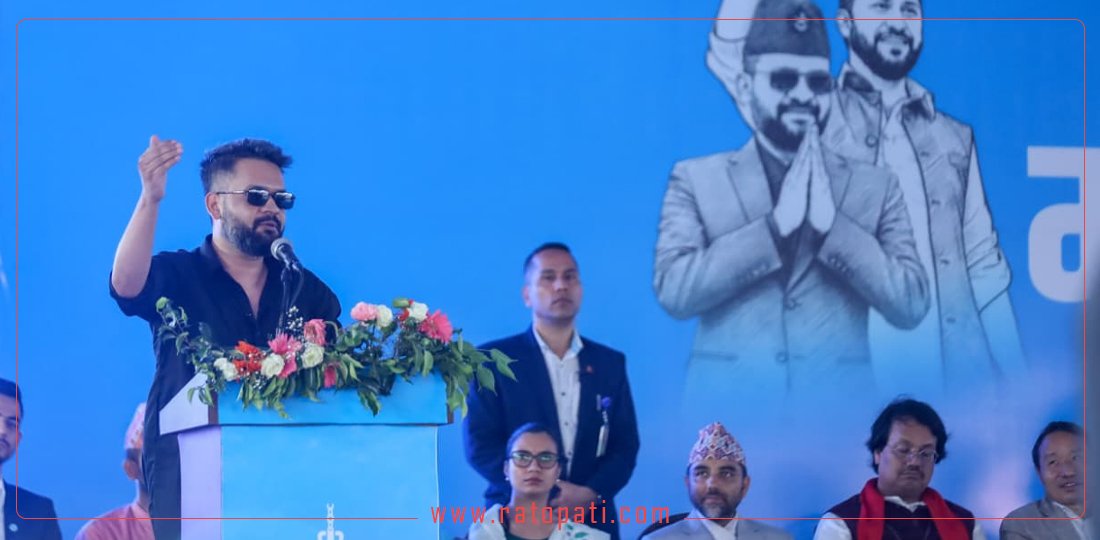
Kathmandu, June 21: Prime Minister Balen Shah has responded at the convention of the ruling Rastriya Swatantra Party (RSP) to opposition parties that had demanded he address the House of Representatives and explain his remarks regarding the border issue.
Addressing RSP’s first general convention in Chitwan today, Shah clarified his controversial statements on the border dispute. Opposition parties had been demanding that he speak in Parliament and provide an explanation regarding the issue. However, Shah himself had not addressed Parliament on the matter; instead, Foreign Minister Shishir Khanal had offered clarification on his behalf.
Taking a swipe at critics who had been demanding that he speak, Shah remarked, “I prefer not to speak, but the day to speak eventually comes.” The comment was widely interpreted as sarcasm directed at opposition parties.
On the border dispute, Shah said that his remarks were based on evidence. “We are not trying to act as mediators. If we do not have sufficient evidence, and if obtaining that evidence requires us to go that far, then we should be prepared to do so,” he said. He also urged people not to question his patriotism.
Shah further addressed the controversy surrounding the recent questioning of officials from the anti-corruption body, the Commission for the Investigation of Abuse of Authority (CIAA).
He insisted that, while investigating past irregularities, the government would hold discussions for as long as necessary. “If required, we will consult with the CIAA not just for five hours but for five years while investigating past wrongdoing. We will not act outside the law,” he said.
RSP Chairman Ravi Lamichhane said the party has entrusted Prime Minister Balen Shah with the responsibility of “scoring goals.”
Speaking at the party’s first national convention in Chitwan, Lamichhane said Shah must now deliver results.
“RSP has delivered the ball to Balen Shah’s feet,” Lamichhane said. “It is his responsibility to score goals one after another. If, after bending down, that ball somehow comes to my feet, then it will be my responsibility to pass it on.”
He made the remarks in an apparent attempt to dispel rumors of dissatisfaction and internal divisions within the party.
Gagan Thapa, president of the Nepali Congress, said his party would firmly oppose any violation of due process.
Offering best wishes at the opening session of the RSP convention, Thapa appeared to criticize the working style of the government and its ministers.
“Wherever due process is violated, Congress will stand firmly,” he said.
Thapa added that Congress would oppose any minister who advocated actions such as tying citizens to trees.
“If any minister says citizens should be tied to trees, we will raise our voice against it,” he stated.
He also said that if RSP takes a strong position against border encroachment, Congress would welcome and support it even more forcefully.
Thapa argued that politics over the past 10–12 years had largely been driven by calculations aimed solely at gaining power. He said the future should instead be guided by public interests and democratic values. He also reiterated Congress’s commitment to protecting the constitution and the current political system.
Pradeep Gyawali, a leader of the Communist Party of Nepal (UML), said there is widespread curiosity about where RSP stands in national politics.
Addressing the convention, he said:
“The question of where RSP stands in national politics is being asked everywhere. Whether you position yourselves at the center, lean to the right, or lean to the left is not the most important thing. The main thing is to become a party that does something meaningful for ordinary working people.”
Gyawali congratulated Ravi Lamichhane on being elected chairman and Balen Shah on becoming the party’s senior leader. He stressed that the convention should not only select leaders but also establish a clear policy direction and roadmap for the party.
Rajendra Lingden, chairman of the Rastriya Prajatantra Party (RPP), claimed that many voters supported RSP because they believed Balen Shah would restore the monarchy.
Speaking at the opening session of the convention in Bharatpur, Chitwan, Lingden said there remains significant support in Nepal for the return of the monarchy.
“There are votes in Nepal from people who want the monarchy restored. The party that openly advocates for a king is RPP,” Lingden said. “But people voted for you because they believed Balen—not RPP—would bring back the king.”
He added that Nepal’s problems lie not only with political leaders but also with the constitution and the state structure itself.
Barshaman Pun, a leader of the Nepali Communist Party, urged RSP to express a clearer and stronger commitment to Nepal’s federal democratic republic and social justice.
Addressing the convention’s opening ceremony in Bharatpur, Pun noted that RSP had gained remarkable public support in a short period of time and therefore carried significant public expectations.
He said the leadership, ideology, strategy, and direction adopted by the convention would have a substantial impact on national politics.
“The entire country is watching this convention of a ruling party that enjoys a strong public mandate. Many people are eager to see what kind of leadership, ideas, strategies, and direction emerge from this gathering, because they will influence the nation as a whole,” Pun said.
He acknowledged differences between his party and RSP, describing them as ideological, policy-related, behavioral, and stylistic.
“We do not doubt your intentions, but we would like to see an even stronger commitment from you toward a federal democratic system based on social justice. I believe this historic convention will help remove the questions, accusations, and doubts surrounding your position on the constitution, democracy, and the established political system. I hope this first convention will provide you with greater ideological and organizational clarity,” he added.
People’s News Monitoring Service.

Login to add a comment