








By Our Reporter
Kathmandu is witnessing a growing debate over the Army’s role in the current landless squatters’ eviction drive. As settlements along the Manohara corridor in Thapathali, Sinamangal and Narephat are cleared, the Army has been present not just to maintain security but also to collect data on squatters across the country. That mix of roles has caught the attention of politicians, lawyers and rights groups.
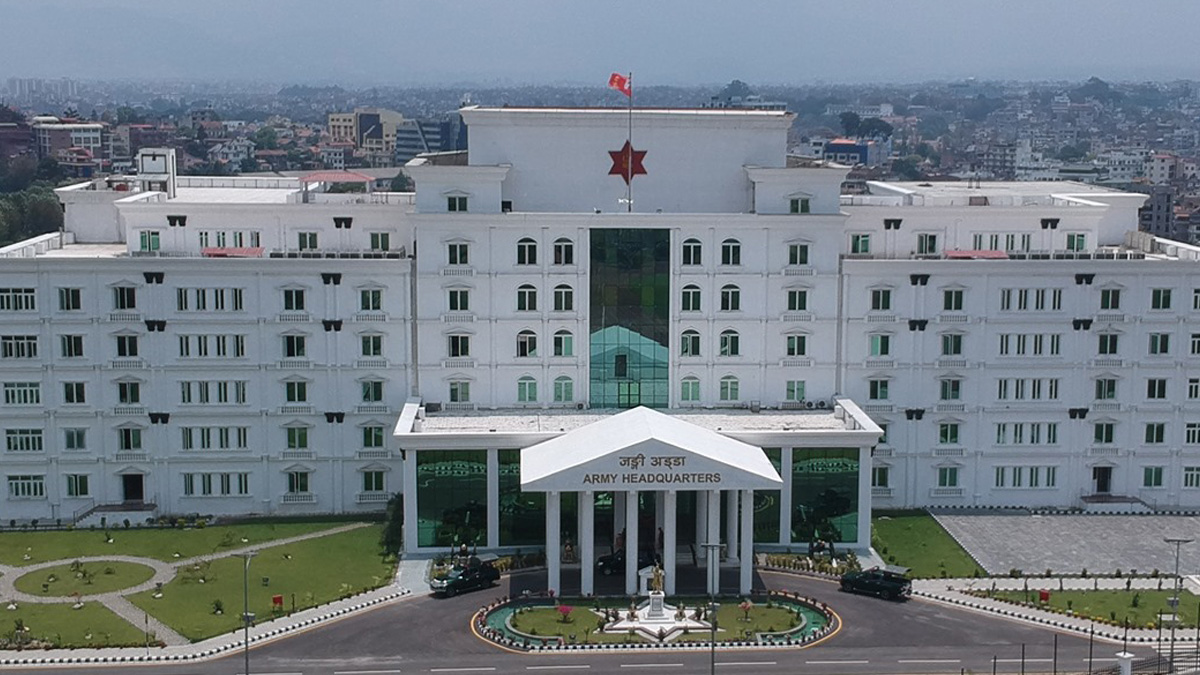
The concern sharpened after Army Headquarters instructed units nationwide to gather detailed information on informal settlements within 48 hours. The Army says this is linked to disaster preparedness with the monsoon approaching. It also points out that it is working through District Security Committees, where it already has a formal place, and is simply supporting government decisions.
On paper, that sounds straightforward. But the timing and scale raise questions. Squatter management falls under the Ministry of Land Management, Cooperatives and Poverty Alleviation. That ministry already holds extensive data from past surveys and commissions, including estimates of more than a million landless or informally settled people. Building a parallel database through the Army inevitably invites scrutiny.
The issue goes beyond duplication. It touches on the broader question of roles. Data collection on a politically sensitive social issue is not a routine security task. Nepal has long tried to maintain a balance between civilian authority and military professionalism. Even in disaster response or internal security, the Army usually operates under clear civilian direction. This time, its role appears more forward-leaning, and that shift is what many find unsettling.
Rights groups have been quick to respond. They argue that evictions without proper resettlement plans go against constitutional guarantees and court orders. The Patan High Court has already directed authorities to identify and rehabilitate squatters before removing them. What critics see instead is a process where demolitions move ahead faster than any serious resettlement effort.
That disconnect is hard to ignore. The government has promised to verify squatters within 60 days and deliver long-term solutions within 1,000 days. Those commitments remain largely on paper. On the ground, eviction drives are moving ahead with little visible progress on rehabilitation, and that gap is driving much of the criticism.
The Army maintains that its role is limited and temporary. It says the data collection will help build an integrated national system to identify genuine landless households and map risk-prone areas. Nepal Police is also involved in similar efforts, pointing to a wider role for the security sector in what is essentially a socio-economic issue.
Even so, perception matters. When security agencies begin identifying and categorising people, communities tend to see it less as administration and more as enforcement. For those already living with uncertainty, that can deepen mistrust. Informal settlements in Nepal are closely linked to poverty, migration and politics. Treating them mainly as a security issue risks missing that complexity.
This situation reflects a broader pattern. When civilian institutions are slow or weak, security agencies often step in to fill the gap. That can speed things up in the short term, but it can also blur institutional boundaries in ways that are difficult to undo.
The government now faces a delicate balancing act. Squatter settlements are expanding, especially in urban areas, and the issue carries political weight. Delaying action only adds pressure. But relying too heavily on the military for both data and enforcement creates its own long-term risks.
A more grounded approach would focus on strengthening civilian systems. The land ministry needs to take the lead, make better use of existing data and ensure that any eviction is tied to verified resettlement plans. Security forces can support the process, but they should not be shaping it.
At its core, this debate goes beyond squatters. It raises a larger question about how the state manages urban growth driven by poverty and how it defines the limits of its own authority. Calling the Army’s role “support” may be accurate in a narrow sense. But in practice, it is already prompting a deeper conversation about whether short-term fixes are beginning to take the place of long-term solutions.

Login to add a comment