







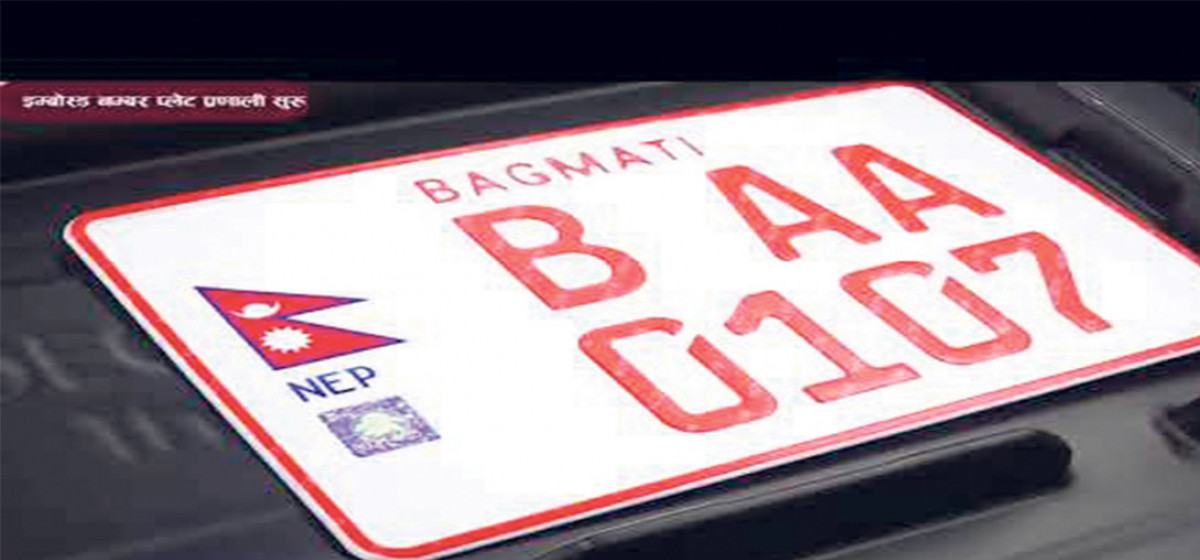
Kathmandu, Aug 7: Starting September 17, all vehicles across Nepal must have embossed number plates. The decision was made in a joint meeting that included ministers from all seven provinces and the federal government, according to officials at the Department of Transport.
So far, about 80,000 vehicles in Bagmati Province have been fitted with these plates. The government has a contract with a US-Bangladeshi joint venture, Decatur Tiger IT, to supply 2.5 million embossed number plates. Nepal is estimated to have between 5 to 6 million vehicles, but even government agencies don’t have exact figures due to the lack of consolidated data.
Transport Department Director Shrikant Yadav said the plates will create a digital record of each vehicle, making it easier to track ownership, detect unpaid taxes, and identify fake or stolen vehicles. Authorities currently recover around 3,000 stolen vehicles each year, and the new plates are expected to reduce this number. The system will also support cross-border vehicle recognition, especially in India, Bhutan, and Bangladesh.
The move is also aimed at helping provincial governments regulate traffic more effectively. RFID-based toll booths and entry checkpoints will only detect embossed plates. Regular plates will no longer work with these systems, which means vehicles without them could avoid detection or bypass tolls.
The new system will replace the seven types of number plates currently in use with a simplified format based on color and text. Yellow plates with black letters will be used for public and tourist vehicles. White plates with black letters will represent private vehicles. Government and institutional vehicles will have white plates with red letters, while diplomatic vehicles will use white plates with blue letters.
Vehicle owners will no longer be allowed to produce plates at local workshops, a practice that has allowed stolen vehicles to circulate with fake numbers. All plates will now be printed centrally and distributed to transport offices across the country based on demand. Before installation, vehicle and owner details will be digitally recorded and linked to the plate. Once installed, the plate can’t be reused or transferred, as it breaks if tampered with.
The cost for these plates has been fixed by the government. Motorcycles will be charged Rs. 2,500, three-wheelers Rs. 2,900, four-wheelers Rs. 3,200, and larger vehicles Rs. 3,600. So far, 800,000 plates have been produced, with 80,000 already installed.
The project was introduced as a flagship initiative of the Department of Transport in 2016, with the goal of installing 2.5 million plates within five years. That target was missed due to several delays. Legal disputes, including one filed at the Supreme Court regarding the use of English letters and numbers, caused significant holdups. There were also corruption allegations that led to an investigation by the Commission for the Investigation of Abuse of Authority. On top of that, the COVID-19 pandemic disrupted progress.
Nepal signed a $33.85 million contract with the joint company to supply the plates. The agreement includes installing RFID gates at the main highway entry points of all provinces. Portable RFID scanners will also be provided to traffic police and transport inspectors. RFID gates are already active in parts of Kathmandu, with additional ones being set up in Nagargun, the BP Highway, and areas like Farping where passenger vehicles operate. Other gates are planned for Itahari in Koshi, Pathlaiya in Madhesh, Butwal in Lumbini, Surkhet in Karnali, and near Pokhara along the Prithvi Highway.
According to Yadav, these delays—caused by legal, technical, and administrative reasons—pushed the project back by several years. But with infrastructure now in place, the nationwide rollout is moving forward again

Login to add a comment