








By Narayan Prasad Mishra
We know that Prince Gyanendra was to be on the throne according to the country’s constitution after the most shocking incident of the Royal Massacre and King Birendra’s sad demise. So he became king in June 2001. At that time, we had a multiparty democratic system with a constitutional monarchy. Girija Prasad Koirala, the leader of the Nepali Congress Party, the party known as the democratic party, was the prime minister. The country was in turmoil. There was no peace in the country, and people’s lives were at considerable risk because of the Nepal Communist Party (Maoist) arms struggles. On the other hand, there was an alarming political situation because of the feud among the political parties, personal rivalry, conflict, accusations, and counter-accusations among the parties and their leaders. However, on November 22, 2005, seven parties and the Nepal Communist Party (Maoist) stood united, making a 12-point agreement to fight against King Gyanendra’s regime when he assumed power by dissolving the parliament on February 1, 2005.
A big revolution with lakhs of people appeared in the streets. Their prime demand was the reinstatement of the dissolved parliament. By compulsion, King Gyanendra reinstated the dissolved parliament using his royal power. That movement or revolution was started under the leadership of the Nepali Congress Party, which symbolizes the party of democracy for establishing absolute democracy, with much dissatisfaction with King’s step, labelling it as the undemocratic step. They also agreed to pass the constitution through a constituent assembly. In this context, people thought all the topics related to the country and people, including the monarchy–government systems, religion, and language, would be decided by the constituent assembly most democratically with the people’s participation.
To our surprise, the government under Girija Prasad Koirala started taking undemocratic steps regarding the important topics of the people’s concern about the constitution before having the constituent assembly just after the establishment of the parliament with the consent of the seven parties and the Maoists. They made the country a secular state instead of a Hindu state, a republic instead of a constitutional monarchy, a federal system, etc. I was surprised to see these things done in the name of democracy. I thought that, in this case, democracy functioned dictatorially. What occurred was not democracy in my conscience. The seven parties with the Maoist party acted as if they became like the Kamadhenu Gai (the celestial cow), which we read about in Hindu scriptures and religious stories—according to the legend, the sacred cow, the divine cow Kamadhenu, resided with Sage Jamadagni, the father of Parshuram, who destroyed the Kshatriya clan (warrior race) 21 times. Kamadhenu, the divine, miraculous cow, could provide her owner whatever they desired without limitations and boundaries. At that time, Kamadhenu’s picture and the story came to mind. I wrote the following poem titled Kamadhenu Gai (the celestial cow) in Nepali, which was published in Janasatta Saptahik (Janasatta Weekly) on March 29, 2008 (2064/12/16 )
Poem in Nepali
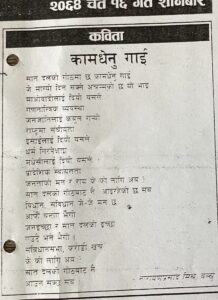
Translation in English:
A Celestial Cow
A celestial cow in the cow shed of the seven parties
It could give anything; this is amazing, brother
It gave to Maoists – Republic system
It gave Indigenous people a federal system
It gave to Christians a secular state
It gave to Madhesis – Territorial autonomy
What is the use of the opinions of the people now
Everything is coming from the cow shed of the seven parties
Laws and the constitution, whatever they wish
They could make, and late them make
People’s wish and the seven parties’ wish
They could say they are the same; let them say
Constituent Assembly, millions of expenditure
What is for it now
From the cow shed of the seven parties
Everything can come
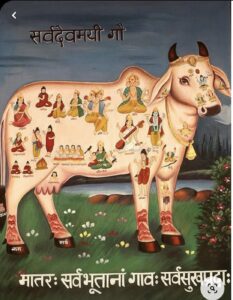
A picture of a celestial cow (Kamadhenu)
We all know our present constitution was born in that way—though the people’s advice and opinions in writing were collected from all over the country, they were not even opened according to the talk of the town. According to the rumor, the majority voted for the Hindu state and many other things, but the Constitutional Assembly did not pay any attention to the majority’s opinions. From the very beginning, our present democracy has adopted a dictatorial tendency. Consequently, it seems it had a dictatorial effect on its functioning. That is why I think we see dictatorial conduct and behavior in our democracy and our leaders. In the name of democracy, the parties that hold the government have been using state power for their own benefit and that of their followers rather than giving due attention to the country’s and people’s welfare dictatorially. People of this country do not hope to see democracy in the country until the system of power-sharing ends for the mutual benefit of the parties.
The views expressed in this article are the author’s own and do not necessarily reflect People’s Review’s editorial stance.

Login to add a comment