







By Our Reporter
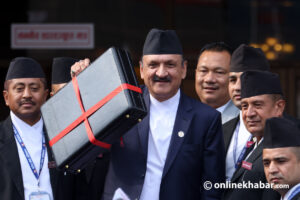
Finance Minister Dr Prakash Sharan Mahat has announced the budget of Rs. 1751.31 billion for the Fiscal Year 2023/24. He presented the budget in the joint session of the Federal Parliament on Monday. His budget is larger by Rs. 63 billion than the ceiling set by the National Planning Commission and by 16.37 per cent of the adjusted size of the current FY 2022/23 Rs. 1549.99 billion and 2.37 per cent smaller than the original budget size Rs 1793 billion.
Then Finance Minister Janardan Sharma had presented the budget for this year while later Bishnu Prasad Paudel downsized it during the mid-term review in February.
Experts have termed the motion to reduce the budget a ‘courageous move’ of the finance minister. However, still, the budget looks ambitious and scattered.
The government has allocated about two-thirds of the budget — Rs. 1141.78 billion (65.20 per cent) — for recurrent expenditure which also includes the allocations for the sub-national governments, maintenance of the infrastructure projects, and salaries and subsidies to be paid by the government. Rs. 400.8 billion will be transferred to the provincial and local governments.
About 17.25 per cent of the budget (Rs. 302.7 billion) is allocated for development projects while 17.55 per cent or Rs. 307.45 billion is earmarked for financial provisions.
Capital allocation has been reduced compared to the current year’s allotment of 21.2 per cent or Rs. 380.38 billion. However, revenue collection of the government has remained dismal this year as it has mobilised only 35.6 per cent (Rs. 135.4 billion) of the total annual target with only 45 days of the current FY remaining.
Dr Mahat has projected Rs. 1248.6 billion revenue collection for the next fiscal and it will cover the largest source for the expenditures. The revenue estimates make up about 71.3 per cent of the total expenditure estimates. Other sources for the expenditures include Rs. 49.94 billion in foreign grants.
The remaining sources would be managed from foreign loans of Rs. 212.75 billion and domestic borrowing of Rs. 240 billion. This means the budget has a deficit of Rs. 452.75 billion (25.85 per cent of the total size of expenditure).
Presenting the budget at the parliament, Dr Mahat said that the budget was designed aiming at achieving the economic growth rate of 6 per cent and containing inflation at 6.5 per cent. According to the Nepal Rastra Bank, the inflation rate in Nepal was 7.76 per cent in April.
He also said that the government had prepared the budget for the next year with the slogan of the second phase of economic reform and structural change of the economy.
However, he is likely to face a tough time in managing the resources since given the current year’s performance future prospects don’t look promising. The government could collect only Rs. 829.6 billion in revenue and other payments against the expenditures of Rs. 1101.5 billion by Sunday, creating a huge gap between income and expenditure.
In the budget, the government has pledged to make preparations to expand access to electricity to all households across the country within the next two years, and transmission lines, micro and small hydroelectricity projects, and renewable energy from solar and wind would be developed to meet this objective.
Dr Mahat claimed that about 900-megawatt electricity would be added to the national grid in the next fiscal year with the contribution from 111 MW Rasuwagadhi, 102 MW Mid-Bhotekoshi, 42.5 MW Sanjen and many other private sector projects.
FM Dr Mahat also said that he had allocated a budget to the projects that could be completed in time with the estimated funds. He has drastically reduced the budget of the Ministry of Water Resources and Irrigation (MoWERI) and the Ministry of Physical Infrastructure and Transport (MoPIT).
Rs. 87.45 billion is earmarked for the MoWERI which is Rs. 21 billion less than this year. Likewise, the budget of MoPIT has come down by Rs. 30 billion to Rs. 131.59 billion.
Through the budget, the government has announced to completion of 150 motorable bridges along the highways and strategic roads. Expansion of Suryabinayak-Dhulikhel road, and Kalanki-Basundhara section of Kathmandu Ring Road, underpass and flyover construction at the national highway including Saatdobato, Ekantakuna and Koteshwor in the Kathmandu Valley, Kathmandu-Terai Fast Track, Tokha-Chhahare Tunnel, Kaligandaki Corridor, East-West Highway, Karnali Highway, Postal Highway and many other roads and infrastructure projects have got their way into the budget of the next fiscal 2023/24.
Signature bridge construction will be started on the Narayani River and Tinau River. Simikot, the only district headquarters to be connected with the national road network, would be connected next year.
Likewise, the government aims to establish a chemical fertiliser plant in the country in a public-private partnership model via the Investment Board of Nepal while for the next fiscal year, Rs. 30 billion is allocated to subsidise the fertiliser purchase.
For social security programmes including senior citizen allowance, Rs. 157.7 billion has been allocated which is higher by Rs. 23 billion compared to the allocation of the current fiscal year.
The senior citizen allowance of Rs. 4,000 has been continued while the eligibility age is 68 years.
However, the government has revived the controversial constituency development programme and Rs. 50 million is allocated for each election constituency. This allocation has drawn criticism from the public.
Kathmandu Mayor Balen Shah has said that the constituency development programme has reduced the status of the lawmakers to the level of ward chairs.
On Tuesday,’s post-budget press meet, FM Dr Mahat had to spend most of his time to defend the allocation of the budget for the controversial programme which was discontinued under the pressure of the Nepali Congress two years ago.

Login to add a comment