







 By Our Reporter
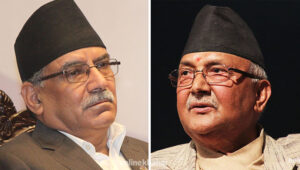
Rifts between Prime Minister Pushpa Kamal Dahal ‘Prachanda’ and the CPN-UML, the main party in the ruling alliance, have widened further after the CPN-Maoist officially decided to forge consensus in the election of the president.
After the meeting of the office bearers of the party that concluded Tuesday decided to elect the president in consensus, the fate of the ruling coalition has been questioned because Dahal was appointed PM on December 25 last year by striking a deal with UML Chair KP Sharma Oli, according to which Dahal would lead the government for the first two and a half years and leave the post for Oli, UML would take the posts of the President and the Speaker. However, the Speaker would also quit in two and a half years for the Maoist Centre. The two parties and other coalition partners divided all the posts except for the President and Vice President according to the same deal.
Chief Ministers and Speakers have also been appointed based on the same deal. Now when the elections of the President and Vice President are yet to be held, PM Dahal has been making moves to elect the President from other than the CPN-UML.
Had the Nepali Congress not given the vote of confidence to the PM on January 10, PM Dahal would have been helpless before the UML, and he would have not dared to go against the deal. But now when NC also supported him, he is sure that his government will survive even if the UML withdraws its support, and it is what the NC wants. Maybe PM Dahal had also assured Nepali Congress president Sher Bahadur Deuba to give NC the post of the President if the latter voted him in the floor test.
When the Maoist Centre officially decided to forge consensus in the election of the President, it has now become clear that someone, probably Ram Chandra Paudel, will be elected a new president in March 9 elections. Although the name Krishna Sitaula has also been floated as a potential candidate for the top post, he may not fit as he was rejected by the voters in the election to the House of Representatives in Jhapa 3. Dr Baburam Bhattarai is another candidate, but NC may not agree to give up the post.
Obviously, PM Dahal, who was fed up with the political activities of President Bidya Devi Bhandari in the past two years, does not want to have ‘Oli’s yes man’ in the post again. After he became powerful by gaining support from the NC, PM Dahal started seeking an ‘all acceptable’ president now. From the UML, he wants either Subas Nembang or Astha Laxmi Shakya, but Oli wants to have Bishnu Rimal or Ishwar Pokharel, both loyal to him.
However, the present coalition may continue even if the NC candidate gets elected to the post of President because if the UML withdraws its support, it will only lose important ministries in the centre and four chief ministers in provinces. The UML probably does not want to lose these posts which it succeeded to gain at the last moment.
The case of Rabi Lamichhane has also fueled the enmity between Dahal and Oli because the latter has been exerting pressure on Dahal to appoint Rabi as Home Minister after Rabi regained his citizenship but lost the post of the lawmaker, Deputy Prime Minister and Home Minister after the Supreme Court verdict of Friday. Dahal has said that he would decide on Home Ministry only after the SC gives a full verdict on the case. It is also said the Maoist Centre wants to keep the ministry with it even after the verdict.
And if after two years, the UML could quit if the NC offered its support to Dahal to continue to work as the Prime Minister. As such, the UML ministers will be replaced by NC and other coalition parties will continue to support the new alliance.
Anyway, by distancing with the UML over the election of the President, Dahal is not risking his two and a half years’ term, but increasing the chance of becoming the first PM to complete a full five-year term after the revolution of 1951.
Are two types of justice in Nepal?

Rabi Lamichhane’s case was finalised through a fast track on Friday. The Supreme Court in its verdict annulled his post as a lawmaker stating that Lamichhane had not had valid citizenship when he filed his nomination for the election to the House of Representatives, he got the certificate of winning. Consequently, he lost all his political posts. The SC clearly said that Lamichhane was not found following the legal procedures to regain Nepal’s citizenship which he had relinquished after getting USA citizenship in 2014.
However, he has now become a Nepali citizen. After the decision of the Supreme Court on Friday, Lamichhane had become a non-citizen. On Sunday, he restored his old Nepali citizenship reaching the Kathmandu District Administration Office.
As per the order of the Supreme Court, Lamichhane regained his Nepali citizenship from the District Administration Office in Kathmandu on Sunday. According to the Supreme Court’s decision, he only had to complete the process to get citizenship, so he took the citizenship through the normal process.
However, the way his case was decided has raised a question of whether two types of justices exist in Nepal. Several criminal cases are pending in the SC, but the case of Lamichhane was decided overnight. The SC had not begun the process on the case against Govinda Raj Joshi, Aftab Alam and others for years, but it gave a verdict against Lamichhane less than three months after the case was filed against him.
Lamichhane obtained Nepali citizenship on February 22, 1994, from the District Administration Office, Kathmandu. Lamichhane, who went to the US, received US citizenship on February 21, 2014.
Even though he got American citizenship, he did not inform the Nepal government or the district administration office about it.
Lamichhane is undergoing investigation under a criminal offence charge for using his Nepali citizenship and passport even after obtaining an American passport in 2014.

Login to add a comment