







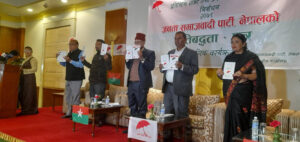
Kathmandu, 5 November: The Janata Samajwadi Party (JSP) has brought forward the issue of directly elected executive president and directly elected chief ministers in the provinces. In the JSP’s manifesto released this afternoon for the House of Representatives and State Assembly elections, it is said that a government should be formed with a directly elected president in the union and a directly elected chief minister in the provinces. It has also mentioned that if the government is formed in the Union, it will arrange for a directly elected president and directly elected chief ministers in the provinces.
JSPN manifesto states: In accordance with the principles of direct and participatory inclusive democracy, the party will arrange for an executive president elected by the people based on adult suffrage in the Union, adopt that the chief minister and the chief executive in special structures and local levels are also directly elected on the basis of adult suffrage.
Interestingly, Upendra Yadav is one of the main leaders of Madhes and has always been at the helm of the party. In his quest of gaining political ambitions, JSPN has forged alliance with K.P. Oli’s CPN- UML and has been canvassing for votes for his party, particularly in Saptari constituency- 2. Having won the previous parliamentary elections, he and his party members remained ministers for most of the time. His party JSPN remained in the government of Madhes Province. The government of Madhes Province had never been unstable. It was maneuvered with huge budget. Madhes government gave several slogans including “water in fields and jobs in houses”. These slogans were just used to attract voters and fulfill partisan ends.
General elections also provide voters with an opportunity to evaluate political parties and elected representatives. Upendra Yadav’s JSPN, which ruled Madhes for the entire period. The paupers of the Terai, have raised voice that how much did this party contribute to the development of Madhes and finally to the development of the country? Now the slogan of prosperity and development has been launched but how much did Yadav do while in power and how much does he believe today that he can promote the quality of life in his constituency. The true toilers of Madhes have been questioning the entire JSPN’s leadership.
It may be worth mentioning to attribute the erstwhile Nepali Congress Madhesi leader JP Gupta taking to the social media has argued that 27.7% of people in Madhes state are under the grip of poverty. Independent experts say it’s even greater than 35 percent. Madhes province has the highest multifaceted poverty in the whole country. Out of the 77 districts of Nepal, the population of eight districts of Madhes province is multifaceted poverty is 35%.
According to the latest data, only 50% of the school-age children in this province go to school. Province-2 comes after Karnali province in terms of population suffering from malnutrition. In Madhes province, 58% of women in the age group of 15-49 are suffering from anemia and 36.8% of newborns are born underweight. Out of the total 35,520 schools in the country, the number of schools in Province-2 is 4137. Over 24.20% of youth from this province have migrated to sell labour. This shows the serious situation of unemployment in the districts within Madhes province. The economic growth rate of Madhes province is only 2.3%. It has the lowest youth literacy rate in the country at 63%, while Gandaki province has the highest at 95%.
Compared to the total of 4,01,236 industries in the country, the number of industries in Madhes province is 54,910. There are only 13 large government hospitals in the population of 54,04,145. In terms of controlling the current Covid-19, the province seems to have failed. The health infrastructure is in ruins. In the context of Nepal, the situation of Madhes province is not only bad but the JSPN is lost in oblivion and tussle for power. However, Madhes province looks worse in comparison.
What has improved after the adoption of federalism? How much is the contribution of the old system in the above figures and how much did Upendra Yadav improve? How much did he contribute to reform? Why not ask Upendra and his allies? The conscious voters of Madhes should ask him, especially the young voters of Saptari constituency- 2 should seek answer from Yadav, ‘when Madhes can live decent and dignified life.

Login to add a comment