








By Narayan Prasad Mishra
We all give great value to the judicial independence of the court. The soul of the court is independence. We cannot imagine a government without the constitution, law, rules, and regulations. Similarly, we cannot think of a language without grammar, as we cannot think of moonlight without the moon and the sunlight without the sun. In the same way, we cannot think of a court without independence. According to Brittanica Encyclopedia, “judicial independence means the ability of courts and judges to perform their duties free of influence or control by other actors, whether governmental or private. The term is also used in a normative sense to refer to the independence that courts and judges ought to possess”.
Traditionally, conventionally, we also have different levels of courts, from the district court to the Supreme Court. Our constitution has established and guaranteed the complete independence of the court. According to our law, no one is supposed to speak against the court; if it is done, it is punishable. Similarly, no one is supposed to influence the court. We do not lack rules and regulations in everything – freedom of speech, writing, equality, justice, democratic rights, human rights, fundamental rights, good health, quality education, job opportunity, etc. Only the problem in our country is the difficulty of experiencing all the good things mentioned above in the paper, not in practice. Our democracy and democratic rights are benefited only by power circles. We know the general people have been left behind always using the rights mentioned in the constitution, whether in the past or present. We feel the same way about our judiciary.
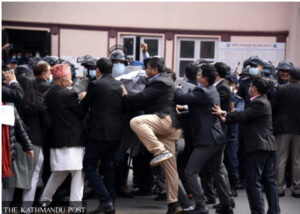 A protest organised by the Nepal Bar Association and Supreme Court Bar Association
No one is unaware that our judiciary has been highly politicized since the inception of the multiparty system after implementing the Constitution of the Kingdom of Nepal in 1990. History has witnessed many big protests by different parties against the Supreme Court verdict. Whenever the ruling came against the interest of the particular party and parties, they organized big protests. They spoke against the court and the judges anything they wanted, crossing the border of the judicial supremacy. We saw the court was made helpless and had to stay as if it had no ear and eyes to take action against them. Many protests by different parties against the court decision on different matters and the reinstatement of the Parliament from King Gyanebdra’s time to date are fresh examples of it in our memory. There were many more protests before that. King Gyanendra had to reinstate the Parliament because of the protest and the revolutionary movement. Similarly, when we recollect some activities of the judges against their Chief Justice in the court for the last some years, we see the judges are working as rivalries and enemies against their chief and each other rather than working as members of the team. It somewhat looks like a power struggle to snatch power one from another by any means – right or wrong.
If we honestly study the above problem, we can conclude that it occurred for two main reasons. They are – 1. Lack of democratic culture in our politicians and parties. 2. Appointment of the judges with the blessings and support of the political parties and leaders. Because of the first reason, they do not hesitate to speak against the independent court. Because of the second reason, there is always a chance of politically influenced decision of the court on the case in favor of their master party who blessed them in their appointment. Even if there is an impartial verdict, the loser party in the case always doubts it because of the lack of trust. We realize that the court, judges, and lawyers all have become political players in the country. We see and smell even the ex-chief justices’ political role when they jointly exhibit the statements from time to time on the court matter as we see the vice-chancellors of the universities appointed based on political activities rather than academic performance exhibit their political statements being top educationalists of the country.
In this context, when we study the protests cases against the chief justices of the Supreme Court of Nepal from the last few decades, either for Bishwanath Upadhya, Sushila Karki, Gopal Prasad Parajuli, or the presently suspended chief justice Cholendra Shumsher Rana, we find they all were originated politically. The cases were created when some political masters were not happy with them. At the same time, we see that the issues were not raised against them so long as the political masters were happy despite much evidence of being raised a case against someone. To my holy conscience, the most unholy protest is the recent protest made by the Nepal Bar Association and Supreme Court Bar Association for the resignation of chief justice Rana. It was such a protest that even the judges of the Supreme Court joined the protest against their chief.
I do not see any moral ground in it because the lawyers should do any work based on law, not by force, as the Bars did against him, even if there were severe evidence issues against his performance. The demand for forced resignation should not be the justice to anyone in a democratic country. How can the people hope to have justice from the courts if the chief justice himself cannot get justice from the court or the judges based on law? How can the people hope to have justice in the country where they see their chief justice himself as the victim of injustice by force against the constitution and law. It creates fear and terror in innocent people’s minds when you see that picture from your impartial eye.
The protesters said it was for the independent, fair, clean, and fearless judiciary. I feel such lawless agitation, protest, and demand would create more fear among the judges, discouraging them from maintaining an independent judiciary against the Bar’s wish. If the demand of the agitating lawyers were met, the future judges would always get scared of them in imparting their duties. That should not have been the culture and ethics of the lawyers blocking his way to enter the court instead of going to the legal procedure for the matter. I feel that should not be in a civilized society. I wish the bar associations or any other associations of any profession in the country would run and act like professional associations, not the political parties. The tragedy in our country is that all the professional associations, including the university professors, engineers, and the medical doctors’ associations, are running like political parties. Hardly you find holy, pure, and independent people. Politics is everywhere, like the air in the atmosphere. Society has established that independent people like us have no conscience. That is just like losing one’s conscience but accusing others. It is sad to see that the lawyers are taking the case and law into their hands, not taking the case to the courts for judgment. It seems funny for me to see that some judges saw a good reason to participate in it. I am glad that the protests disappeared though it took a different turn – impeachment, the constitutional legal procedure.
It seems our judiciary has been polluted so much that we see dirty politics in the Bar and court. Similarly, we see dirty politics in the judgment. We cannot say that the cases in courts were not won and lost not because of political influence. We cannot say that politics did not influence the court’s verdict. We often feel that the judgment is the result of political pressure. The present major political parties are making this mess in our judiciary with the political appointment of the judges with Bhagabanda politics (sharing and dividing their share of portfolios ). Unless they are ready to stop it, our judicial system will remain more in the political mess as political centers rather than the independent judiciary, the heart of democracy.

Login to add a comment