








By Narayan Prasad Mishra
After the Paleolithic Era, Neolithic Era, human beings experienced and learned many things about nature, life, and living in evolution and development. Long and long after that, they knew about recording their experience and knowledge in many different ways – recording on clay tablets, stone, leaves, skins, papers, clothes, etc. Even after developing the languages, letters, and writing, recording and transforming knowledge was difficult. One can make one or a few copies of book writing by hand, not hundreds or thousands as you can do by printing. After developing the printing technique in 1439 with his movable type by Johannes Gutenberg in Germany, human experience and knowledge traveled throughout the world. That was the beginning of modern books.
We know books are the recorded experiences and knowledge of human beings. Because of books, human knowledge could travel throughout the world. People from any corner of the globe could benefit from them. Books contain all aspects of human knowledge – history, geography, literature, culture, traditions, science, technology, agriculture, industry, medicine, etc. You can learn everything from the books – conflicts, war, human suffering, discoveries, and inventions in human history. Books are the sources of all knowledge.
We all know that books contain the experience and knowledge of the authors who write. Collecting books means collecting knowledge. In collecting books and putting them all together in some place for the people in an organized way to disseminate knowledge, the modern library was born in the world. The libraries select the best books needed for their community, collect, scientifically organize them, attract readers, and disseminate knowledge through different means. So the libraries are the centers of expertise for acquiring and sharing knowledge. In modern times, the libraries are also called learning resource centers, academic centers, disseminating centers, study centers, information centers, media centers, documentation centers, reading rooms, etc. The Library is where you get to know everything you want. You need a library for your study, teaching, and research. You cannot think of research without the library. That is why the developed countries of the world give tremendous importance to libraries. They have not only one or two but many huge, extensive libraries with millions of books, journals with varieties of disseminating services. People want the libraries like the groceries in life. They want libraries like the medicine shop in life. They have a long tradition of modern libraries in their countries. We all know their research, discovery, development, invention, and achievement are primarily based on the services of the libraries. Some examples of noted libraries are the Library of Congress, New York Public Library, Harvard University Library of the USA, The National Library of China, and National Diet Library of Japan.
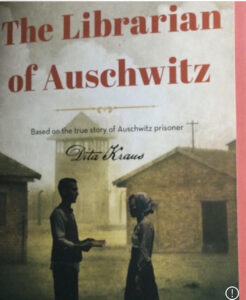
Cover page of the book
In this context, I want to talk and write about the librarian and library, which may be the tiniest and the just in name in the world but has a history of unparalleled love of books in human history. That was the Library of Auschwitz. Auschwitz is in Poland, where Nazi Germany, under Adolf Hitler, the Chancellor of Germany, the cruelest person on earth, operated 4o concentration and extermination camps during World War II after occupying that country. The camp was conducted from May 1940 to January 1945 until the Soviet Union liberated them. According to history, over 1.1 million men, women, and children lost their life here. They were war inmates, mainly Jews, Poles, Romani, and Soviets. The people deported to the camp were separated into two groups — 1. strong and healthy enough for forced labor 2. babies, young children, pregnant women, the elderly, the disabled, and the sick. The No 2 group was to die in a gas chamber. Among living also were starved, worked to death, even killed in medical experiments, and gassed. History witnesses that 6 million Jewish people were killed in the Holocaust because of the Nazi campaign to eradicate Jews from Europe. According to the report, over 5 63 000 people visited the museum there in 2021. That was the center of tyranny ever heard in human history. We can imagine how the super tyranny could be. We have also experienced some kind of hatred and tyranny during the Maoist movement in Nepal though we are slowly forgetting now. People were tortured, hanged, stabbed, gun downed, bombed, hands and legs cut.
According to Dita Kraus, a Jew, the holocaust survivor, and secret librarian for the children’s block in Auschwitz, “they had a library on legs, a living library in Auschwitz. Teachers who knew particular books had become a living library. They rotated among the different groups, telling the children stories they knew almost by heart.” Books and reading materials were banned there. No one was supposed to possess it. No one was supposed to see it. According to the Nazis’ tyranny, books are extremely dangerous, and they make people think. They awaken the people. So books should not be to inmates’ access. The guards, the inspectors inspect them twice a day, making them stand. If the inspector catches anyone with a book, they execute them. Not only a day or hours, but every moment was also a challenge for them to survive.
In that circumstances, they loved, collected, and hid some books. That was their library. Dita was made the secret librarian and worked secretly under the fear of life and death, hiding and pushing people to read even mutilated books. She thought that the wisdom of centuries of civilization might be lost without the books – geography, literature, mathematics, history, language. Books are precious. The courage of Dita, the librarian, and the love of books of the inmates are exemplary and inspiring to all human beings. That is an extraordinary example of the love of books and the library service. A vast majority of our people in Nepal who have not yet realized the importance of books, libraries, and the valuable role of librarians in imparting knowledge certainly get inspiration by reading this book. When you love books and carry them with you, it means you always have inseparable friends with you. Dita, 9, with her parents, was taken from her home in Prague, the capital of the Czech Republic, by the Nazis and was imprisoned at Auschwitz in 1939.
The book “The Librarian of Auschwitz,” a novel was written by Antonio Iturbe, is based on the true story of Dita Kraus, the holocaust survivor, and translated into English by Lilit Zekulin Thwaites, tells about it to the World. Besides, it gives a vivid and cinematical horrible heart-breaking, unimaginably painful, agonizing picture of the life and conditions of the prisoners. The book is an international bestseller. I am happy to read this book from my beloved granddaughter Asha Adhikari, 15, a voracious reader who reads 3/4 hundred pages of books in 2/3 days. This year, she got that book as a Christmas gift from Nancy Hatch, a Peace Corps librarian, to Tribhuvan University Central Library, our dear friend to whom and her husband Douglas Hatch, Asha, and my grandson Gaurav call Grandma and Grandpa. Nancy was an integral part of our workforce in creating and developing TUCL with my beloved wife, late Shanti Mishra, the founder and first Chief of this library, and me.
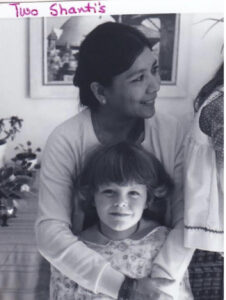
Shanti Mishra with Shanti Ruth Hatch in 1977
Our life with our library joined and connected us with Nancy and Doug, with love and affection, with the relation of heart and mind. It made us an extended family between the two nationalities — Nepal and the USA. We became one, though, living in two different countries. Their kids and our kids are inseparable cousins and always happy to be together. It may be interesting for the people to know that Dough and Nancy gave the name Shanti after the name of my wife Shanti Mishra to their first daughter, who was born in Nepal when they both were in our University. That is why their first daughter’s name is Shanti Ruth Hatch. At that time, Doug was the Professor of Mathematics in the College of Education as a Peace Corps volunteer. This may be an enjoyable and exciting example for all of the strong relationships of love and affection, not the relationship of the family of blood. I think this is also an exciting part of the history of the development of our University library. Once upon a time, our typical home was Tribhuvan University Central Library, Kirtipur, Kathmandu. We worked and enjoyed being there always for its development. So I give credit to our Library for our love and unity. The Library was the bond and the bridge between our love and the relation. I cannot think of my life separating the history of that Library. I always believe that the Library’s history is also our history if the people are not ungrateful to the nobel work done for the country.
Currently in the USA

Login to add a comment