







COMMENTARY

By M.R. Josse
KATHMANDU: Following U.S. Secretary of State Mike Pompeo’s virulently anti-China speech, 23 July, a consensus of sorts has crystallized around the claim that an incipient new Cold War between the United States and China is now raging.
Pompeo therein called for “a new alliance of democracies” to counter what he alleged was a grave threat emanating from Beijing, targeting America’s “freedom” and undermining the “rules-based order.”
Referring to U.S.-China ties, he deplored the “massive imbalances in that relationship that have built up over the decades and the Chinese Communist Party’s design for hegemony.” He then went on to urge, implausibly, everyone outside China – “the United Nations, NATO, the G-7 countries, the G-20” – to join the U.S. in opposing the People’s Republic of China.
‘OLD’ COLD WAR
 I would now invite readers’ attention to some observations from one of Pompeo’s most distinguished predecessors – to wit, Henry Kissinger – who recalls that Nixon was not just the president who opened the way to China, but who “knew how to cast the resulting relationship in geopolitical terms and had presented the American view on world affairs.”
As F.S. Aijauddin says in Dawn, 30 July: “Clearly Pompeo had chosen not to consult Dr Kissinger, nor to read his book On China (2011). In it, he warns that ‘any cold war to develop between the countries would arrest progress for a generation on both sides of the Pacific [and] spread disputes into internal politics of every region at a time when global issues such as nuclear proliferation, the environment, energy security, and climate change impose global cooperation.’ ”
While it remains to be seen how ‘everybody outside China’ reacts to Pompeo’s alarmist appeal, in this essay, I choose to focus on the genesis of the ‘old’ Cold War – between the U.S. together with her World War II Western allies and the Soviet Union following Nazi Germany’s defeat – excavating not-so-well-known geopolitical insights or half-forgotten historical facts.
While the ‘old’ Cold War is generally thought to have emerged after the Allies’ victory over the Axis Powers in WWII, in fact, its seeds were planted much earlier. This can roughly be timed from when Roosevelt’s America decided to fund an ultra-secret $ 2 billion nuclear weapons research programme in August 1942 – the so-called Manhattan Project.
That was the precursor to the atomic bombing by the U.S. of Hiroshima and Nagasaki, on 6 and 9 August 1945 respectively, leading to the acceptance by the Japanese government, on 10 August 1945, of the Potsdam Declaration which had emerged from the 17 July-2 August 1945 Potsdam Conference attended by the three principal Allied powers: the U.S.S.R., the U.S., and the U.K.
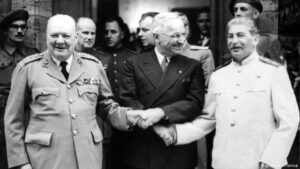
While the Soviet delegation was led throughout by Premier Joseph Stalin, and that of the United States by President by President Harry Truman, the U.K. delegation was initially led by Premier Winston Churchill, and – following his stunning defeat at the 28 July 1945 British general election – by Premier Clement Attlee.
It may be recalled that while the Potsdam Conference produced a cascade of agreements, its principal order of business was how defeated Germany, which had agreed to unconditional surrender nine weeks earlier on 8 May 1945, should be administered. The other goals of the Conference included the establishment of a postwar order, peace treaty issues, and countering the effects of war.
What may also be noted is that the summit conference in Potsdam, a Berlin suburb, took place five months after the Yalta Conference attended by Stalin, Roosevelt and Churchill. Roosevelt, who was far chummier toward Stalin than Churchill, succumbed to illness on 12 April 1945 and was succeeded by his vice-president Truman, a down-to-earth Missourian and no-nonsense politician who generally shared Churchill’s pathological aversion to communism.
GO-IT-ALONE POLICY
The United States’ secret development of the atomic bomb, and its subsequent devastating deployment against Japan, without a hint to Moscow, was a major factor in fuelling suspicions about the United States’ postwar intentions vis-à-vis the Soviet Union. As chronicled by William R. Keylor (The Twentieth Century World, Oxford University Press, 1996):
“The diplomatic tug-of-war between the United States and its Russian ally concerning the political reorganization of the postwar world had already begun. Upon learning of the test (in a New Mexico desert, 16 July 1945) during the Potsdam Conference of the Big Three wartime leaders, Truman informed Stalin that the United States had developed a new weapon ‘of unusual destructive force’ – a fact already known to the Russian leader through his espionage network.”
Equally seminal to the birth of the ‘old’ Cold War are these illuminating additional insights from Keylor: “Some historians have suggested that Truman was eager to wield the atomic weapon against Japan in order to frighten the Soviet Union into granting political concessions in Europe as well as to terminate the war in the Far East before Russia could participate in the victory in that theatre and therefore claim a role in the postwar military occupation of Japan…
“Though ostensibly acting on behalf of the victorious coalition, the United States proclaimed its intention to manage the occupation of Japan without the assistance of wartime allies and administer it as a single political unit. The acrimonious Soviet-American disputes over the treatment of postwar Germany would not be reenacted over the treatment of postwar Japan.”
But if the Soviet Union was effectively bypassed as far as enjoying the spoils of victory vis-à-vis Japan is concerned, the Soviet Union, for her part, had been just as successful, and unscrupulous, in pre-empting any postwar role for the U.S. and Great Britain in east and central Europe!
In fact, there was an informal partition of liberated Europe into pro-Western and pro-Soviet spheres as dictated by the military situation, at the moment of Germany’s collapse. Each of the two zones eventually adopted political institutions, economic practices and foreign policies that reflected the preferences and influences of their liberator.
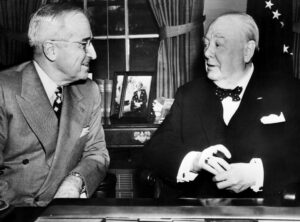
The essence of this global bipolarity was dramatized by Churchill in his famous ‘Iron Curtain’ speech delivered at Westminster College, Fulton, Missouri on 5 March 1946. Though by then Churchill was merely a former British premier, he had been invited by Truman, a Missourian, knowing full well that their sentiments regarding communism and the Soviet Union meshed. (The two had met at the Potsdam Conference, as referred to earlier.)
With Truman at his side, Churchill’s peroration stressed the necessity of the United States and Great Britain to act as the guardian of peace and stability against the menace of Soviet communism which had lowered an ‘Iron Curtain’ across Europe. Churchill used the term to refer specifically to the political, military and ideological barrier created by the U.S.S.R. following World War II to prevent open contact between its dependent eastern and central European allies, on the one hand, and the West and other non-communist regions, on the other.
The core of Churchill’s exhortation contained his memorable warning that an ‘Iron Curtain’ had descended across the European continent “from Stettin in the Baltic to Trieste in the Adriatic.”
(On a personal note: while in Missouri last year, yours faithfully hugely enjoyed a junket to the Churchill Museum at Fulton’s Westminster College. It was stuffed to the gills with evocative World War II memorabilia of the period when he provided gutsy, visionary and inspirational leadership to the Allied cause during the fraught war years, particularly before America’s entry.)
POTSDAM/SOUTH CHINA SEA DISPUTE
Let me now direct attention to some largely forgotten facts on the nexus between the Potsdam Conference and the South China Sea dispute. The latter, of course, attracts global notice today constituting as it does a key component of the United States’ current geopolitical/ideological offensive against China, spearheaded by Pompeo.
Apart from the cardinal German issue, the Potsdam agenda included the question of the sovereignty of a group of South China Sea islands of the South China Sea Japanese forces captured from the Chinese. As recalled by Keewee Tan (Waveney Economics Money Talks, 18 July 2020):
“At the end of the Potsdam Conference, it was agreed, in the signed document and in front of witnesses, including Chinese leader Chiang Kai-Shek, that the group of islands, including the Paracel Islands, the Scarborough Shoal, and the Spratly Islands would be handed over to China…
“In 1946, China was too poor to even have a large enough ship to transport their soldiers. In the spirit of friendship, U.S. warships transported Chinese soldiers to the Spratly Islands…to claim territories that the Potsdam Conference agreed upon…”
Tay reminds: “In 1947, China drew a map with 11-dashed lines around the island territories to mark its sovereignty.”
After a raft of revealing disclosures too long to be listed here, he pops this pertinent question: “Why is everyone still arguing over the ownership of China’s territories bordering her 11-or-9 dashed lines that had been agreed to at Potsdam in 1945? How far back in history do you want to go back?”
Tay explains: “In 1949, Chiang Kai-Shek retreated to Taiwan and Mao came to power in Beijing. The U.S. did not like it one bit…In September 1951, there was a multi-nation conference named the Treaty of San Francisco to re-establish peaceful relations between Japan and the world. China was not invited because people couldn’t agree whether Taiwan represented China…
“The 1951 Conference didn’t really address the South China Sea issue. Worse, some of the islands were handed over to other parties. China’s ownership of the South China Sea islands was denied because the U.S. took over their administration until 1971.”
Coming back to the query about how far back in history need one go, and the connected legal axiom that a new law cannot apply to a past event, Tan responds, tongue firmly in cheek: “If we did, then peoples of Hawaii, Guam, Diego Garcia and the native Indians of North America could ask for their back and seek compensation.”
THE CRUX
The crux of the matter is, of course, that the current anti-China crusade that the United States has decided to launch – with Japan, India and Australia, among others, in tow – is quintessentially about retaining America’s pre-eminent position in the international order following the collapse of the bipolar world in 1991, with the demise of the Soviet Union.
However, this not only flies against the facts related above; it is also counter to the inexorable law of history concerning the natural rise and fall of nations and civilizations. While America is, admittedly, still at the top of the international pecking order, others, including China, are in the process of rising, after years of internal strife, stagnation and foreign exploitation.
In other words, the South China Sea dispute is, at its heart, all about whether, or for how long, the world will remain uni-polar when the clear trends show that it is giving way to a multi-polar one.
Policy pundits in Nepal, too, should not lose sight of key or relevant facts of history and geopolitics; they should, instead, serve as guiding beacons of light.
The writer can be reached at: manajosse@gmail.com
People’s Review Print Edition

Login to add a comment