








By Narayan Prasad Mishra
I am a dutiful citizen of this country who has neither close ties nor hostility toward any political party, group, class, or their leaders or activists—whether royalist, multiparty, socialist, or communist. Based on the knowledge, understanding, wisdom, and experience I have gained through my own judgment, I have honestly fulfilled my civic responsibilities toward the country, leaving no stone unturned.
I served Tribhuvan University as an active, dedicated, and diligent officer, in such a way that the influence of my work and sense of duty were felt throughout the institution, even under the leadership of highly reputed educationalists such as Sardar Rudra Raj Pandey and Dr. Trilokya Nath Upreti. Despite all this, following the political tsunami that hit Nepal in 2046 B.S. [1990], I too became caught in the web of an undemocratic conspiracy by those who called themselves democrats but forcibly retired people under the guise of “voluntary retirement.” I was therefore compelled to accept forced retirement at that time.
Though a citizen may be deeply patriotic and sincerely love their country that does not necessarily mean that he or she must always wish to live there. When a government fails to uphold justice, respect free thought, or support citizens who think independently, even a deeply patriotic person may lose the desire to live in his or her own country. Love for one’s country and dissatisfaction with its government are not contradictory; indeed, genuine concern for the nation may be precisely what leads a citizen to question or oppose injustice.
I often felt that Nepal was not the right place for us to live, recalling the injustices my beloved wife, late Shanti Mishra, and I experienced simply because we chose to remain independent, self-respecting, and unwilling to compromise our principles. Yet we endured those deeply painful injustices and chose not to leave, even when we had an opportunity to do so.
Since then, I have learned from experience that even a person who possesses qualities such as being active in service, creative, dedicated, hardworking, honest, dutiful, and self-respecting—and who carries these qualities in his very bones and blood—can become helpless in this country if he has no support from any class, group, or political party.
That experience changed the way I look at politics and government. I came to realize that the name of a political system, the ideology of a party, or the identity of a leader is not, by itself, what determines whether people live better lives. What matters is how those who hold power actually govern. A government should be judged by its honesty, morality, justice, fairness, administration, development, and commitment to the welfare of its people.
Since that time, I have held the view that when we speak of government, it should be a government that also comes to the aid of such helpless people. I have therefore continued to write, with the hope at the center of my thoughts that such a government may one day exist in my country.
I myself am a helpless, ordinary writer, and I do not really believe that my thoughts, words, and sentences can make much difference. Yet my love for the country keeps stirring something within me. The problems of the country and its people continually surge through my heart and mind.
I do not know why, even though I am a helpless ordinary citizen who could not even solve my own problems and who was forced to retire at the age of 49, with fourteen years still remaining before the normal retirement age, I continue to concern myself with offering suggestions and advice on how to solve the problems facing the country. This is, after all, a country where people seldom speak out against injustices committed by the powerful. Sometimes I wonder whether this is my strength, my weakness, or simply my madness.
Yet I continue to write.
On the coming Bhadra 23, it will be exactly six years since I began writing an article every week, without interruption, for the English weekly People’s Review. When I counted the articles published in this newspaper alone, I was delighted to see that the total had reached 275.
Continuing this journey, as I moved around my neighborhood in the USA, some thoughts occurred to me yesterday. Based on it, I composed a poem in Nepali and translated it into English. The Nepali poem and its English translation are given below:
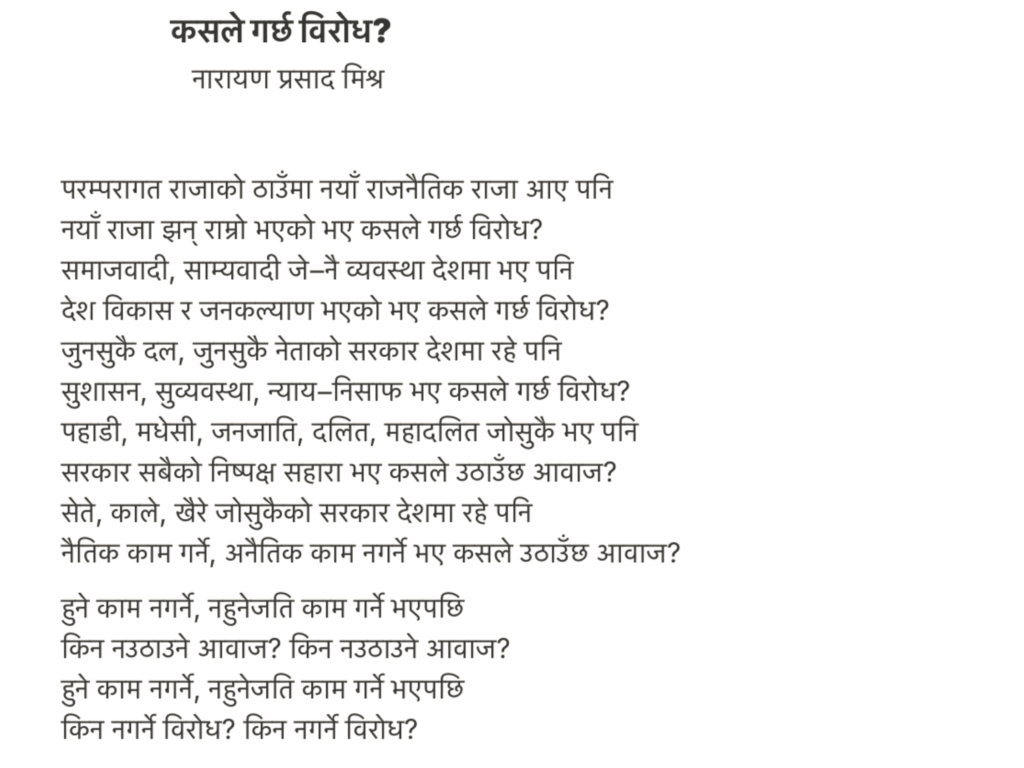
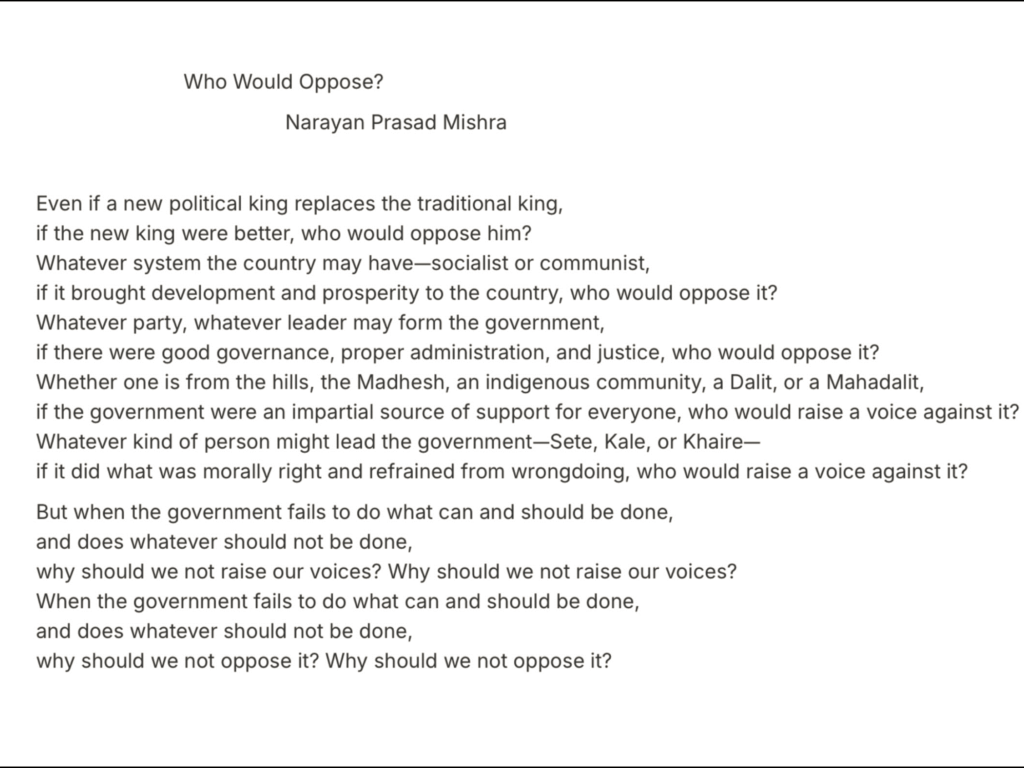
After witnessing so many political changes during my lifetime, I have come to believe that the name of a political system is less important than the principles by which it operates. Political labels can be like costumes. They may look impressive, but they do not necessarily reveal what lies underneath.
For me, therefore, the real question is not who governs, what party governs, or what political system they claim to represent. The real question is: How do they govern, and what do they do for the country and its people?
If they bring development, protect justice, practice fairness, uphold morality, administer the country honestly, and stand beside the helpless and powerless, that would be enough.
That is what matters.
About the author: A non-partisan writer of several books and numerous articles in Nepali and English; former Chief of the Office of the Tribhuvan University Service Commission, Nepal; and a senior citizen in his mid-eighties.

Login to add a comment