








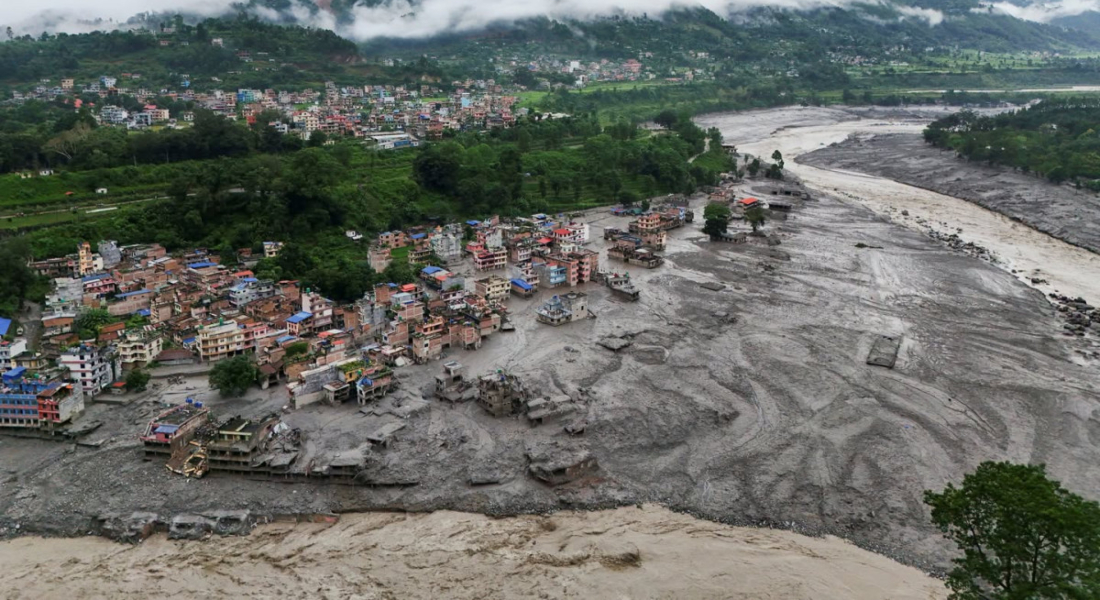
Kathmandu, Sept 7: The devastating Bhotekoshi flood of August 26 has caused extensive damage to schools in Dhading, Nuwakot and Rasuwa, disrupting the education of more than 10,000 children.
Preliminary data from the Ministry of Education shows that 19 schools in the three districts have suffered direct damage. Ten schools have been totally destroyed and nine partially damaged. Of the completely damaged schools, eight are community schools, and two are institutional schools. Among the partially damaged schools, four are community, and five are institutional.
The figures are preliminary. A ministry team is currently inspecting the affected areas to verify the extent of damage and update records concerning schools, students and teachers.
The disruption extends beyond the 19 directly damaged schools. Eight schools that survived the flood are currently being used as shelters or holding centres. Including schools involved in health desks, psychosocial support and other emergency activities, at least 32 schools have been affected.
“Some school buildings have been swept away, while only debris remains at others,” said Bir Bahadur Dhami, information officer at the ministry. Even schools whose buildings survived cannot immediately resume classes, he said, as some are being used to accommodate displaced people.
About 250 children are currently reported missing, along with 19 to 20 teachers. The flood has also left many surviving children struggling with psychological distress, making the return to normal schooling more complicated.
The ministry estimates that more than 10,000 children across the three districts have had their learning disrupted. In Rasuwa alone, about 200 to 250 children have been directly affected, while damage to schools and colleges in Nuwakot has disrupted learning on a larger scale.
With some schools unlikely to reopen soon, authorities are considering using undamaged schools as residential facilities where affected children could stay and continue their education.
The ministry has deployed technical teams led by the Department of Education to assess the situation. The teams, working with NGOs and development partners, will determine which schools can reopen, where temporary learning centres are needed and where residential arrangements may be required.
“The priority now is to move from rescue to recovery and from recovery to learning,” Dhami said.
Rebuilding damaged schools could take considerable time, he said, but prolonged disruption to children’s education could create another lasting loss.
People’s News Monitoring Service

Login to add a comment