







By Professor Zhan Xun
Rumors cannot rescue the missing, political speculation cannot explain nature, and geopolitical manipulation should have no place in disaster reporting
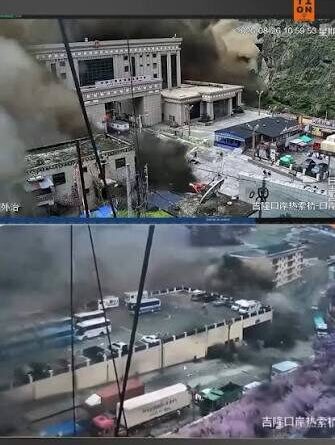
The devastating debris flow that struck the Nepal–China border region on August 26 has brought enormous human suffering to communities on both sides of the Himalayas. Lives have been lost, hundreds of people remain missing, roads and infrastructure have been destroyed, and rescue workers are risking their own lives in extremely difficult terrain to search for survivors.
At such a moment, the most basic human response should be sympathy for the victims, respect for the missing, support for rescue operations and cooperation across the border.
Unfortunately, alongside the disaster itself, another disturbing phenomenon has emerged: the rapid circulation of politically charged rumors and speculation attempting to blame the disaster on Chinese construction, Chinese infrastructure or even an alleged deliberate attempt by China to create an “ecological disaster.”
Such claims are not merely irresponsible. When presented without credible scientific evidence, they represent the insertion of geopolitical narratives directly into disaster reporting.
Science Cannot Be Replaced by Political Imagination
One widely circulated narrative claims that Chinese construction activities in the Himalayan region caused an avalanche, which then triggered flooding and debris flows. Various versions point to road construction, settlements, border infrastructure, mountain excavation or changes to river channels.
But where is the scientific evidence?
Establishing the cause of a high-altitude cascading disaster requires serious investigation involving glaciology, geology, geomorphology, hydrology, meteorology, remote sensing and field surveys. Scientists need to determine where the initial collapse occurred, what material was involved, how much ice, rock and debris was mobilized, how the mass entered the river system, and how the disaster evolved as it moved downstream.
None of these questions can be answered by looking at photographs of construction projects and then drawing a politically convenient conclusion.
Correlation is not causation. Proximity is not causation. And political suspicion certainly is not causation.
To jump from “there is Chinese construction in the region” to “Chinese construction caused the disaster” is not scientific reasoning. It is speculation searching for evidence after the conclusion has already been chosen.
Even more astonishing is the description of the disaster as a “purposeful ecological disaster.” Such an accusation requires extraordinarily strong evidence. Without such evidence, it crosses the line from speculation into conspiracy theory.
Journalists spreading such claims might benefit from spending less time imagining geopolitical plots and more time reading basic books on geology, glaciology and hydrology.
The Himalayas deserve scientific respect, not political fantasy.
A Natural Dam Is Not a Chinese Reservoir
Another misleading narrative circulating online concerns the word “dam.”
Reports referring to a “dam burst” or “dam collapse” have easily been transformed on social media into claims that a Chinese hydropower dam collapsed or that China deliberately released water from a reservoir.
This is a fundamental confusion of terminology.
In mountainous disaster environments, a “landslide dam” or “debris dam” can be formed naturally when rock, ice, mud or debris suddenly blocks a river valley. Water then accumulates behind this natural obstruction, creating a landslide-dammed lake. If the blockage becomes unstable, it may breach and produce severe downstream flooding.
That is entirely different from an engineered hydropower dam or reservoir.
Turning “landslide dam” into “Chinese dam,” and then turning “dam breach” into “China released water,” is not a minor translation problem. Once repeated in headlines and social media posts, it creates an entirely false causal narrative for ordinary readers.
Words matter, especially during disasters.
A journalist who cannot distinguish a landslide dam from a hydropower dam should first consult a geologist or hydrologist before publishing sensational claims to millions of readers.
“Most Likely” Is Not Evidence
Perhaps even more troubling is the tendency of some reports to place conclusions such as “most likely” directly into sensational headlines while providing no independent scientific evidence capable of supporting that probability.
Most likely according to whom?
Which geological survey?
Which satellite analysis?
Which glaciological investigation?
Which peer-reviewed assessment?
Which team of scientists has established the causal relationship?
If the principal evidence consists of social media posts repeating allegations from other social media accounts, adding the phrase “most likely” does not transform speculation into fact.
Journalism has professional standards precisely because the public cannot independently verify every claim appearing on a screen.
A headline is not a laboratory. Repetition is not verification. Suspicion is not evidence. And “most likely” cannot be used as a rhetorical shortcut to manufacture certainty where scientific certainty does not exist.
To do so is deeply misleading to the public and contrary to the basic ethics of professional journalism.
Any media organization willing to put such a conclusion into a headline without sufficient evidence should seriously reflect on its professional standards.
Do Not Turn Human Suffering Into a Geopolitical Weapon
There is an even more important issue.
People on both sides of the Nepal–China border are suffering.
Families are waiting for news of missing relatives. Rescue personnel are entering dangerous areas covered by deep mud and unstable debris. Roads have been destroyed. Rivers remain dangerous. Mountain slopes are unstable. A landslide-dammed lake poses additional risks. Hundreds of rescuers are working against time while facing the possibility of further rainfall, landslides and flash floods.
Against this background, using the tragedy as an opportunity to manufacture hostility between China and Nepal is particularly disturbing.
Natural disasters should not become convenient raw material for geopolitical confrontation.
When every avalanche becomes a political conspiracy, every flood becomes evidence of another country’s malicious intentions, and every natural dam becomes a “Chinese dam,” disaster reporting ceases to inform. It becomes propaganda disguised as journalism.
This violates not only journalistic professionalism but also the humanitarian spirit that should guide public communication during a catastrophe.
Before asking how a tragedy can be exploited politically, we should be asking: Where are the missing? How can rescue teams reach them? What caused the disaster scientifically? Is another collapse possible? How can downstream communities be protected? What information should China and Nepal share? How can future cross-border early-warning systems be improved?
Those are the questions that matter.
The Himalayas Need Cooperation, Not Conspiracy Theories
The Himalayas are one of the world’s most complex and fragile high-mountain environments. Glaciers, steep valleys, earthquakes, intense rainfall, landslides, ice avalanches, glacial lakes and rapidly changing river systems interact across national borders.
Nature does not recognize immigration checkpoints.
An avalanche does not carry a passport. A debris flow does not understand geopolitics. Floodwater does not distinguish between Chinese and Nepali territory.
That is precisely why the correct response to this disaster is cooperation.
China and Nepal need stronger cross-border disaster monitoring, hydrological information sharing, satellite and remote-sensing cooperation, geological risk assessment, emergency communication mechanisms and coordinated early-warning systems.
Scientists should investigate what happened. Rescue workers should be allowed to do their work. Journalists should verify before accusing. Governments should share information. And the international community should support, rather than politicize, disaster relief.
Above all, we should retain a sense of humility before nature.
The mountains are powerful enough without humans inventing conspiracies around them.
Rumors will not rescue a single missing person. Sensational headlines will not stabilize a landslide-dammed lake. Geopolitical manipulation will not prevent another debris flow.
And attempts to exploit a shared tragedy to sow suspicion between the Chinese and Nepali peoples will not destroy a friendship built through generations of exchanges across the Himalayas.
In the face of disaster, what is needed is not finger-pointing but helping hands; not conspiracy theories but scientific investigation; not political manipulation but humanitarian responsibility.
Respect nature. Respect science. Respect the victims. And work together.
That is what this tragedy demands of all of us.
(The author is a professor at the School of Public Administration at University of Electronic Science and Technology of China and chair of the Department of Journalism and Communication.)

Login to add a comment