







Kathmandu, Aug. 11: Prime Minister Balendra Shah has begun reaching out directly to foreign diplomats, ending his stubborn approach that kept ambassadors largely away from his office.
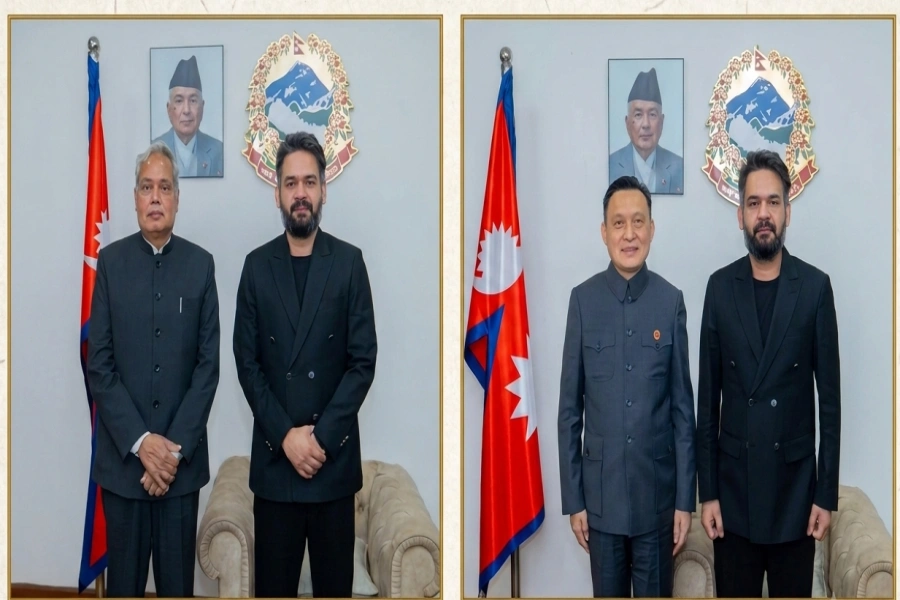
Shah met the ambassadors of India and China separately on Monday at the Prime Minister’s Office in Singha Durbar, marking a clear departure from his earlier insistence that diplomatic contacts should follow established protocol and largely go through the Ministry of Foreign Affairs.
For nearly four and a half months after taking office, Shah maintained limited direct contact with foreign envoys. Unlike his predecessors, who routinely received ambassadors at the prime minister’s residence or office, Shah kept such engagements tightly controlled.
The approach initially drew praise from those who saw it as an attempt to impose greater discipline on diplomatic dealings. But it also left Nepal’s diplomatic community with limited direct access to the prime minister.
That changed on Monday. Shah first met Indian Ambassador Naveen Srivastava and later held talks with Chinese Ambassador Zhang Maoming. Each meeting lasted around 45 minutes, with officials from the Foreign Ministry also present.
The talks covered Nepal’s relations with both neighbours, development cooperation, mutual interests and areas where bilateral engagement could be expanded.
After meeting Shah, Srivastava said the two sides discussed ways to further strengthen the “robust, multi-faceted” India-Nepal partnership. He also conveyed greetings from Indian Prime Minister Narendra Modi.
According to the Prime Minister’s Office, Shah underlined the importance of Nepal’s historic ties with India and called for stronger cooperation in areas of common interest. In his meeting with the Chinese ambassador, he similarly stressed the need to deepen Nepal-China relations and widen bilateral cooperation.
The change comes after Shah’s earlier policy reportedly blocked or complicated meetings sought by several senior foreign officials visiting Nepal. Senior US officials were among those who reportedly sought appointments with the prime minister.
Questions also arose over a proposed visit by Indian Foreign Secretary Vikram Misri, with uncertainty over whether he would secure a meeting with Shah cited as one of the concerns. The visit eventually did not take place. Talks on a possible visit by Shah to India have also failed to produce a clear outcome.
Soon after assuming office, Shah had invited diplomatic mission chiefs and representatives to Singha Durbar for a joint briefing. Diplomats, however, viewed such collective meetings as no substitute for direct, regular engagement between the prime minister and foreign envoys.
His latest meetings suggest Shah may now be adjusting course. The outreach to India and China could be the first sign of a broader shift in his foreign policy, moving from strict adherence to protocol toward more direct political diplomacy.
That shift comes at a critical time. With pressure mounting on the government to deliver economic results, Shah needs stronger ties with Nepal’s key development partners, investors and neighbouring powers. Direct engagement with India and China may therefore be less about protocol and more about political and economic necessity.
People’s News Monitoring Service

Login to add a comment