







By Our Reporter
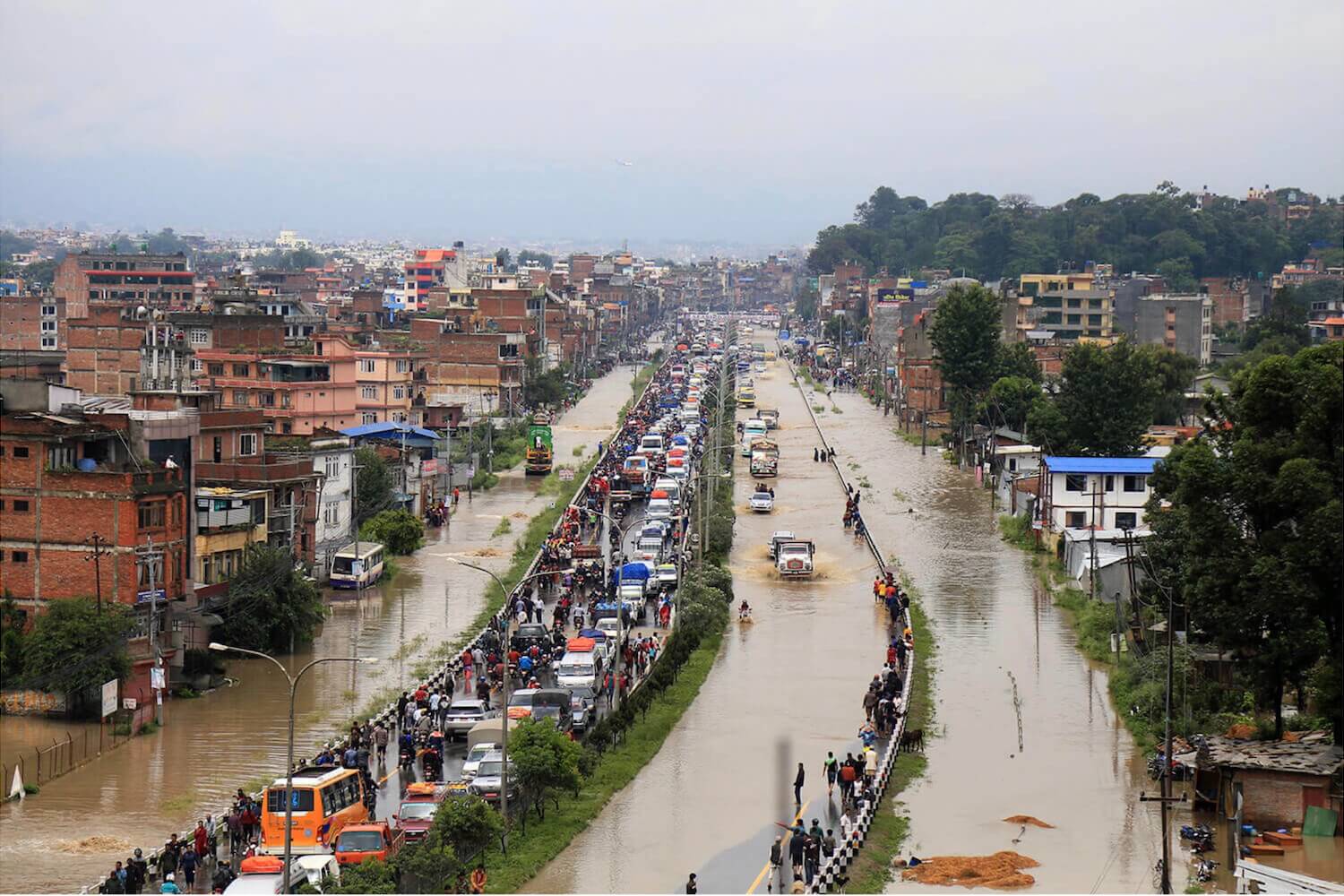
Every monsoon, Kathmandu repeats the same cycle. A few hours of rain bring traffic to a standstill. Roads disappear under water. Shops flood. Vehicles break down. Social media fills with images of submerged intersections in Tinkune, Koteshwor, Teku, Kalanki and Balaju. Officials blame heavy rainfall. Citizens blame poor drainage. Then the water recedes, attention fades and little changes until the next storm.
The pattern has become so predictable that flooding is now treated as a seasonal inconvenience rather than an urban planning failure.
That is a mistake. Rain does not flood Kathmandu. The city floods because decades of unplanned development have steadily stripped away its natural ability to absorb and manage water.
Kathmandu once had a landscape that worked with nature. Paddy fields, ponds, wetlands, streams and open spaces acted as natural reservoirs. Rainwater soaked into the ground, replenished groundwater and flowed gradually into rivers. Flooding certainly occurred, but the land itself helped reduce its impact.
That natural system has almost disappeared. As urbanization accelerated, ponds were filled to make way for buildings. Wetlands became housing plots. Farmland turned into roads and parking lots. Streams were narrowed, diverted or buried beneath construction. Concrete replaced soil across much of the valley.
The result is a city that behaves like a giant waterproof surface. When rain falls today, very little enters the ground. Water races across roads, rooftops and paved courtyards before overwhelming drainage systems that were never designed for such volumes. What appears to be a drainage problem is actually the visible symptom of much deeper failures in land use planning.
This explains why even ordinary rainfall now produces extraordinary disruption. Many believe wider drains alone will solve the crisis. Better drainage is certainly necessary. Kathmandu’s stormwater network is old, undersized and poorly maintained. Plastic waste, illegal sewer connections and construction debris frequently block water flow.
But bigger drains alone cannot compensate for the disappearance of natural water storage. In fact, larger drains often move floodwater downstream more quickly, transferring the problem instead of solving it. Unless rainwater can be stored, absorbed or slowed before reaching drainage channels, flooding will continue.
The city’s rivers tell the same story. Bagmati, Bishnumati, Dhobikhola, Manohara and other rivers have steadily lost their floodplains to settlements and commercial development. Riverbeds have risen because of waste disposal and sediment accumulation. Natural channels have narrowed. Water that once spread harmlessly across floodplains is now forced into built up neighborhoods.
Nature eventually reclaims its space. Climate change is making an already fragile system even more vulnerable. Scientists have consistently found that rainfall in South Asia is becoming more intense over shorter periods. Kathmandu now experiences heavier cloudbursts that quickly overwhelm drainage infrastructure. Climate change is not the root cause of today’s flooding.
It simply exposes the weaknesses that poor planning created over decades. Perhaps the greatest institutional failure lies in fragmented governance. Roads fall under one agency. Rivers under another. Sewerage, drinking water and urban planning are managed separately. Kathmandu Valley itself is divided among multiple local governments, each making decisions within administrative boundaries while water ignores those boundaries entirely.
Flood management cannot succeed under such a fragmented system. The valley needs planning based on watersheds rather than municipal jurisdictions. Water follows topography, not political maps.
Other cities offer valuable lessons. Singapore combines canals with green public spaces. Rotterdam stores stormwater in parks that double as recreational areas. China’s Sponge City program restores wetlands, permeable surfaces and natural drainage systems. Copenhagen redesigns streets to safely channel floodwater during extreme rainfall. Their approaches differ, but they share one principle: make room for water instead of trying to force it away.
Kathmandu needs both immediate and long-term action. In the short term, drains must be cleaned before every monsoon, blocked culverts reopened, illegal structures removed from waterways and flood prone intersections equipped with emergency pumping systems. Municipalities should strengthen early warning systems and improve coordination among emergency agencies during heavy rainfall.
These measures will reduce immediate disruption but they will not eliminate the problem. Long term solutions require a different vision of urban development. The valley must restore ponds and wetlands wherever possible, protect remaining open spaces, prevent further encroachment on river corridors and require rainwater harvesting in new buildings. More permeable pavements, urban parks and groundwater recharge zones should become standard features of future development rather than optional additions.
Equally important is enforcing land use regulations. Kathmandu cannot continue approving construction in natural drainage corridors while expecting engineering alone to prevent flooding. The city does not suffer from a shortage of technical knowledge. Engineers, planners and environmental experts have proposed many of these solutions for years. The problem has been weak implementation, fragmented institutions and short-term political thinking.
Kathmandu’s flooding is therefore not simply a monsoon story. It is the cumulative result of decades of planning that treated rivers as obstacles, wetlands as vacant land and concrete as the only measure of development. Until the city rebuilds its relationship with water instead of trying to overpower it, every monsoon will bring the same question, the same flooded streets and the same avoidable crisis.

Login to add a comment