







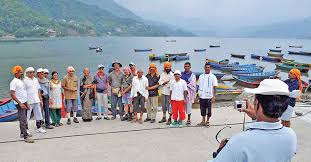
Kathmandu, June 16: Recently, Pokhara has witnessed a significant influx of Indian visitors. The surge is not limited to Pokhara alone but has also extended to the Himalayan district of Mustang. Large numbers of Indian pilgrims traveling to visit the Muktinath Temple have contributed to the growing crowds in Mustang. Tourism entrepreneurs in Pokhara and surrounding destinations are pleased to see tourist sites bustling with Indian visitors.
The rise in tourist arrivals has significantly increased hotel occupancy rates. According to tourism operators, hotel occupancy in Pokhara during this period in previous years used to hover around 20 percent. This year, however, occupancy has reached as high as 90 percent. They say that the increased arrival of Indian tourists has provided a major boost to Pokhara’s tourism sector during what is usually a slow season.
As the number of Indian tourists has grown, concerns regarding management and organization have also surfaced. Tourism entrepreneurs have voiced complaints both publicly and on social media, saying that management has not kept pace with the growing crowds. In addition, some criticism has been directed at the activities and behavior of certain Indian visitors.
In response to the growing criticism, the Nepal Tourism Board has issued a set of guidelines specifically targeting Indian tourists, outlining what they should and should not do while traveling in Nepal. According to the Board, the notice contains information about precautions and procedures that visitors entering Nepal through various border points should follow.
The Board stated that tourists entering Nepal by road must obtain entry permission from the Government of Nepal’s Customs Department, either online or physically. While obtaining the permit, visitors are requested to provide details including the names of passengers in the vehicle, their ages, gender, the estimated duration of stay in Nepal, and the places they intend to visit.
Although Indian citizens do not require a visa to enter Nepal, the Board has requested that they carry valid identification documents. It has also advised travelers to ensure that their vehicles are in good condition, as Nepal’s roads—particularly in the mountainous regions—are narrow and contain numerous sharp turns. Indian drivers are expected to be experienced and familiar with Nepal’s geography, climate, and weather conditions.
The Board has also urged tourists to keep religious sites clean and, where necessary, carry bottled oxygen to prevent health problems caused by high altitude. Visitors have been warned that disposing of clothes, materials, or waste outside designated areas is against the law and may result in legal action. Tourists planning to cook their own food have been advised to obtain the necessary permission by contacting hotels or relevant authorities in advance.
The Board has further requested visitors to respect local culture, traditions, and residents. Tourists are encouraged to use polite and respectful language and wear decent attire. “Problems sometimes arise because visitors are unfamiliar with travel conditions in Nepal. Indian tourists, in particular, have faced difficulties. Therefore, we issued this advisory to help ensure that visitors do not encounter problems during their stay,” said Maniraj Lamichhane, Senior Director and Head of the Nepal Tourism Board’s Gandaki Province Office.
Lamichhane said that the advisory was also necessary because the number of Indian visitors entering Nepal this season exceeded expectations. He added that the information, currently being circulated through social media, will soon be displayed on digital boards at airports and in public places.
“This notice has also been issued to convey the message that Nepal is a safe destination. Indian visitors should know what they can and cannot do while in Nepal. We also plan to publish the guidelines in Hindi,” he said. “If drivers are informed about road conditions, the risk of accidents can be reduced. Drivers should also be aware of Nepal’s roads and environment.”
According to him, Indian tourists visiting Nepal are currently allowed to bring Indian currency equivalent to up to US$5,000 per person. Previously, the limit was only INR 25,000. He said the current ceiling stands at approximately INR 475,000, equivalent to US$5,000.
Hari Sharma, President of the Hotel Association Gandaki, also believes that while tourist arrivals have increased, greater attention must now be paid to management. “The arrival of Indian tourists this season has been better than we expected. However, if management is not improved, it could create problems. Necessary infrastructure must be developed at various locations,” he said. “Building infrastructure alone is not enough. Tourists entering Nepal must also know what they are allowed and not allowed to do. It is the responsibility of the government, the Tourism Board, and tourism entrepreneurs to provide that information.”
Tourism operators expect the current influx of visitors to lead to even higher arrivals in the coming season. Sharma said that tourists should therefore be informed at border entry points about the rules and regulations they must follow while in Nepal.
“Tourists must be aware and responsible. We tourism entrepreneurs must also improve our practices. We have to comply with the law and provide accurate information to visitors. It is not enough simply to do business; we cannot ignore our responsibilities,” he said. “The state benefits when tourists visit Nepal. Therefore, all stakeholders must cooperate in managing tourism effectively.”
People’s News Monitoring Service.

Login to add a comment