








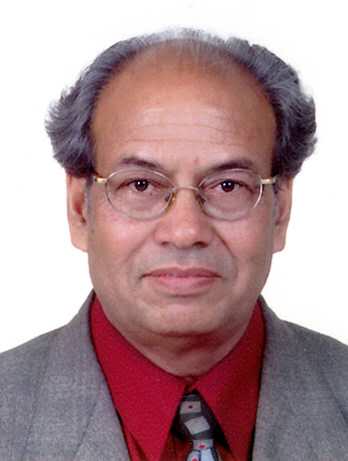
Narayan Prasad Mishra
I began my working life at the age of 17 as a junior clerk in a government office, while continuing my studies at a night college in Kathmandu. Those early years were not easy, but they were full of learning. My work took me through many offices and different positions, and in each one, I carried out my duties diligently and never lagged behind my colleagues. I still take pride in remembering that, wherever I worked, I somehow became the most trusted and favored staff member of my immediate superiors.
Later, life’s twists and turns brought me to Tribhuvan University. There, as in all my previous offices, I served with sincerity, honesty, dedication, and unwavering loyalty to the institution, successfully keeping my record untarnished. Over the years, I rose to a high-ranking position with a special class grade. I never held any short-term positions such as Vice-Chancellor, Rector, Registrar, or Director—roles often filled through the blessings of powerful patrons, much like appointments to the country’s Constitutional Bodies. After heading several departments, I eventually became the Chief of the Service Commission Office of Tribhuvan University, which is responsible for recommending the appointment of academic and administrative personnel. In that role, I felt my work was significant, and I continued to believe sincerely in the value of education and academia.
But times changed. With the arrival of multiparty democracy, our hopes for a free and fair system quickly gave way to disappointment. Democracy, in practice, became a dictatorship of political parties, and the academic center I worked in gradually turned into a political arena. In 1992, at the age of 49, I lost my job—without any fault of my own—during the vice-chancellorship of Kedar Bhakta Mathema. That sudden and unjust dismissal was a turning point in my life.
Since then, I have lived primarily for the cause of the nation and its people, reading and writing with no personal ambitions left to pursue. My many books and hundreds of articles in English and Nepali are the result of it. I am now in my mid-eighties, single, and mostly living in the USA with my daughter. I have no job, no work, and no family members at home in Nepal, though my heart longs to return there. Even though I am far away from my motherland, my thoughts are never far from it. I think about Nepal constantly, and I worry about its future. My daily routine involves reading, watching, and listening to whatever I can—newspapers, television, YouTube—anything that connects me to my homeland.
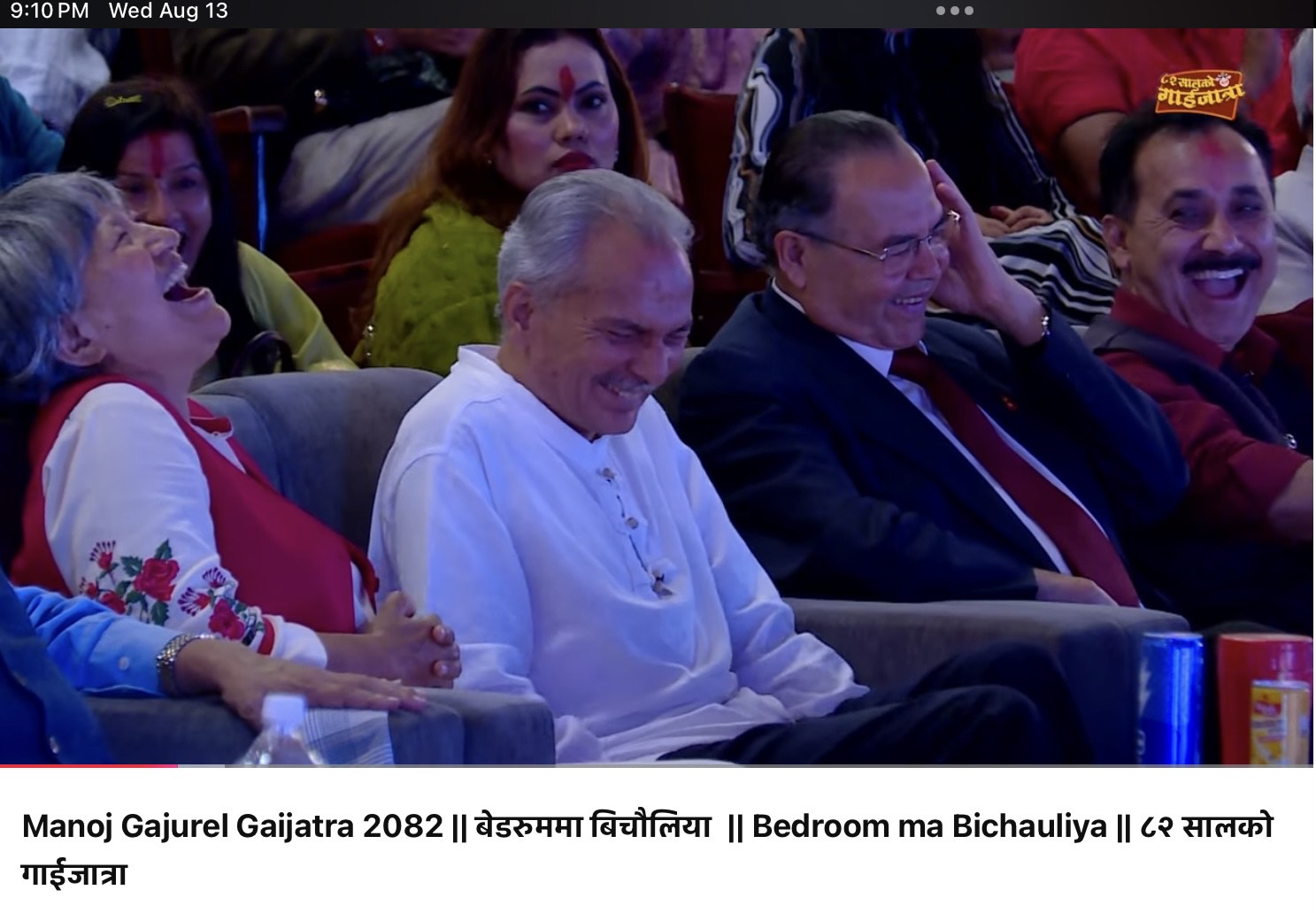
On August 13, 2025, while browsing YouTube on my iPad, a title caught my attention: Manoj Gajurel Gaijatra 2082 – Bichauliya (Broker) in Bedroom. I have long admired Manoj Gajurelji for his extraordinary talent, wisdom, and humor—admiration equal to what I feel for Santosh Pant, the legendary and unforgettable humorist and satirist of our country. I consider Santosh Pant the jewel of humour and satire in our land. I know Manojji as a fellow member and vice president of the organization Sisnupani, of which my late wife, Shanti Mishra, and I were honorary members. We joined Sisnupani out of affection for Chatyang Master (Krishna Murari Gautam), Nepal’s celebrated satirical poet, social worker, and activist, during his presidency. To me, Chatyang Master was not just a cultural icon but also the heart and soul—the very creator—of that organization, along with some other like-minded friends.
I watched the YouTube video Manoj Gajurel Gaijatra 2082 with great interest, and the more I watched, the more I was drawn in. The performance painted a painfully accurate portrait of today’s Nepal—plagued by bad governance and rampant corruption—through sharp humor and biting caricature. The central figure was a wealthy bagman and political fixer (played by Manoj) who could walk straight into the prime minister’s bedroom to strike any deal, as long as a bribe was involved. Through his dialogue and acting, Manoj shows that in Nepal, the bagman holds more power than the prime minister—able to form and topple governments at will, to unite rivals when convenient, and to split them apart just as easily. The satire references real corruption scandals and portrays prime ministers as deeply compromised. By caricaturing Prachanda, Oli, Rana, and others, it makes clear that no prime minister of the Republic of Nepal is innocent.
What struck me even more was the audience itself—packed with high-ranking officials, well-known politicians, and former ministers and prime ministers. Many of these people were, in reality, the very players in the corrupt game being mocked. Yet they laughed uncontrollably, as if the satire applied only to the present government, and not to their own past actions. That was an exact illustration of the ugly picture of the present republic and its prime figures, like a face smeared by smallpox.
Around the same time, I came across two other YouTube videos. One, from the channel Bir Gorkhali, was titled राजा फर्काउन सेनाको गोप्य तयारी (“The Army’s Secret Plan to Bring Back the King”). The other, from Nepal Sandesh, was titled राप्रपाको बैठकमै हानाहान (“A Fight in the Rashtriya Prajatantra Party’s Meeting”). The second video was unintentionally comical—two groups of a small, monarchist party physically fighting each other in a meeting, while claiming to champion the return of the monarchy.
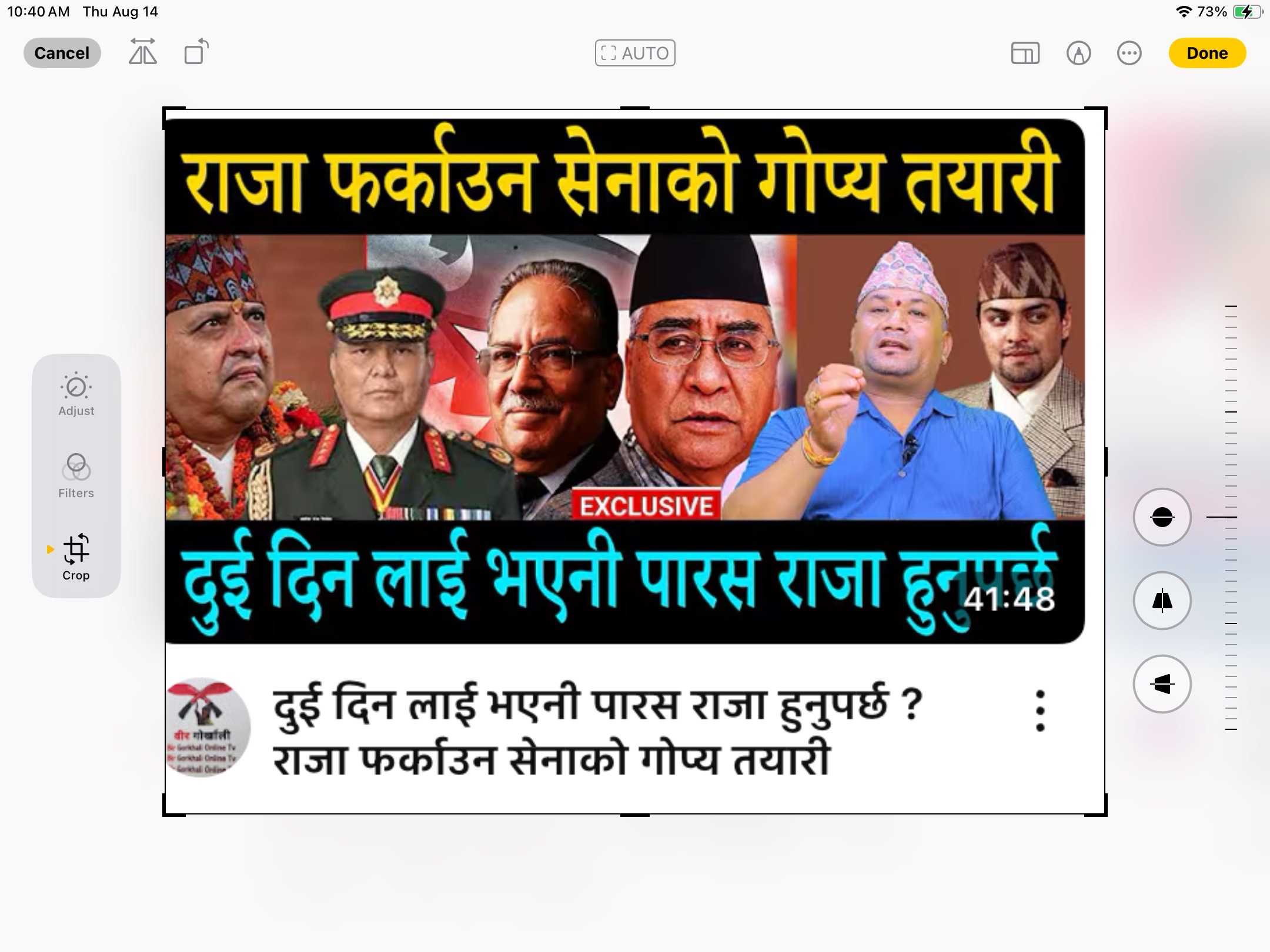
The Bir Gorkhali video, however, made me pause. The channel appears to have a serious pro-monarchy voice, yet if the army truly had a secret plan to restore the king, why would they broadcast it publicly? Doing so would immediately sabotage such a plan. I concluded it must be fake news. Then I wondered—what was the purpose of putting out such false information? Who stood to gain? The question left me unsettled.
The Rashtriya Prajatantra Party’s internal fight confirmed my suspicion: they exist not for the monarchy but for some other agenda. If they cannot unite for their leading cause, how could they possibly stand against the larger parties? In truth, I see no political party in Nepal today with a genuine and united voice for the monarchy.
I have never belonged to any political party—monarchist, democratic, communist, socialist, or otherwise. I am a wholly non-partisan human being who values democracy and longs for good governance, justice, equality, and equal opportunity for all. I believe these alone are enough to develop our country for everyone’s welfare. I do not quarrel with any political system that delivers these principles and stays free from corruption, bad governance, suppression, and oppression—nothing more, nothing less. Sadly, the present, disfigured republic is delivering none of these. Instead, it has become the very opposite, and I see no alternative that is either possible or hopeful, which fills me with sorrow.
But, whether we like it or not, I believe we are bound to live in a present republic, whether it is black or brown, scarred by smallpox, or plagued with cholera and typhoid. That is the reality we face.
narayanshanti70@gmail.com

Login to add a comment