







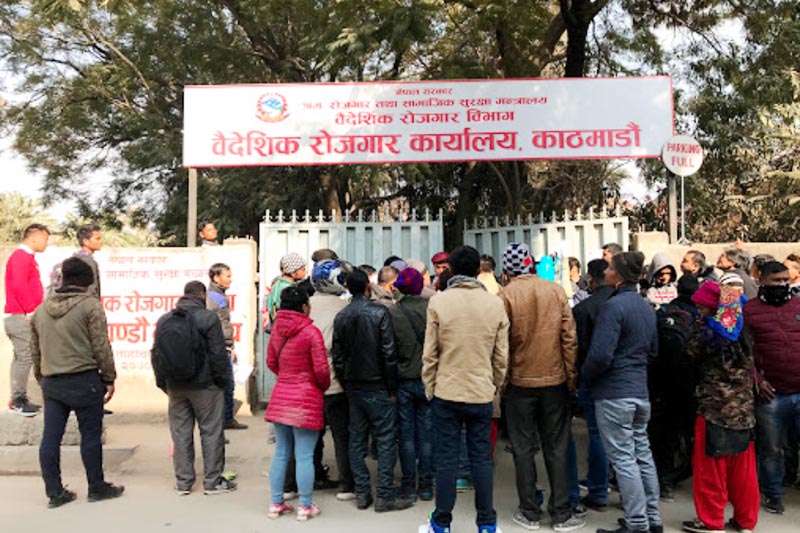
Kathmandu, August 18. The number of complaints filed at the Department of Foreign Employment has crossed 36,000, with workers cheated during foreign employment, left stranded, or denied jobs and salaries as per contract still waiting for justice. The backlog has grown as the settlement process remains slow, leaving thousands of migrant workers in limbo for years.
The Director General of the department informed that complaints dating back to 2007 are still pending. He said around 200 new cases are added daily. In the last fiscal year alone, 1,822 complaints were registered under relief and rescue, 5,632 in the legal branch, and 5,337 in the police branch. Of them, only 979 under relief, 528 under the legal branch, and 4,876 under the police branch were settled.
“We have limited staff, which has delayed the settlement process,” he said. “We have a phased plan to clear old cases, beginning with complaints from 2007 to 2013 in the first stage.”
To make the process easier, the department has introduced an online system for lodging complaints, removing the need for victims to visit in person. But despite such measures, the pace of settlement remains slow, forcing thousands of workers and their families to wait endlessly. Addressing fraud in foreign employment and ensuring timely justice has become one of the department’s biggest challenges.
Meanwhile, the Ministry of Labour is preparing to amend the Foreign Employment Act. One of the key proposals is to transfer jurisdiction of individual fraud cases under Section 43 from the department to the district courts, as these cases often take years to resolve at the department.
Labour law expert advocate Som Luintel said handing over investigation of fraud cases to the police is a positive step, but shifting adjudication to district courts would be a regressive move. “Past experience shows hearings in district courts are lengthy and less effective,” he said. “In contrast, 92 percent of the Foreign Employment Tribunal’s decisions have been upheld by the Supreme Court, which shows its effectiveness.”
Luintel suggested that while police could handle investigations of both individual and institutional fraud, adjudication should continue through the tribunal or through foreign employment benches at high courts in the provinces, in line with Supreme Court directives.
People’s News Monitoring Service

Login to add a comment