







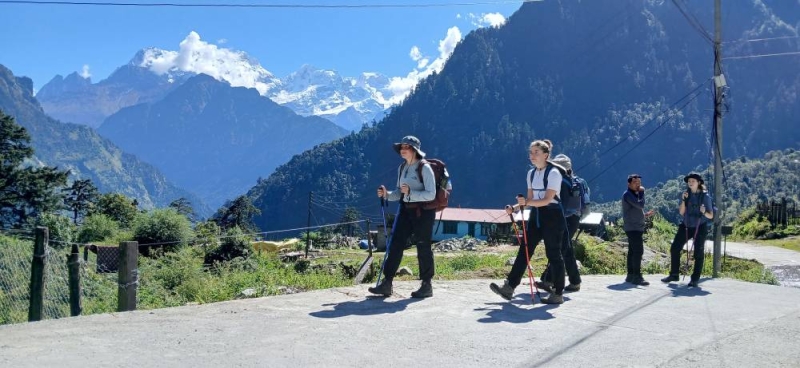
Pokhara, July 18: The world-renowned Annapurna region, famous for trekking, witnessed a 25 per cent increase in tourist arrivals in the last fiscal year compared to FY 2080/81.
According to data from the Annapurna Conservation Area Project (ACAP), 222,180 foreign tourists visited the region in FY 2080/81, while the number rose to 278,113 in FY 2081/82. Among them, 157,786 were from South Asian countries, and 120,327 were from other nations. Project Chief Dr. Rabin Kadel reported a year-on-year increase of 55,133 visitors.
The monthly breakdown of tourist arrivals in the last fiscal year shows the highest inflow in Chaitra (mid-March to mid-April), with 44,977 visitors. In contrast, the lowest number was recorded in Shrawan (mid-July to mid-August), with 5,710 arrivals. Bhadra (mid-August to mid-September) saw 13,279 tourists, followed by 30,732 in Ashwin (mid-September to mid-October), and 33,310 in Kartik (mid-October to mid-November). In Mangsir (mid-November to mid-December), the figure dropped to 14,011, while Poush (mid-December to mid-January) saw 14,033 arrivals. Magh (mid-January to mid-February) recorded 9,034 tourists, Falgun (mid-February to mid-March) brought in 19,470 visitors, Baisakh (mid-April to mid-May) saw 41,853, Jestha (mid-May to mid-June) had 31,955, and Asar (mid-June to mid-July) concluded the fiscal year with 19,749 tourists.
According to Dr. Kadel, the two main trekking seasons—Ashwin–Kartik (autumn) and Chaitra–Baisakh (spring)—draw the highest number of visitors. These peak seasons also attract many tourists for religious purposes. The number of tourist arrivals has been growing steadily each year. In FY 2079/80, the region saw 172,108 tourists, which rose by over 100,000 in just two years.
Tourism in the Annapurna region, which had suffered during the COVID-19 pandemic, has now returned to its pre-pandemic rhythm. Annapurna continues to be a globally recognized trekking destination. Although visitor numbers tend to dip during the rainy and winter months, the region remains busy with both domestic and international tourists during other times of the year.
Foreign tourist arrivals by road are also increasing annually. While most Indian visitors heading to destinations like Muktinath prefer road travel, tourists from other countries generally opt for trekking. ACAP records only the data of foreign tourists entering the conservation area.
Every year, hundreds of thousands of tourists visit popular destinations along the Annapurna Circuit, such as Annapurna Base Camp, Mardi Himal, Sikles, Lwang, Ghandruk, Tilicho Lake, Thorong La Pass, Upper Mustang, Muktinath, Ghorepani, and Poon Hill. Spread across 7,600 square kilometers, the Annapurna Conservation Area covers 87 wards in 15 local units across Kaski, Lamjung, Manang, Myagdi, and Mustang districts. Its natural beauty, biodiversity, Himalayan lifestyle, and rich culture make it a top choice for both domestic and international visitors.
The Annapurna Circuit is recognized as one of the world’s best trekking destinations due to its spectacular mountain views, trekking-friendly infrastructure, favourable climate, local hospitality, and quality services. Treks of varying lengths—short, medium, or long—are possible through routes in Kaski, Lamjung, Manang, and Myagdi.
People’s News Monitoring Service

Login to add a comment