







By P.R. Pradhan
To what extent have the foreign puppets been scared by the increasing popularity of the deposed king among the Nepali people, which could be experienced by unhealthy and untimely remarks made by corrupt political leaders and foreign-paid academicians!
The Kantipur Media Group, among other mainstream media, is known to be biased against the restoration of the Hindu kingdom despite the street demand for scraping the present political system with federalism, secularism, and republicanism. The reason for their bias could be the secret funding they are receiving at the cost of serving the core interests of the foreign powers.
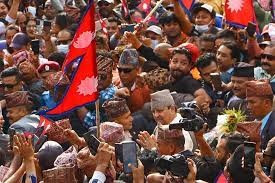
These media, which hesitated to provide a little space about the human sea that appeared to greet the deposed king wherever he was visiting in recent months, are manufacturing anti-monarchist articles. We can understand that in the course of serving their foreign bosses, they declined to give space to the fact about the increasing popularity of the monarch in the country. The former king visited many places, most of which were the Tarai districts. The Tarai people, at large, appeared to greet and listen to the king.
Moreover, scared of the possible return of the Hindu monarchy, these media have started to publish dollar-sponsored articles by those “intellectuals” who have been serving the foreign powers.
Not odd, we saw two write-ups—one in the Kantipur Daily, another in The Kathmandu Post Daily—published by the Kantipur Media Group on February 6.
Khimlal Bhattarai a politburo member of the UML, believes the return of the institution of monarchy is an insignificant debate.
Likewise, Mitra Pariyar, a former staffer in the British Embassy in Kathmandu, who enjoyed the scholarship and did his graduation from Oxford University, published his piece “Dangerously Deluded Monarchist”.
The main theme of both articles is that there is no chance of the return of monarchy in Nepal.
Bhattarai believes that the step taken by King Gyanendra on Magh 19, 2061, was a move against democracy, however, we believe, the move was to bring the derailed democracy back on track. India took it as an opportunity to unify the political parties under the 12-point agreement. Although the political parties claim that they were able to end the monarchy, that was an Indo-West gameplan, we are all aware.
When they argued that the return of the institution of monarchy was impossible, they might have seen commoners in the streets asking the king to come and save the nation. The fact is that, due to the popularity of social media, the attempts to black out any event by mainstream media have now become impossible.
Particularly talking about Pariyar, who has been assigned to Nepal with the mission of dividing Nepali society by spreading communalism, the issue of caste discrimination, and provoking the Tarai communities, among others, is strongly anti-Nepal and pro-west “intellectual”. We have nothing to say as he is receiving euros and serving Western agendas.
The common impression is that if a scholar is either Harvard-returned or Oxford-returned, he is pro-West, and if a scholar is from JNU, is surely pro-Indian.

Login to add a comment