








By Shanker Man Singh
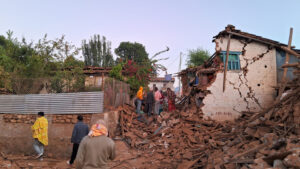
Everyone has been saddened by the news that Jajarkot, Rukum West, and other areas have suffered huge human losses due to the earthquake. It is necessary to immediately send a rescue team to the affected area to treat the injured. Besides, it is also necessary to make arrangements to provide humanitarian aid to the affected areas. About 150 plus people have died from the earthquake, which had its epicentre at Ramidanda. The number of injured people is also very high.
Heartfelt tributes to those who lost their lives in the tragedy of Jajarkot. There is an urgent need for relief, medicine, food, shelter, clothing, and reconstruction and rehabilitation. The Disaster Management Council is also expected to be activated for disaster management. The current earthquake is a big disaster for Nepal. The Government should come up with an immediate action plan and concept of a comprehensive immediate relief, rehabilitation, and reconstruction or new construction program that addresses all the important concerns arising from the earthquake for immediate relief, economic rehabilitation, livelihood, and enhancing the long-term capacity of all stakeholders to fight in the future.
The government should successfully and effectively implement the Nepal Earthquake Reconstruction and Rehabilitation Policy and related acts, which include all measures and institutional initiatives to be taken by the government in the earthquake-affected areas. The policy should detail the structure and development of entitlements that help reflect the vision of a successful reconstruction and rehabilitation plan.
Nepal is prone to disasters like earthquakes, floods, droughts, etc. These disasters have caused widespread loss of life and property over the years, resulting in a negative impact on economic development agreements.
Some guidelines
Prepare an emergency kit that includes essential items such as water, non-perishable food, flashlights, batteries, a first-aid kit, important documents, and any necessary medications.
Ensure enough supplies for at least three days. Develop an emergency plan with your family. Designate a safe meeting place inside and outside your home. Discuss how to contact each other if separated during an earthquake.
Secure heavy furniture, appliances, and other items that may fall during an earthquake. Use brackets, straps, or adhesives to keep them from falling. Know your area. Understand the earthquake risk in your area.
Identify safe and dangerous areas in your home and community. If you are outside, move to an open area away from buildings, street lights, and utility lines. Protect your head and neck.
If you are driving, pull over to a safe place away from overpasses, bridges, and buildings. Fasten your seat belt and stay in the vehicle until the vibration stops.
If you are in bed, sit up in bed and protect your head with a pillow. After an earthquake, check for injuries, and assess yourself and others for injuries. Provide first aid as needed.
Inspect your home for structural damage, gas leaks, and electrical problems. If you smell gas or suspect a leak, turn off the gas supply and leave the building. Be prepared for aftershocks, which can follow a main earthquake.
Take photos or videos of any damage to your property for insurance purposes. Stay informed about the status and any further developments. Continue to monitor news and alerts. Remember that preparedness is key to minimizing the effects of an earthquake.
Regularly review and update your emergency plan and supplies to ensure you and your family are well-prepared. An active, comprehensive, and sustainable approach to disaster management is felt to be the need of the moment.
As a result, it is expected that the implementation of the ‘Disaster Management Policy’ for Nepal will be effective by establishing a high-level body or authority to deal with these problems.
The effects of earthquakes vary in magnitude and intensity, with earthquakes occurring all over the world except in rare areas. Destruction of towns and cities is one of the effects of earthquakes.
What is an earthquake?
An earthquake is the result of a sudden release of energy in the Earth’s crust that creates seismic waves. The seismic activity of an area refers to the frequency, type, and size of earthquakes experienced over some time. If you throw a stone into a pool of still water, a series of waves are generated on the surface of the water. These waves spread in all directions from the point where the stone hit the water. Similarly, any sudden disturbance in the Earth’s crust can cause vibrations in the crust that travel in all directions from the point of disturbance.
A focus is the point on a fault where it ruptures and from which seismic waves emanate. The epicentre is the point on the Earth’s surface directly above the focus, the point where the earthquake or underground explosion originates. A fault line is a surface trace of a fault, a line along the center of the earth’s surface.
A fault plane is a crack or sudden drop in the ground. Fault scrap is a topographic expression of faults attributed to displacement of the land surface by movement along faults. Faults in the earth’s crust are the main cause of earthquakes.
“A fault is a break or fracture of two blocks of rock in response to stress.” This movement can be rapid, like an earthquake, or slow, like a creep.
The continuous medium and large earthquakes in the western part of Nepal have started disturbing the accumulated earthquake power in other parts of the country.
Geologists claim that the accumulated energy around the federal capital, Kathmandu, and under the mountains to the west is being disturbed. It is the power of the old and the new. Experts say there are some reasons for the accumulation of power.
After the 7.8 magnitude earthquake in 2015 with Gorkha as its epicentre, a few years passed in aftershocks. It has deposited the power of another great earthquake under the ground in Kathmandu.
According to the National Earthquake Measurement and Research Center, the continuous tremors of various earthquakes in western Nepal have started to increase in the past three years. After the 6.3 and 5.3 magnitude earthquakes that occurred in Bajhang last time, earthquakes continue to occur continuously in that area.
The vibration was well felt as far as Kathmandu. Before that, there was an earthquake in Bajura in Baisakh. A senior seismologist at the center has said that Kathmandu was also shaken by the 6.4-magnitude earthquake with Jajarkot as its epicentre at midnight a few days ago. It is said that even though the earthquake happened at night, more people and property have been lost in Jajarkot and Rukum. A team of officials has reached Jajarkot to study the impact of the earthquake on the geological level.
Only after the study will it be found out how much the plates inside the womb of the earth collided with each other. According to seismologists busy with earthquake monitoring, more than 160 small aftershocks were felt.
More than 500 aftershocks of Bajhang earthquake alone were felt.
According to the Center, the power of a mega-earthquake of magnitude 8, which has been stored for a long time, is stored under the ground in western Nepal. It would take a magnitude-8 earthquake to go off at once.
The recent 6-and-a-half magnitude earthquakes do not release even a fraction of the power of a great earthquake because the power of an 8-magnitude earthquake is accumulated, while 32 earthquakes of 7 magnitudes should occur.
Similarly, if 1,024 earthquakes occur, the power of one 8-magnitude earthquake will be released. This is a serious matter to be taken note of provided by the Centre.
If it ends with an earthquake of less than 5 magnitude, 32 thousand earthquakes should occur. The lower the magnitude of the earthquake, the more earthquakes should occur, but these earthquakes should not occur as aftershocks.
The danger has also increased because that power has been sitting under the ground for five hundred years in the western subsurface of Nepal.
A senior seismologist says that since the current earthquake did not cause cracks and the power did not go out, there is a possibility of another moderate earthquake in West Nepal within the next few days.
So it is important to be careful. Some of the major causes of earthquakes are tectonic causes and surface causes. Large explosions, landslides, landslides on steep coasts, ocean waves, avalanches, railway trains, heavy trucks, or large mining projects.
Some of them are man-made; others are natural. Seismometers are instruments that measure ground motion, including seismic waves generated by earthquakes, volcanic eruptions, and other seismic sources. Seismometers can be used on the Earth’s surface, in shallow vaults, in boreholes, or underwater.
Earthquake forecasting is generally defined as the specification of the time, location, and magnitude of future earthquakes within specified limits. But some of the evidence of upcoming earthquakes are as follows: Abnormal behavior of animals, water levels in wells, fluctuations in oil flow from oil wells Foreshocks or small aftershocks before large earthquakes Temperature changes Earth’s surface uplift changes in seismic wave velocity.
Financial assistance from the government will also be available for repairing damaged houses. A promise should be made to enforce the building code and bring in a new housing policy for the reconstruction of destroyed houses.
It also deals with developing integrated settlements, building earthquake-resistant houses and ensuring a safe and sustainable housing system. It is important to commit to rebuilding the destroyed heritage by making a special plan.
It is also important to arrange for the government to make travel arrangements for Nepalis who have gone abroad for work if they lose their family members or their houses are destroyed in a disaster.
It is important and necessary to commit to providing adequate relief money to the families of the earthquake victims and free treatment for the injured. It is also expected that there will be a commitment to build a temporary shelter for the displaced families until a permanent house is built and arrange food, drinking water and medicine for the earthquake victims. The provision of relief money for those who lost their property due to house collapse will also be mentioned in the document, it is hoped. A temporary rehabilitation center should be constructed for orphans, single women, senior citizens, patients, pregnant women and disabled persons.
Identity cards should be distributed to the earthquake victims and the state should provide funds for relief, restoration and reconstruction, mentioning the details of the damage. Until the damaged structures are reconstructed, the government should arrange a temporary center to run education, health, justice and security services.
Free seeds and fertilizers and agricultural implements should also be made available at subsidized rates to earthquake-affected families. Earthquake victims should also get relief in bank loans and interest rates and priority in government jobs.
It should be mentioned in the instructions that all the support money given by the national and international parties will be deposited in the government fund and spent transparently. The government should speed up its diplomatic initiatives to gather financial support for the reconstruction program that requires billions of rupees.
Should a parliamentary committee be formed to monitor and monitor disaster management efforts by forming a high-level powerful body to conduct disaster reduction, disaster management, rehabilitation and reconstruction programs?
Will the National Reconstruction Advisory Committee be formed under the coordination of the Prime Minister? It can also be expected that an all-party system will be built at three levels: center, district and municipality/township to manage and address the issue of the earthquake.
The views expressed in this article are the author’s own and do not necessarily reflect People’s Review’s editorial stance.

Login to add a comment