








By Shanker Man Singh
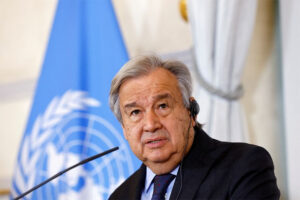
UN Secretary-General Antonio Guterres’ visit to Nepal, which was postponed due to Hamas’s attack on Israel, is going to take place on 29 October. It is relevant here that at the invitation of Prime Minister Pushpa Kamal Dahal.
During a cursory review of history, UN Secretary-General Ban Ki-moon visited Nepal in 2008 at the invitation of then prime minister Dahal, and the then Secretary-Generals Javier Perez de Cuellar, U Thant, and others also visited. Four General Secretary of the United Nations visited Nepal and after 1971 Dr. Kurt Waldheim and Javier Perez de Cuellar came to Nepal. U Thant, the only Asian Secretary-General for the United Nations, visited Nepal and on his initiative, the Lumbini Development Committee was formed in 1967.
Like the United Nations, Nepal also advocates and respects sovereignty, geographical integrity, political independence, and non-interference in the internal affairs of others. A staunch follower of the United Nations, non-alignment, BIMSTEC, BBIN, and SAARC, Nepal adheres to the policy of positive neutrality, regards the United Nations as the guardian of the freedom of small nations, and hopes to move forward with the same spirit.
Major agenda
The New York-based Nepali diplomat has announced that the main agenda of the visit is climate change and ways to minimize its impact on people’s lives. “He plans to deliver lectures on pressing issues including climate change and will interact with stakeholders.
Nepal reiterates that developing countries especially least developed countries have experienced a huge decline in the resources of United Nations operational activities for development. LDCs need more support from these agencies as most LDCs have noted far-reaching reforms. In the absence of foreign direct investment flows, now available in many developing countries, LDCs lack physical infrastructure and physical resources.
Landlocked
The situation is exacerbated in landlocked developing countries by the high costs of producing and transporting their exportable goods and the difficulty of maintaining the tight delivery schedules demanded by world markets.
Lacking direct access to the sea and a significant market base within their borders, these landlocked countries cannot offer any comparative advantage necessary to attract foreign direct investment.
In terms of additional financial resources and the transfer of appropriate technology, Nepal considers concrete measures to address built-in handicaps to be the minimum requirement.
The past seven decades have seen the United Nations strive to fulfill its charter objectives, peace, and prosperity – the highest aspirations of mankind. Conflict, extreme brutality, poverty, hunger, overpopulation, and environmental problems continue to grow.
Role of the League of Nations
The role of the United Nations is not only as a peacekeeper but also as a preventer of conflict further emphasized as the nations of the world turn to their organization to help them solve their problems and move them forward.
Biodiversity and Nepal
2 trillion ($200 billion) will be mobilized in the Biodiversity Fund. Such a decision was made at the recently concluded United Nations Convention on Biological Diversity conference in Montreal, Canada. By 2025, at least US$2 trillion will be mobilized annually in domestic and international biodiversity funding from both public and private sources. The conference organized by the United Nations, chaired by China, and organized by Canada has set 4 goals to achieve the Kunming-Montreal Global Biodiversity Framework (GBF) by 2030.
The goal of the conference was to adequately and gradually increase the level of financial resources in an effective, timely, and easily accessible manner from all sources including domestic, international, public, and private. For this, at least 200 billion US dollars will be mobilized annually by 2030.
Although the 15th Biodiversity Conference made a theoretical decision, it seems that it is not clear who will deposit the amount in the fund. While mobilizing funds in the fund, the internal investment of countries like Nepal is not enough, which has to suffer the loss of biodiversity due to climate risks.
Due to the risk of climate change, wildlife habitats are narrowed, eroded, and finally destroyed, there is a shortage of drinking water for wild animals when there is a problem due to forest fires, and wetlands are drying up and disappearing due to floods and landslides. The possibility of spreading diseases and epidemics has also increased.
It is expected that this visit will be fruitful to ask for more resources from the international community and development partners by showing the achievements that Nepal has achieved so far in biodiversity conservation.
At this time, Nepal’s main focus seems to be on financial support based on progress (performance-based financing). It is imperative to check pollution, threatened biodiversity, and deforestation in the Himalayas. The causes of environmental protection are overpopulation, deforestation, pollution, lack of awareness about the effects of environmental degradation, lack of effective nature conservation policies, and preventing the abuse of natural resources.
A cursory review of history shows that until a few years ago, forests were at the center of environmental discussions in Nepal. The government aggressively propagated the slogan ‘Green forest: Nepal’s wealth’. ‘Plant trees, save forests’ was written almost everywhere. However, in the last few years, climate change has changed that place.
According to the opinion of some experts, the main reason behind this is probably the wider impact of climate change, meaning that no aspect of Nepali human life has been untouched by climate change.
In this situation, the issue of climate change was not only positive but an absolute necessity. However, the problem arose when environmental issues other than climate were overshadowed.
The slogan ‘Green forest: Nepal’s wealth’ was real. Nepal’s wealth is its natural heritage, and its biological diversity Local communities in Nepal must be able to cope with the diverse impacts of climate change, from melting glaciers and the emergence of new diseases in the mountains to floods and high temperatures in the lowlands.
Overall, there is no doubt that today’s major issue in the Biodiversity COP (COP 15), as in the Climate COP (COP 27), was financial resource management.
Underdeveloped country: Nepal
The world’s least developed countries are in a race against time to meet the Sustainable Development Goals by 2030. Bold investments in health, education, and social security systems are needed – all the resources needed to fully implement Agenda 2030 and the Sustainable Development Goals will be available. The world today is facing a crisis of geopolitical divisions, inequality, and climate emergency.
Graduation from LDC status country by 2026
Nepal is currently preparing for an LDC upgrade by 2026. It can be a strange feeling to be recommended for strata without meeting our income criteria. Upgradation is a long-standing aspiration of Nepal. Therefore, national efforts are being made to ensure that it is smooth, sustainable, and irreversible. It is also necessary and imperative that Nepal calls for strong support from its development partners during the visit of the Secretary-General to complement Nepal’s national efforts.
Nepal after upgradation
Even beyond graduation, Nepal should invest more than double its GDP in various fields to compete in the world market. The government alone cannot raise the money needed to lay the groundwork for all regions to prepare for the shock of transitioning from LDC status. And on top of that, LDC graduation is not the end of the story.
With the Secretary General of the United Nations, there is a broad agenda of discussing climate change in Nepal, the peace process of Nepal, and the sustainable development goals of the United Nations.
Apart from climate change and the peace process, Nepal’s contribution to UN peacekeeping and the country’s involvement in other global issues are expected to be other possible agendas of his visit.
Rebuilding Trust and Rebuilding Global Unity:
Nepal is involved in the 2030 Sustainable Development Agenda and its Sustainable Development Goals (SDGs) “Accelerating Action for Peace, Prosperity, Progress, and Sustainability for All”. Reform of the United Nations Nepal agrees that the reform of the United Nations is a matter of interest to all member states and the purpose of the reform is to strengthen the role of the United Nations and enhance its efficiency.
In the post-Cold War era, the world situation continues to undergo profound changes, gradually evolving towards a multi-party world that reinforces the centrality of the UN Charter – peace and development in broad freedom. Therefore, the global cause is to make the United Nations a better equipped, institutionally and economically more vibrant world organization to face the challenges that will develop in this century.
It is true that the United Nations still has a long way to go on the road to reform, and the Third World should see the proposals as a good start. The United Nations is the only representative world forum to discuss and resolve issues of global concern. For the past 6 plus decades, Nepal’s role in various forums under the United Nations has helped to increase its identity and reputation around the world.
Nepal joined the United Nations on December 14, 1956. For the first time, Nepal participated in the United Nations Summit and International Conference on Human Environment held in Stockholm, Sweden.
Since then, Nepal has participated very actively in various United Nations summits and international conferences organized under the leadership of world bodies.
Graduation has positive and negative effects on the country’s economy. A comprehensive assessment of both positive and negative impacts should inform all stakeholders in the economy.
After about 55 years, Nepal is going to be upgraded from the list of least developed countries to developing countries. The 76th General Assembly of the United Nations approved the proposal to upgrade from the list of least developed countries to developing countries.
Since 1971, Nepal has been on the list of the least developed countries of the United Nations. According to a statement issued by the United Nations, Nepal, Bangladesh, and Laos are being upgraded to developing countries together. With this, all the countries of the Asian continent except Afghanistan will be upgraded to developing.
Nepal, Bangladesh, and Laos will have a 5-year preparation period to upgrade to developing countries, the statement said. The United Nations considers it eligible for upgrading if it meets two indicators of human assets, economic risk index and per capita income. Nepal was ready for upgradation in 2018 based on indices other than per capita income. However, Nepal sent a proposal for upgrading after 2022, which was accepted by the United Nations, showing the reasons for the earthquake and blockade.
Currently, the date of up-gradation is fixed in 2026. Nepal has not yet met the limit of per capita income. Nepal has a score of 71.2 in the human capital index, which should score more than 66 points. 28.4 should be less than 32 on the economic risk index. Per capita income is only 1 thousand 58 dollars instead of 1 thousand 222 US dollars. The private sector, Federation of Nepal Chamber of Commerce and Industry, Confederation of Nepal Industry and Nepal Chamber of Commerce, etc., have been protesting against the up-gradation citing reasons such as low per capita income, COVID-19 causing more risks to the economy, low export scores of Nepal and the reduction of various customs-free facilities for exports after the upgradation. However, since these facilities are very insignificant, the experts have been arguing that the upgrade will be a far-reaching benefit for the country. There is also an opinion that Nepal’s reputation among the international community will increase if the level is upgraded, and based on that, direct foreign investment and loans from the private sector can be brought from the world market.
Both the public and private sectors should be well aware of the stratification effects. More importantly, provincial and local governments should have adequate information and knowledge about the impact of LDC graduation and what the likely scenario might be in terms of the flow of official development assistance and other support from bilateral and multilateral agencies. After moving up from the list of least developed countries, Nepal will also move up from the list of low-income countries of the World Bank to the list of low-middle-income countries.
Nepal should send a positive message to the world that Nepal is not a poor country but a dynamic economy. Currently, due to its status as a least developed country, many concessions are available to Nepal in terms of business facilities, market access, concessional loans, and membership fees of various bodies. Being a least developed country, various countries and regions have provided customs and quota-free access to Nepal. But the picture of that facility usage looks different. Nepal is committed to sustainable development, and this commitment is reaffirmed in key policy documents such as the current 16th Development Plan and the 25-year long-term Vision 2100 that internalize the goals.
To sum up, the present visit of the Secretary–General will put the further impetus on strengthening Nepal -UN relations along with all the UN Agencies. Moreover, truth and reconciliation, climate change, and Nepal’s gradation from LDC by 2026, among others, should be on the agenda for discussion and action, rather than generally said about the UN that finally UN agencies often decide where to organize the next Summit.
So Nepal needs homework and leg work to convince the positive outcome of the Secretary-General’s visit as in 2008 Ban KI Moon and the present SG is also coming during the tenure of PM Dahal, he should be able to show his convincing power to do something fruitful for Nepal and the down-trodden people of Nepal along with the long-standing TRC issue.
The views expressed in this article are the author’s own and do not necessarily reflect People’s Review’s editorial stance.

Login to add a comment