








By Shashi P.B.B. Malla
Presidents, prime ministers, foreign ministers, finance ministers, and heads of international organizations, and their sherpas [principal assistants and facilitators] met for the annual leaders’ summit in India’s capital, New Delhi, from 9-10 September.
The main theme for the meeting was sustainable development, but the ongoing conflict in Ukraine was also discussed.
What is the G 20?
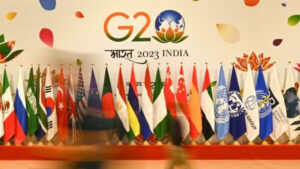
The G 20 – or Group of Twenty – is an association of countries that meets to discuss global economic and political issues.
Between them, G 20 countries account for 85 % percent of the world economic output and more than 75 % percent of world trade. Moreover, they contain two-thirds of global population (BBC, Sep. 9).
The G 20 members are 19 nations plus the European Union (EU): Argentina, Australia, Brazil, Canada, China, France, Germany, India, Indonesia, Italy, Japan, Mexico, Russia, Saudi Arabia, South Africa, South Korea, Turkey, the United Kingdom and the United States.
A smaller group of G 20 member countries meet as the G 7.
Why was the G 20 founded & Why does it matter?
The group was founded in 1999 after the Asian financial crisis. It was designed to be a forum for finance ministers and officials to discuss ways to restore economic stability.
The first leaders’ summit was held in 2008 in response to that year’s financial turmoil, to promote international cooperation.
The G-20 has broadened its focus in recent years to include issues such as climate change and sustainable energy.
Every year, a different G 20 member state takes over the presidency and sets the agenda for the leader’s summit.
What was this year’s G 20 Summit about & Who attended?
As 2023 president, India wanted the summit to focus on issues such as:
- sustainable development
- “striving for just and sustainable growth for all in the world”
- debt forgiveness for developing countries.
US President Joe Biden likely talked to leaders of developing nations about proposals to reform the World Bank, which could result in more money being available to them to spend of infrastructure, as well as measures to tackle climate change.
A lot of negotiations took place in one-on-one meetings between leaders on the sidelines of the main hall.
India’s Prime Minister Narendra Modi wanted the summit to promote his country as a major global power, and himself as an important world leader, ahead of a general election due in spring 2024.
Modi tried to make sure that the summit was not dominated by rows about the war in Ukraine, as happened at the 2022 summit in Bali, Indonesia.
Arguments about the conflict meant there was no joint statement at the end of the G 20 foreign ministers’ meeting held in New Delhi in March this year.
Russia’s President Vladimir Putin did not attend the summit. Instead, he sent his foreign minister, Sergei Lavrov.
China’s President Xi Jinping also stayed away. The Cinese premear, Li Qiang went in his place.
Other Difficult Issues
In May 2023, China and Saudi Arabia boycotted a G 20 meeting on tourism, which was held in Indian-administered Kashmir, because the Kashmir region contains territory claimed by Pakistan and China, as well as India.
A row had also recently broken out between India and China after Beijing released an official map that claims the north-eastern state of Arunachal Pradesh (which China calls ‘South Tibet’) and the Aksai Chin plateau in Ladakh as Chinese territory.
The US had asked China to set aside its tensions with India and play a “constructive role” at the summit.
What has the G 20 achieved?
At the 2008 and 2009 leaders’ summits, during the financial crisis, leaders agreed to a host of measures to rescue the global economic system.
However, subsequent summits have been less constructive, often because of tensions between rival world powers.
In any case, one-to-one meetings between leaders have often proved constructive.
Agreement on Declaration after Softening Ukraine Language
The Group of 20 leaders reached a consensus on a joint declaration, avoiding explicit condemnations of Russian aggression against Ukraine, but defying doubts about whether a document could be issued at all (Nikkei, Sep. 9).
- Urging adherence to the United Nations Charter, the statement says: “All states must refrain from the threat or use of force to seek territorial acquisition against the territorial integrity and sovereignty or political independence of any state. The use or threat of nuclear weapons is inadmissible.”
- Addressing the argument among some members that the G-20 should be primarily a forum for economic cooperation, the statement says “that while the G 20 is not the platform to resolve geopolitical and security issues, we acknowledge that these issues can have significant consequences for the global economy.”
- Saturday’s declaration highlights “the human suffering and negative added impacts of the war in Ukraine with regard to global food and energy security, supply chains, macro-financial stability, inflation and growth, which has complicated the policy environment for countries, especially developing and least developed
- It also calls for ensuring unimpeded delivery of grains, foodstuffs and fertilizer from both Russia and Ukraine – “necessary to meet the demand in developing and least developed countries, particularly in Africa.”
And the members called for avoiding attacks on infrastructure relevant to food and energy security.
- “We will unite in our endeavor to address the adverse impact of the war on the global economy and welcome all relevant and constructive initiatives that support a comprehensive, just,and durable peace in Ukraine,” the declaration reads.
- The African Union on Saturday was also accepted as a permanent G 20 member.
Throughout its year at the helm of the G 20, India had been unable to goad an agreement on the text about Ukraine – at all previous meetings joint statements had been blocked.
The leaders’ summit was seen as the last opportunity for New Delhi to bridge the gap – something Indonesia had managed to accomplish.
Ahead of India’s 2024 elections, Modi had invested considerable political capital in pursuing a successful summit, closely aligning himself with the event – exemplified by countless posters displayed around New Delhi featuring his visage.
Curiously, the Delhi Declaration does not include a direct mention of the “Global South”—a buzzword for Modi and India this year, which hosted a Voice of Global South summit in January.
The declaration does, however, include many passages defending the interests of developing countries.
India’s foreign minister, S. Jaishankar conceded that the Ukraine war was a polarizing issue, but insisted the declaration reflected the current geopolitical reality.
Critical Voices
The former President of the US Council on Foreign Relations (CFR), Richard Haass is of the opinion that in reality, the G 20 will have little if any impact on pressing world issues.
This is because the G 20 tends to disappoint. It is a gathering, not an institution. There tends to be little follow up. The large membership is increasingly divided on the most significant issues of the day, rotating leadership, and lack of permanent professional staff also explain why little tends to be accomplished.
Absence of Putin
Putin’s decision not to attend was long expected as he is very wary of leaving Russia given the international warrant on his head for war crimes.
He wants to avoid being the object of widespread criticism over his war in Ukraine.
He is concentrating on prevailing in the war and persevering at home.
Xi’s Non-Attendance
Xi’s eleventh-hour decision not to attend was more of a surprise given that he has joined the gathering every year during his decade in power.
He may be trying to convey irritation with India’s larger strategic tilt towards the West and/or frustration over border differences.
He may be hoping that his absence takes away from the luster of India’s big moment.
He may have also concluded that the time is not auspicious for a bilateral meeting with President Biden but would find it difficult to turn one down if they are both in the same room.
But the more interesting possibility is that he wanted to remain at home to deal with China’s growing economic problems and the potential they will pose political problems for him.
The New York Times’ chief China correspondent summed up the situation up this way: “Consumers are gloomy. Private investment is sluggish. A big property firm is near collapse. Local governments face crippling debt. Youth unemployment has continued to rise. The economic setbacks are eroding Mr. Xi’s image of imperious command, and emerging as perhaps the most sustained and thorny challenge to his agenda in over a decade of power.”
India: A Great Power?
Modi’s message at the G-20 was clear: India is becoming a great power under his guidance and leadership and will usher in an era of global peace and prosperity.
However, many beg to differ. Sushant Singh, a lecturer at Yale University, makes the case in Foreign Affairs that because of serious domestic constraints, Modi cannot make India a great power (Sep. 4). Government-backed intolerance is tearing the country apart.
1,000 miles away from New Delhi, in the north-eastern state of Manipur, India is caught in a conflict that suggests it is in no
The state’s ethnic violence has forced the Indian government to deploy thousands of troops inside Manipur, reducing the country’s capacity to protect its borders from an increasingly assertive China.
Moreover, the ongoing violence could give other Indian separatist and ethnic partisan groups an opening to challenge New Delhi’s primacy.
India is one of the most diverse countries in the world. It cannot function if these varied populations are in intense conflict.
Modi and his political party the Bharatiya Janata Party (BJP) and its parent organization, the Rashtriya Swayamsevak Sangh (RSS) have been promoting Hindu nationalism and majoritarianism non stop.
Non-Hindu people are, at best, second-class citizens. Modi’s and the BJP’s exclusionary agenda is alienating hundreds of millions of Indians who do not belong to the country’s Hindu majority. The BJP has a track record of prompting violence and unrest.
With such a domestic track record, how can Modi’s India aspire to be a leader of the ‘Global South’? Its so-called non-aligned policy is a sham; in fact, it is ‘hedging’ and transactional in pursuit of its own interests. For its own reasons, the West is wholeheartedly supporting India and turning a blind eye to its domestic misdeeds.
In the long run, Modi’s project will undoubtedly take a toll on the authority and credibility of the Indian state. The glory of the G 20 presidency will turn out to be ephemeral and a distant memory.
The writer can be reached at: shashipbmalla@hotmail.com
The views expressed in this article are the author’s own and do not necessarily reflect People’s Review’s editorial stance.

Login to add a comment