








By Narayan Prasad Mishra
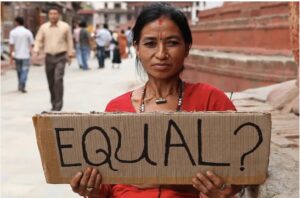
Nepal is a patriarchal country. According to our culture and traditions, men are considered superior to women. Traditionally, Nepalese women are not equal to men — culturally and legally. The laws of our country were and are based on the superiority of men, not the equality of men and women. But our country worked a lot for the welfare of its women and to give them equal legal rights when it celebrated International Women’s Year, 1975, with a variety of development programs for the upliftment of women in the country, according to the United Nations General Assembly’s address to all the member countries of the world. My beloved late wife, Shanti Mishra, was the Member-Secretary of the International Women’s Year Committee Nepal, 1975, under the patronage of Her Majesty Queen Aishwarya Rajya Laxmi Devi Shah. She put her soul and brain into the cause of Nepalese women the whole year and achieved a lot. The details of her annual report about the achievements of this year for women are given in her book “Voice of Truth: the Challenges and Struggles of a Nepalese Woman”. p. 426-439. I vividly remember the promulgation of the sixth amendment of the National Law (Muluki Ain) at that time for the cause of women, including giving property rights and making the daughter the heir apparent of the property in case of no son, at the request of that committee under its program. That rule was not in our law. The married daughter was not supposed to get the parent’s property after the parent’s death, even if the parents had no son. According to the then law, the property used to go to the parent’s brothers and nephews. That was a landmark in the history of legal amendments for the cause of women in our country. People hardly remember who did what – good or bad, in this country, the country cursed by Sati (a widow sacrificing herself by sitting atop her deceased husband’s funeral pyre) – may no patriot have a peaceful ending in this land.

Late Shanti Mishra, the Member Secretary of International Women’s Year Committee, 1975 Nepal
Though less or much has been done for the cause of women and to make them legally equal to men, our culture and traditions of treating women are almost the same in the country. We all know that girls are discriminated against for their benefits in our family and society, and boys are prioritized in everything – food and clothing, health, education, entertainment, enjoyment, etc. This is done by the father and even the mother, a woman. Suppose someone has two kids — one son and one daughter and has some limitations in meeting their needs for education, health, or clothing. In that case, they meet the son’s requirement, not the daughter’s, or not make them share equal availability. We still witness this culture in practice.
People consider boys their future bread earners, old age caretakers, and protectors, but not girls. The most disappointing and disturbing fact for me is that in this culture, parents consider boys are not supposed to do any household work – sweeping, cleaning, cooking, serving, dishwashing, etc. They do not want their sons to do this work. The boys have been spoiled in this matter since childhood. Only the girls are taught and trained for this work, and they are the ones who are to do this work even if boys and girls are both students and need equal time to study. Parents do not permit their sons to do the household work – cooking, dishwashing, cloth washing, etc.— even if some boys, with their inner conscience, come forward to do these things and help their mothers or sisters. That is what I experienced in my family and in other families. I remember telling my mother I wanted to help her with dishes as a child. She did not want me to help or permit me to do it. When people grow up with this culture, knowingly or unknowingly, they naturally get influenced by it unless they use their conscience.
Because of this culture of discrimination between boys and girls in our family, our society is mainly based on this and has developed this way. Automatically, most men think they are superior to women and are not supposed to do household work. And these cultured men think they have every right to be prioritized over women in everything — eating, clothing, sitting, resting, sleeping, chatting, playing, walking, and roaming. They cannot see women’s eligibility and superiority, even if they are highly qualified and efficient compared to themselves. They do not realize women have a hard life with overloaded work. They think women must be inferior due to their caste.
We see primarily in villages that men play cards, chat, and gossip. On the other hand, women hardly get time to rest – taking care of the kitchen, house, field, children, cattle, etc. When you are influenced by this type of culture, you cannot see the truth and reality. Under this culture, even the most wooden-headed, naive, innocent, and uneducated men think they are superior to their educated and talented wives.
With this rooted tradition of considering women’s inferiority, women are exploited and discriminated against everywhere – in marriage with a dowry, selection for a job, evaluation for a promotion, nomination, and participation in decision-making positions. In addition, the treatment of widows and women with Chhaupadi (The system under which menstruating women need to live out of the house in a shed-like dwelling.) is another painful aspect of our society. This is another painful chapter related to women’s suffering.
In our traditional style of life and living, men worked out of the house – offices, fields, factories, and businesses. Most women worked at home, doing everything from taking care of children to taking care of the kitchen. Some men were educated, and most women were uneducated. The education of girls was discouraged. The education of boys was encouraged. The division of work between men and women was not unreasonable then. But for the last few decades, this system has changed. Now we also give education to girls. Now we have many highly educated and career-minded women in the country. They are in every field — administration, teaching, medical services, engineering, agriculture, etc. Women have proven in work and field that they are not less qualified, talented, and efficient than men in any field, even in the army, police, or aeronautical services.
Career women work equally with men out of the house when they are in jobs – offices, factories, industries, businesses, etc. I had seen closely how qualified, talented, and active career women work in the office much better than most men, seeing the performance of my late wife, Shanti Mishra, the Founding Chief of Tribhuvan University Central Library. At the same time, she was a praiseworthy house manager and an ideal wife. I always thought people could hardly have such an ideal wife with all the qualities one could expect. I am glad that I was her choice. I am also glad that I could carry out my duties as her ideal husband, supporting her professionally and at home, helping her with every house chore to the complete satisfaction of her expectations, and even more. I was her model.
Even now, many educated men want to enjoy life, considering women as inferior and exploiting them traditionally, not realizing the necessity and importance of an equal partnership to run the family. Very often, they forget three essential qualities of married life – love, trust, and understanding and cooperate by any means without any complex of superiority or inferiority between them in speaking, understanding, working, walking, socializing, etc. They expect all the household work from even career women considering that it is their duty, and they do not realize women’s pain and suffering with the unbearable workload — work in the office and at home. They forget even the meaning and feeling of love towards their wife and become self-centered, forgetting the kindness and compassion of human nature.
This attitude I have seen, even with the Nepalese men who were and are in jobs in Europe and America, who adopted many of the European and American cultures but did not change the culture of looking at women as inferior and figures of exploitation. Sometimes I see our men in these countries following European culture in showing love to their girlfriends or wives openly by hugging, kissing, holding hands, and putting the chin above the wives’ heads in public in front of parents or parents-in-law, which we think is shameless. At the same time, the same people are not helping the wives with household work in a European way. They hesitate to display their love this way. They do not apply or practice their European or American culture to help the wives. More than that, in most cases, the men’s parents and family think they have upper status over the women’s families and expect more respect and honor, more gifts, and more politeness, not realizing such a system cannot work in the modern-day of equality between men and women.
Because of this, sometimes we see a big clash between husband and wife, ending the relationship with separation. If we analyze these things correctly and want to reform the weakness, we must change our bad culture of treating boys as superior and girls as inferior. We must change our attitude to prioritize the boys in everything, learn to treat them equally and make them work equally in household work or other work since childhood. Only then we can create healthy families and society in the modern day with a modern system of men and women working equally with equal education and efficiency. We must realize that living with old traditions and exploiting women traditionally will not work now if you want a happy family life. We must understand that now, women are not bound to tolerate injustices – scolding, insulting, demonizing, dishonouring, taunting, spitting on the face, pulling the hair, throwing out alcohol on the face or head, throwing out of the room, torturing for getting money or other property from the women’s parents, isolating, beating, burning, done to them as before when they were weak educationally, socially, or economically. Now we have women who are strong enough to defend themselves.
At the same time, our society should learn and adopt a new culture of treating daughters-in-law as daughters, not exploiting them as other’s daughters. Similarly, we should learn and adopt a new culture of loving sons-in-law as sons with words and loving behaving, not by just talking and respecting as if they are King of Kings, supreme beings by just being the designation of son-in-law but unloved by heart. Remember that your son-in-law, just like your daughter-in-law, will always be your son and daughter’s age, not your parents’ age, who should receive utmost respect for their seniority. We must change the culture, which is not suitable for us.
The views expressed in this article are the author’s own and do not necessarily reflect People’s Review’s editorial stance.

Login to add a comment