








By Narayan Prasad Mishra
Shanti Mishra, my late beloved wife, was the first full-time lady professor at Tribhuvan University when that University was run at Tripureswar, where we now see the building called Trade Centre. She was a history professor. I remember her tale that she had some M. A. history students in her class who were her teachers when she was in school. When the university opened, they came to do M.A. in their old age. Initially, she felt somewhat awkward, shy, and uneasy about teaching her teachers. That was her unforgettable experience.
She became Chief Librarian after doing M.A. in library science from the United States of America, and she left a professorship’s highly recognized teaching position to create the Tribhuvan University Central Library worthy of its name. That was a revolutionary step for her to enter a library job and be a librarian at that time, the unrecognized profession and the position in the country even now. She devoted herself to the library profession as an ascetic. I supported her to the extent of my knowledge and caliber, knowing no bounds. She brought an unimaginable change in the library’s image from a storehouse of books to a disseminating center of knowledge in the country. But we know that even now, most of our people who hold high positions in developing countries do not seem to think libraries are essential like any other food and drink, as people in developed countries think. For them, it is good to have libraries but not essential. So we still need to do much to make people aware of the importance and essentiality of libraries in education and research in our country.
According to Sidney Sheldon (1917-2007) American writer and producer, “Libraries store the energy that fuels the imagination. They open up windows to the world and inspire us to explore and achieve, and contribute to improving our quality of life”. He is so right in his saying. Libraries acquaint you with the knowledge of the world, the genius of the world, and provide you with the knowledge you need to achieve your goal.
We all should know that a collection of books or other digital materials cannot be called a library. We know the collection of books we see in the bookshop is not a library. Just storing books and simply checking books in and out can also not be called a good library. The systematic arrangement of the vast number of knowledge materials – printed or digital, and scientific disseminating services to all those knowledge seekers without delay – makes them worthy of being called a good library. The present librarians are more high-tech information professionals than book-worm library professionals, and they are smart helping hands and guides to solve the problems of library readers and users. I am always happy to remember the following saying of R. Davis Lankes, Professor and Director of the School of Library and Information Science at the University of South Carolina and the recipient of the American Library Association’s 2016 Ken Haycock Award for Promoting Librarianship.
“Bad libraries build collections; good libraries build services; great libraries build communities.”
Among the ten biggest libraries in the world, I had an opportunity to visit the following libraries with my wife, Shanti Mishra: 1. British Library, 2. Library of Congress, 3.New York Public Library, 4. National Libraries of China, 5. University of California Libraries, and 6. Bibliotheca Nationals as the concerned countries’ state guests. People in our country may be surprised when we say the Library of Congress contains approximately 173 million items and has more than 3,000 employees. Working in the library was Shanti Mishra’s life, and visiting the world’s great libraries was her joy; she visited the National Library of Russia in my absence as a guest of that country. I vividly remember all these things. In every step and every moment of my life, I miss her and feel like an orphan without her. I know there is no other way except to lament. This is the most challenging part and time of our lives. Sooner or later, all people have to face loss.
Most libraries hold books, journals, or other information and knowledge materials inside the buildings. The libraries like those mentioned above have huge buildings with millions of knowledge materials, various types of disseminating services, and reading rooms. Quite different from those libraries, I want to discuss some of the world’s most unusual ones. They are not inside the big buildings. Instead of hoping for readers inside the buildings, these libraries go to the communities to inspire them to read.
They are:
- Lire a la Plage ( France )
This library is known as Lire a la Plage (Reading at the Beach) in France. Under this program, they take books to over a dozen of Normandy’s coastal resorts every summer. People can read books on the colorful beach huts, umbrellas, and deck chairs, but they are not allowed to take books away from the Beach. This program has been running in France since 2005. It is known that similar programs are run on Australia’s Coogee Beach and Bulgaria’s Black Sea Coast.
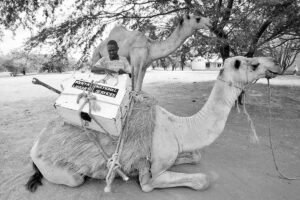
- Camel Library (Kenya)
There is a lack of literacy rates and access to reading materials in the town of Garissa, Kenya. So the Kenya National Library provides library services by creating a Camel Library, as camels are nicknamed ships of the desert in rural northeast Kenya. They send hundreds of books, a tent, and reading mats to the areas of nomadic communities.
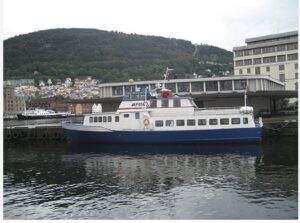
- Epos, a Ship Library (Norway)
In Norway, there are some isolated villages that people can reach more easily by boat than by road. So this country provides library services through a library ship called Epos to 250 villages. It is known that similar services are provided in China and Laos.
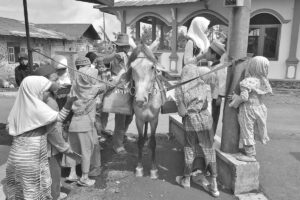
Biblioburro (Colombia)
In Columbia, Luis Soriano, a teacher from the rural northern Colombia town of La Gloria, provides library service through two donkeys. He called it Biblioburro, and he has been taking the books to elementary schools and creating reading habits in the community.
- Logos Hope, a Floating Library (Germany)
It is said that this is the largest floating library in the world. The vessel belongs to GBA Ships, a charity organization based in Germany. (BA means “Gute Bücher für Alle” – Good Books for All). The ship travels worldwide to encourage people to read, increase their knowledge, and foster cultural exchange.
We see many other types of libraries in different parts of the world that give importance to the power of books. We need knowledge to do small or big things. So it is said that imparting knowledge is the greatest gift anyone can receive. Imparting knowledge is the most essential work in nation-building. That is why countries that want development emphasize the development of libraries worldwide. They have huge libraries with millions of knowledge materials scattered throughout the country in villages, cities, offices, industries, and factories. In addition, they provide mobile library services through different mediums – vehicles, ships, boats, trams, and horse-drawn carriages to places without library access. Many mobile libraries and library services are provided by big trucks and boats moving around in the USA and many other countries. The purpose of this is to spread knowledge and make citizens educated and knowledgeable.
We know we need not only one but many modern libraries to meet the library services of our people. We have not been fortunate and have not been able to have even a single well-organized, well-planned public library in the country. Not having a central organized library in the country, there is no sense of thinking about the small or big mobile libraries mentioned above because mobile libraries are libraries that go to places where the established central library services cannot reach the community. Thus first, the concerned ministries, offices, and municipalities must think about establishing well-planned, well-organized, well-equipped libraries with well-chosen reading materials useful for the readers soon. In this context, I want to draw the attention of our very dynamic, active, innovative Mayor of Kathmandu Municipality, Balen Shah, to my previous article “The Necessity of Kathmandu Municipality Public Library and Balen Shah”, published in People’s Review on June 7, 2023, and do the needful. This is the demand of the time and the demand of the country. We must know that without this, we will be behind others without competitive knowledge in the modern world.

Login to add a comment