








By Meera Rajbhandari Amatya
After finishing the work of harvesting Mohi (tenant) on our ancestorial land in Tathali, Bhaktapur, I decided to build a house on that land. The paddy obtained from that land, which was passed down to our ancestors’ grandchildren by our ancestors, used to be fifteen muri (100 Kg). From time to time, Mohi (tenant) used to give seasonal vegetables and some wheat as Kosheli (gift).
Although the area of that land was enough to grow rice and dal (lentils) for our family of four, we were forced to sell that land due to the farmers’ desire not to cultivate, after getting Mohiyani (tenant’s rights). I did not want to sell. While all the family members were making plans to build a house, our mother was adamant that no house should be built there. “Do you know that there is a flood that drowns people, so-and-so year the crops were not given due to the flood?”, etc., etc. In the end, as my mother said, our house was not built on that land. It’s okay if it’s not made. The land on the bank of the Hanumante River was at the proper level. As in previous years, the water level of the Hanumante River has increased, and hundreds of houses have been submerged due to floods. Due to the increase in population in the valley, and the population outside Kathmandu also thronged, which matches the saying of the river will return in 12 years, the concrete jungles were gradually settled on the fertile lands of the valley.
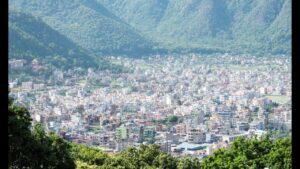
Uncontrolled, unplanned settlements in Kathmandu Valley destroying cultural heritage
As in the previous years, this year too, due to the increased water pressure in the rivers and streams of Khore (Hamunate Stream) Bhaktapur (Khwapah), Balkhu Khola (stream), Bagmati, Bishnumati flooded, the wealth of millions and the lives of all ordinary people were at risk. Due to unorganized cities and physical structures that were settled without studying the geography of the Kathmandu Valley, the problems faced by the Raithanes (indigenous Newah: people) and the effects on the assets connected with the precious culture are increasing among the Raithanes. Moreover, not built according to Vaastu Shastra (the science of architecture), due to the expansion of roads, when the displaced people build houses on cultivable land, the so-called Raithanes or the stakeholders have not even thought about researching and studying the environmental risks that may be caused by the smart city and fast track plans. The culture of Kathmandu affects the social harmony and tourism enhancement of the whole of Nepal and has not been understood either by the state visionaries or at the policy level. Rivers are the basis of every civilization. Kathmandu civilization is the result of the Bagmati and Bishnumati rivers. The notion that Kathmandu culture is the culture of Nepal is still believed. The policymakers of the capital city are far from understanding that the natural environment related to the local climate, water, land and forest, cultural life, the basic pillars of human development, and the environment are constantly working in a complementary manner to each other. In addition, there is no debate at the policy level from the past to the present on the question of what effect the physical development has had or is still having on the cultural and economic development of Kathmandu while destroying the culture and natural environment.
There is no foresight on the part of the state, nor has it become a matter of discussion at the policy level, as to how much Kathmandu’s culture has contributed to Nepal’s social harmony and tourism promotion. The river is the mother of every civilization. The civilization of Kathmandu is the product of rivers such as Bagmati and Bishnumati. The social and cultural relationship of the common people here is connected with the rivers here. There is still no understanding and feeling that the civilization of Kathmandu is the civilization of Nepal, where rituals from birth to death are connected. The country is currently becoming a new Nepal with social transformation. But during that time, neither the debate on the subject matter of social harmony and the issues of co-existence, which sustain the peace process, nor the awareness of the stakeholders. Sanskar and culture are also advocates of social harmony and peace; how much is this understanding? In fact, the Kathmandu rivers, where there are cultural activities related to all castes and cultures in one place, are now being encroached upon. Sometimes in the name of road construction and sometimes in the name of Sukumbasi (squatters), the rivers of Kathmandu are being encroached daily and are in the process of being encroached. But there is nobody to manage it and give alternatives. Nor has there been a debate on this matter. What is even more surprising is that there is no subject matter in the syllabus for the environment of the capital Kathmandu, even for geographical studies at the university level.
The cultural activities from birth to death that took place on the banks of Bagmati, Bishnumati, Rudramati etc. in the past have now been affected. The population of Kathmandu, which is increasing day by day, has also increased the cultural activities of the people. Religion and cultural heritage are connected with the human spirit. In Kathmandu, the Gaura Parva, Chhath Parva, and other festivals celebrated in all seven provinces of the country, are now being celebrated. It can be understood, Kathmandu is an open university for culture. In Kathmandu, where every community of Nepal has lived since the past, all classes are free to practice their culture. Currently, due to the increased population pressure in Kathmandu and its cultural practices, there is no water in the rivers of Kathmandu and their encroachment. In terms of the environment, the river also affects the local physical and natural environment. Despite the weaknesses and short-sighted decisions of the state in the past, it is necessary to make necessary policies to protect and develop the river heritage to preserve the cultural heritage and culture of Kathmandu. Considering the environmental rights as per the constitution, it has been too late to stop encroachment on the river here and to search for alternatives to protect the culture of Kathmandu.
The geography of Kathmandu Valley and the culture and heritage associated with it:
The civilization of the Kathmandu Valley, which remained after the Mahabharata Mountain range was cut through the Chobhar Gorge, and the water was drained out of the Kathmandu Valley, has been, is and is being transformed into an open universe for the intellectual market of world culture. There are a lot of foreign tourists and students who come for more information and study about the religion, culture, tradition, and lifestyle of Kathmandu Valley. Along with the tourism business connected with the Himalayan Mountain environment of Nepal, the Kathmandu Valley is the main entry point, so the culture and anthropology of the Kathmandu Valley are intertwined with the civilization and many subjects are of interest to foreign tourists. Indra Jatra, the main Jatra festival of Kathmandu district, Machindra Nath’s Jatra (Bunga: Dyo: Jatra – Bhoto Jatra) festival of Lalitpur, Visket Jatra of Bhaktapur and the lifestyle of people associated with them are now becoming a selling subject in the world tourism market. Every day at four O’clock in the day at the Kumari house located in Basantpur, the influx of foreign tourists visit the Kumari in the form of a living goddess proves the attraction of visiting the Kathmandu Valley. In addition, Nepal also has a fertile environment for scholarly research on the religion and culture of the Kathmandu Valley.
There are many studies and research about the original religious culture of Kathmandu from America and other countries. In the ancient city of Sankhu, Linda and Jessica came to learn about the arduous fasting of Sri Madhav Narayan or Sri Swasthani, which lasts for a month from Paush Shukla (January Full moon Day) to Magha Shukla. Jessica Vantine Virkenholz, who studied the subject of fasting from the Paush Shukla Purnima every year to the Magh Shukla Purnima, prepared a book, “Swasthani The Politics of Gender, Location, Economy and Identity in Hindu Nepal” from the University of Chicago in 2010. In the conclusion of that question, she wrote that Swasthani is the original goddess of Nepal, even Nepal Valley – Kathmandu, Nepal is a rich country for Nepal Dharma: (Newa: religion) – exclamation by Prakash Man Sakwa: the expert of Newah: religion and culture from Sankhu Origin) Sanatan and Sanatan Hindu religion and culture, but why no one has asked about Swasthani yet? It is written in that question, Brat Pooja (Fasting) of Swasthani is not done anywhere in India.
In fact, the Brata Puja (Fasting) story of Swasthani is as original as Bhairava and Lakhe, the deity worshipped in Nepal. But the irony is that every year our Swasthani books are printed in India. Even our intellectuals, who are not tired of shouting slogans of nationalism, are not even thinking of publishing their original religious and cultural texts from their own country. Unfortunately, young people like Bashabh Juju Rajopadhyay, the son of celebrities like Achutananda Rajopadhyay, who spent years collecting Tad Patra, Thyasfu (Handwritten loose leaf book), and prepared the original Brat Katha book of their own country, were forced to flee to America. Rajopadhyay’s son, who did not run away, continues to practice the Newah: civilization and culture in a foreign land and keeps his country, language, and culture alive. The residents of Nepal are saddened by the current deteriorating situation in Kathmandu. Now in Nepal, we are proud to consider all our cultures including Swasthani as superstitions. We cut a cake on our birthday but we forget the practice of worshipping with Sagun according to the Newah: tradition. After eight months of pregnancy, we have a baby shower. But we forget the tradition of eating curd with beaten or parched rice along one hundred and eight Yomari (Newah food). And you forget the “Dar” of Teej having the snacks of curd, banana and Peda(sweet prepared with milk) and dancing to English and Hindi nasty songs along with alcohol in restaurants.
After entering Kathmandu, even the non-Kathmandu people are forgetting their culture and their original culture is also disappearing. Keeping in mind the geographical situation of Kathmandu, not only the shape of the ancient buildings have changed, but the stories and cultures associated with them are also changing gradually. In recent days, Kathmandu is becoming a place to practice the original cultures of all the seven provinces of Nepal. If the rivers and ponds that are intertwined with the original geographical form of Kathmandu, open squares and farm fields can be restored and brought back to their old form by regulating new policies and procedures, the original religious cultures of all the provinces in Kathmandu can practice traditional cultures such as Teej, Chhath, Gaura Parwa, Udhauli Ubhauli , it will be easy. Of course, rivers and ponds are the basis of every festival culture and should not be forgotten.
The influence of the river and its encroachment on the culture of Kathmandu
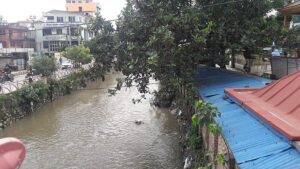
Illegally encroached Bagmati River in the Valley
Bagmati and Bishnumati are considered to be the mother of Kathmandu’s civilization, along with the main rivers and their tributaries. As a whole, the civilization of Kathmandu is known as the Bagmati civilization in the world. The source or origin of the Bagmati River is Shivpuri and the origin of Vishnamati is also Shivpuri. Other rivers and streams flowing in Kathmandu include Dhobi Khola (Rudramati), Tukucha (Ichchumati), Balkhu Khola, etc. And these rivers and streams are directly related to the culture of Kathmandu including the Newah Civilization. The big temples on the banks of rivers such as Bagmati and Vishnumati are associated with Sanatan Newah: Religion and Sanatan Hindu shrines or shrines. There is a huge historic and ancient temple of Gokarneswar Mahadev on the banks of the Bagmati, flowing from the Sundari Jal. Where on the day of Kushe Aunshi(No moon day), there is a pious place to perform Shraddha (a ritual performed after the death of the father yearly) and other rituals for children who lost their father. Guhyashwari Surya Ghat, Pashupati Arya Ghat, Koteshwar Mahadev, Sankhamul, Kalmochan Ghat, Tripureshwar Mahadev, Pachali Bhairav (built by Raja Gunakam Devda, who founded the city of Kathmandu and also mentioned in the history of Indra Jatra), Teku Dobhan and Sundari Ghat and finally Chobhar. There are holy temples like Jalvinayak and ghats of religious and cultural importance.
Similarly, there are ancient temples such as Kankeshwari Mai on the banks of Bishnumati. The rites and rituals of the Raithanes the Newah: Civilization of Kathmandu from birth to death are and were directly related to these temples and the ghats connected to them. In the Newah: civilization, after the birth of a child, the child’s birth certificate (Pee) is kept in a Vyaga: and presented to the Deity Kanga Ajima, which in Nepal Bhasa language is called Chhwasa. There, Ajima (including Kang Ajima, Lutimaru Rijima), meaning the goddess who protects human children, was informed that she/he was a newly comer member in the family when babies were born at home. It is customary to conclude the Vratbandh(threading ceremony) of the son and the marriage of the daughter after the Vanjala (special worship) in the mandir such as Machali Mai, Vijeshwari, etc. There is a tradition of washing the shaved hair in one of these rivers by the eldest paternal aunt (Nini) of the boy. There is a tradition to worship Surya Darshan Pooja (worship to the Sun) on a river edge when a daughter’s Barha: is kept for 12 days (traditional rituals to stay rest for 12 days before or after first menstruations of a Newah: girl), it is worshipped. Sunita Shakya who is now staying in the United States after her marriage remembers her Barha: pooja for Surya Darshan, she had the Pooja at the river edge of Shankhamul Ghat of Bagamati River. Similarly, the last rites performed after a person’s death are Dah Sanskar Nhenuma (a special ritual in which a daughter cooks rice on the seventh day of death), Vyanke (being fresh by cutting the hair, nail and bath), Pakha: Jaah:, which is performed on the tenth and eleventh day, was and still is a tradition in the ghats of the temple located in the same river.
Under the caste division of Kathmandu, every community had its own traditional lamp (Masan or Deep). Rather than caste discrimination, it can be said that these ghats have been segregated inspired by the philosophy that there should be queues and no crowding even at the last event. “Deep” like Karveer Deep, Tankeshwar Deep, Maitidevi Deep, Kanga Deep or Kankeswari Deep of Kathmandu are examples of this. In the past, across the Kankeshwari temple in Kathmandu, there was a suspension bridge on both sides of the Masan Ghat or Deep. But during the past forty years, the banks of the Bishnumati River were not only washed away under any pretext but after the Nepalese government built a road on the banks of these rivers, the ancient shrines and temples in those areas have been overshadowed and the cultures and customs of Raithane residents, especially the Newah Civilization, have been overshadowed even more.
Sunita Shakya of Mangal Bazar remembers being taken to Sankhamul for sun worship after taking her out and says, “Our mandatory ritual was to go to Bagmati, to worship the sun and bathe there. At that time, the urbanization of Kathmandu was increasing, but the water was not dirty. I bathed with the same water; I want to cry when I see the current condition. Sunita, who has been living in Ohio for the past seven years, believes that due to the wrong policy of the Nepalese government and the wrong notion of the leaders, concretization has increased on the riverbanks and valleys of Bagmati in Kathmandu. Vijay Raj Rajopadhyay has a similar complaint. The local Vijay Rajopadhyay says that there is a special place for the Rajopadhyays of Yale (Lalitpur) at the Sankhamul Ghat for the Shravani ritual to be performed every month of Shravan. Now the government of Nepal has demolished that board. Rajopadhyay says that the parks built at Sankhamul Ghat including Union Park are not only the originality of the ghat but because the Bagmati River is too narrow, there is a danger that the historical temples and heritages in the ancient Sankhamul Ghat will be destroyed one day due to a big flood.
There is a similar story of Satya Naran Dangol, a resident of Kathmandu. Satyanaran has a fresh memory of washing his face in the river Bishnumati on the bank of the Kankeshwari temple along with his grandfather located on the bank of Bishnumati and visiting the temple as soon as his eyes open in the morning. He remembers well, there were many prime lands across the river that he owned. But now they have to buy everything. But Naran Dangol could not eat vegetables according to the season and fruits like Halwa Bet, and Bhogte Aalu Bakhras. Now he has turned into a vegetable buyer. He could not see where time had taken him. Kathmandu has suffered similar stories of millions like Satyanaran Dangol. Again, the culture and civilization of Kathmandu have been preserved by the Raithane Newah: since the beginning of time. These are the cultural practices of Newah: a civilization that is worth being surprised and proud of. Every Jatra festival in Kathmandu, whether it is a Hindu (?) or Buddhist festival, to bathe the gods and goddesses in the Jatra festival, to hold Jamra during Dashain, to worship Jamra, to worship idols and worship materials of the Jatra festival (Gathamuh), to take bath during fasts and pujas, Sankhu Shalinadi River, Bagmati and other rivers have a tradition of compulsory bathing. The use of these rivers remains compulsory.
Impact of Encroachment on Kathmandu’s natural environment and River
From the bank of Bagmati behind the Pachli Bhairav temple in Kathmandu to the east and west, from the Pachli temple to the west and east, from below the current Thapathali bridge to the east, the concrete houses and mud huts of the so-called squatters have been encroached by thick settlements. It is not that the home administration is not aware of those squatter settlements built by mixing the important ghats of the ancient historical Bagmati. From time to time, the political leaders did take an interest in the encroachment. But from time to time, accusations have been made that the squatter settlements have been kept under special protection to help in various levels of political agitation in Kathmandu. Moreover, the Kathmandu Metropolitan City has encroached on the land of the ghat under the pretext of a dumping site for garbage and as a playground for Vishwa Niketan School. It is necessary to find out how many agencies have encroached on Bagmati banks.
In this way, the Bagmati and Bishnumati rivers, which have been associated with the civilization of Kathmandu, are continuously encroached upon, and the reason why there was no local government for twenty years in the past and the reason why the country was stuck in the quagmire of Maoist conflict for ten years is considered by the local residents to be the main factor. Although some locals protested against this, they said that they could not speak because of the fear of the administration. In the past, the population of Kathmandu was kept in the middle, and for the last work, the workers were forced to work. Which is confirmed by the Brahmanals that were built later. In which people who have reached the last hour of life are bathed up to their knees to make it easier for them to die. It can be assumed that it was established to make it easier to bury the dead in times of epidemics, which took place in various periods in the Kathmandu Valley in the past, due to the presence of Brahmanal in the Ghats. But it can be seen that some of the Brahmanals within the Sukumwasi settlement have vanished and few still exist. Why the administration is still silent even when the Bagmati bank, which is the main shrine of Kathmandu, is being encroached upon, is a matter to be considered.
Conclusion
Policies and programs designed to protect the natural environment of every capital city and make the local air and water healthy are the first and priority policy actions of the state. Cities and civilizations are not only concrete physical structures and populations, but also inside and outside the city Riverside Ghats, Ponds and open spaces and squares and monasteries with which the local land, forest, life, water resources and cultures are connected. Even though the Kathmandu Valley has been encroached on and disorganized due to such distortions and anomalies in the recent past, the government of Nepal must make policies and implement those policies to protect the life of the federal capital Kathmandu and the natural and cultural environment associated with it. At the same time, the relevant bodies related to the policies and programs made for the development of Kathmandu in the past corrected the misconceptions that could not include the common people who are directly related to the local land environment and the culture and religion associated with it, for the development of policies including renaissance necessary for the development of Kathmandu in the present day. The current demand is to start a campaign to restore a beautiful and green Kathmandu by including the advice, knowledge, skills, and experience of the community.
The writer is a student of PhD in Environment and Media. She can be reached at: amatyameera@gmail.com

Login to add a comment