








By Deepak Joshi Pokhrel
Just two months ago, the world witnessed major developments with respect to technology and artificial intelligence. It is said that the first half of March 2023 marked the beginning of a new beginning. We thus can conclude that the era of artificial intelligence has truly begun. Within two weeks, the world witnessed the launch of GPT-4, Bard, Claude, Midjourney V5, Security Copilot and other AI tools. All these have raised the eyebrows of people across the globe compelling them to think what will be its benefit and its repercussions at the same time.
There are several ways in which AI tools can aid democracy. However, the most notable one is that it could plausibly educate citizens, help them deliberate together, summarize what they think, and find possible common ground. Our politicians might use large language models, or LLMs, like GPT4 to better understand what their citizens want.
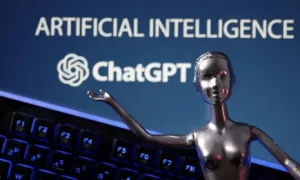
Ever since we restored democracy, poor governance which often gives rise to high-voltage corruption, has remained our hallmark. Poor governance has laid the ground upon which government officials and bureaucrats come together and join hands to earn quick money. This is where the role of AI can be substantial. With the AI, a public option LLM like GPT4 Chat GPT would provide a vital independent source of information and a testing ground for technological choices with big democratic consequences.
Over the years, multi-billion tech companies have controlled and managed state-of-the-art AI systems as per their interest and advantages. These companies work together to decide how we engage with AI and what sort of access we have. They are guided and driven by the objective to earn money — no matter how it comes. AI could help prevent and mitigate corruption risks as early as possible.
Likewise, AI has a huge potential in different government sectors such as physical infrastructure, transportation, telecommunication, data security and management, finance, healthcare, research and development, policymaking, legal and justice system, etc, Nepal has been facing challenges in the energy and utility sector. With the rapid growth of industrialization, we are unable to meet growing demands and allocate proportionately. AI can be applied in optimizing and predicting energy utilization by developing power generation and balanced energy usage intelligent machines
Similarly, a knowledge-based geographic information system can be used to make decisions and formulate policies for issues including environmental monitoring and management, land use planning, motor vehicle navigation, and distribution logistics Additionally, AI is applicable in other areas such as healthcare, public safety, transportation, defense and predictive maintenance (planning for floods and other disasters).
Most obviously, LLMs could help us formulate and express our perspectives and policy positions, making political arguments more convincing and informed, whether in social media, letters to the editor, or comments to rule-making agencies in response to policy proposals. This is not today when AI will replace humans in the political debate and dialogues. It will not. But AI will only help us express ourselves in a more efficient manner contributing to improving a participatory process.
The periodic election is a lifeline and gives fresh oxygen to democracy across the globe. It helps to make democracy stronger and more vibrant. But the election in our country has always come under the scanner for obvious reasons. Political observers often come up with the conclusion that the election was not fair and impartial, after every election — be it local, provincial or federal. Artificial intelligence is already affecting the upcoming elections across the globe in ways that could reshape how campaigns are run and voters are informed or misled. If 2008 and 2012, were the Facebook election, the election slated hereafter will be the AI election.
A.I. Chabot’s could run national electronic town hall meetings and automatically summarize the perspectives of diverse participants. This type of A.I. — moderated civic debate could also be a dynamic alternative to opinion polling. Politicians turn to opinion surveys to capture snapshots of popular opinion because they can only hear directly from a small number of voters, but want to understand where voters agree or disagree.
Finally, and most ambitiously, A.I. could help facilitate radical democracy at scale. As Carnegie Mellon professor of statistics Cosma Shalizi has observed, we delegate decisions to elected politicians in part because we don’t have time to deliberate on every issue. But A.I. could manage massive political conversations in chat rooms, on social networking sites, and elsewhere: identifying common positions and summarizing them, surfacing unusual arguments that seem compelling to those who have heard them, and keeping attacks and insults to a minimum.
With these new innovations, the voices are now gaining currency across the globe. They are pointing out how these AI tools can aid democracy which is in jeopardy in many developed countries in recent times. But at the same time, there is fear that AI Systems like Chat GPT and GPT 4 will harm democracy. No doubt, for centuries, breakthrough innovations — from the invention of the printing press, and steam engine to the rise of air travel and the internet — have propelled economic development and expanded access to information. We cannot overlook the harm caused by them.
In future, AI will have an immense role to save democracy. It has to ensure that the best form of government will not vanish into thin air. However, we must be careful that AI does not harm and undermine democracy at the same time.

Login to add a comment