








By Narayan Prasad Mishra
Until 1951, Kathmandu Valley was a forbidden land. The coming to this place or the going from this place was unimaginable. No motorable road existed connecting Nepal to its neighboring countries. In fact, motorable roads didn’t even connect cities within the country. The travelers from Raxxaul, India, would take one full day in a train and a truck to reach Bhimphedi, the western part of the checkpoint in Kathmandu. From Bhimphedi, people needed to walk to Kathmandu just as the people of Kathmandu walked to Bhimphedi to go to India or other places. The four-wheel vehicles imported from other countries for Kathmandu then had to be carried on the shoulders of dozens of porters with long wooden poles and other devices. There were strict and rigid entry rules at the checkpoint, like the present passport system, to travel to other parts of our own country if going away from Kathmandu or coming to Kathmandu. That permit for entry and the permit for exit was strictly maintained. After the revolution of 1951, by introducing democracy under King Tribhuvan Bir Bikram Shah Dev, our modern development process in almost all sectors started in Nepal.
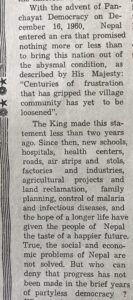
This development process took a speedy step in creating the vital infrastructure in all sectors – roads, factories, industries, business and commerce, education, administration, law, justice, administration, social reform, etc. in our country during King Mahendra’s rule. By giving due attention to it with great appreciation, Keith de Folo, the American scholar and an independent writer who lived in Nepal then, wrote the following sentences in his article” Democracy Without Prejudice,” published in “The Rising Nepal” on June 12, 1969.
Recently I happened to see the following news published in Rochester Times Union, NY, USA, on Jan. 31, 1972, when King Mahendra died.
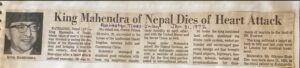
Those were in the files of press clippings on Nepal sent to me by our dear friends – Douglas and Nancy Hatch, who lived in Nepal around 1970 and live in Cortland, New York now. It depicts the memorable contributions of King Mahendra in brief without any prejudice. We must remember him as the King of the creation of modern Nepal if we are not a people of ungratefulness. According to Arab Proverb, “A grateful dog has more worth than an ungrateful man” we must accept that ungratefulness is a sign of wickedness. You cannot see the goodness of anyone if you are prejudiced and want to close your eyes. But the real history and facts cannot be erased. The contributions of King Mahendra are and will be there as long as Nepal is on earth. However, some political parties and their blind followers, recently seen as the corrupt actors making Nepalese fake Bhutanies for money, do not want to see them. I do not have to see an example of it far away and can see a small piece of an example of development around where I live.
Until 1959 we did not have a university. Our colleges were affiliated with Patna University. They were run according to the rules and regulations of that university. Academically the colleges were under them. To meet the requirement of a university, then queen mothers Kanti Rajya Laxmi Devi Shah and Ishwari Rajya Laxmi Devi Shah, the mothers of King Mahendra and the Queens of King Tribhuvan initiated in establishing Tribhuvan University in Nepal and even provided some funds for this cause. As a result, Tribhuvan University, the first university in this country, was established by King Mahendra in Nepal in 1959 in Kirtipur, acquiring about 3500 ropanies of land. That was an unforgettable landmark in this country’s higher education history.
That was when the present Kathmandu to Dakshinkali road did not exist. That was when the present ring road construction in Kathmandu had not been in anybody’s mind. The road from Kathmandu to Kirtipur was not in good shape. Even after Kathmandu-Dakshinkalii Road was constructed around 1964, this road was not broad enough to run the buses. The width of that road was about 24 feet, and it had two narrow wooden bridges – one Bishnumati River Bridge at Kuleshwor Mahadev Temple and the other Balkhu River Bridge at Balkhu. The buses could hardly run with a few inches of extra space in the bridges.
I bought land at Balku at Rs 4000 a ropani at that time. I lived there with my beloved wife, Shanti Mishra, after constructing a house with no running water tap or electricity line as we wanted to be near the university where we both worked. We witnessed the terrible situation of that area when we first moved and, with time, experienced the unforgettable development around us. I often pleasantly remember it with joy and happiness.
People used to drink water from the river as there was no water tap or well around. That was a village like any other remote area without electric light, and people went to bed earlier when the darkness came with sunset. There were no shops around for vegetables or foodstuff. People needed to go to Kalimatii near the Soaltee mode road to the west to shop through Teku, as the present broad road to Kalimati from Kuleshwor Ganesh did not exist.
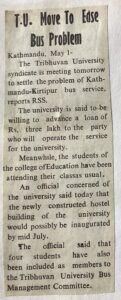
Going from Kathmandu to University, Kirtipur, was not easy at all. Only two buses running without a schedule made life difficult for travelers. Sometimes people needed to wait hours to get the bus and struggle to get in, pushing each other with good strength and energy. Students and teachers could not get on time for study and teaching. So the students had to strike for several days for this cause on April 28, 1969. I vividly remember the university administration had arranged two buses on contract with some transportation company by giving a Rs 3 lakhs loan without interest. Despite this, bus transportation caused terrible inconveniences for many years. The following news cutting of 1969 published in ”The Rising Nepal” depicts the poor transportation situation.
 People of Patan, either from Sanepa, Shanta Bhawan, Kupundole, or other places across from the Bagamati River, had to come to Kirtipur through Thapathali as there was no other motorable bridge around when they came with four-wheelers. Even the walkers from Patan had to come to Kirtipur through Teku or Sundarighat suspension bridge, moving around quite a distance.
If you compare those things with the present facilities of roads, bridges, electricity, running water, shopping centers, transportation, etc., the development has peaked around the area. We must happily remember it. This is an example of a piece of development achieved based on King Mahendra’s development policy and plan and pleasant memory. That is unforgettable for me. In this context, I am bound to remember King Mahendra for developing infrastructure throughout the country. I sincerely feel our fellow citizens should not be ungrateful towards this King whether they like or dislike his political philosophy. Low or high people should be evaluated based on facts and truth, not prejudices.

Login to add a comment