








By Our Reporter
Nepali people across the country are participating in the local level election to elect their representatives for the next five years on Friday. Elections are obviously a testing time for the political parties. However, this time, people are not happy with the ways the political parties are contesting the local polls. The voters having faith in particular parties have no candidate to cast their vote to the party of their choice because of an unnatural alliance among the parties.
While the ruling five parties have forged an electoral alliance under the leadership of the Nepali Congress, the UML is contesting the election alone in most places although in a few places it has forged an alliance with Rastriya Prajatantra Party and others.
The alliance has irked the voters of the Nepali Congress because they have no party candidates in three of six metropolis, four of 11 metropolis and in several municipalities. In a few places, NC leaders have fielded rebel candidates against the candidate of the coalition parties, but in many places, they will be voting for the Maoist or the Socialist candidates.
Bharatpur Metropolitan City has again become the major battleground for both the ruling alliance and the UML. While the coalition parties have fielded Renu Dahal of the Maoist Centre for the post of Mayor, NC leader Jagannath Paudel has fielded rebel candidacy against Dahal and UML has Bijay Subedi, former Assembly Member of Bagmati Province.
When the entire state mechanism and establishment of NC have thrown its strength for Dahal and against Paudel, UMl’s Subedi is likely to win the battle. However, if the NC leaders and supporters unite for Jagannath, he can pose a challenge to Dahal and Subedi. Of course, it was the Bharatpur dispute during the local election of 2017 that made the NC suffer defeat in the parliamentary elections later the same year, history is likely to repeat again.
Controversial remarks by Arzu Rana, wife of Prime Minister Sher Bahadur Deuba, and the threatening speech by Pushpa Kamal Dahal have increased sympathy for Paudel, which could be costly not only for Dahal father and daughter but also for NC president and PM Deuba
As the NC supporters are not happy with the alliance, enthusiasm for poll among them is poor. Yet, they will cast their votes, which can alter the expected poll results.
When the election results start pouring in on Saturday morning, people will know which party is stronger. PM Deuba has already admitted that UML is still strong and the UML’s strength compelled them to forge an alliance.
Election alliance not effective despite supreme leaders’ warning
Leaders of the ruling parties do not look happy when the alliance failed to become as effective as was desired.
Although NC president and Prime Minister Sher Bahadur Deuba has not expressed any words against other parties of the ruling alliance, Pushpa Kamal Dahal of the Maoist Centre, Madhav Kumar Nepal of the CPN (Unified Socialist) and Upendra Yadav and Dr Baburam Bhattarai have openly expressed their dissatisfaction over the implementation of an alliance.
Dr Bhattarai and Yadav have been boycotting the meetings of the ruling alliance. The two leaders also were not with Deuba, Dahal and Nepal when they toured the country addressing the election rallies.
When NC leaders fielded rebel candidates in Bharatpur, Pokhara and Janakpur, disobeying the centre’s instruction, Maoist rebel candidates are contesting elections against the coalition candidates in several municipalities including Dhangadhi sub-metropolitan city. Moreover, Pushpa Kamal Dahal on Monday urged the voters in Kaillai to vote for the rebel candidates.
What Dahal said on Monday clearly suggested that the alliance would not produce the desired results.
Meanwhile, Madhav Kumar Nepal has blamed the NC for the ineffective implementation of the alliance. He warned in Pokhara and elsewhere that the NC should not exhibit its ego, otherwise the NC leaders could meet the fate that KP Oli met. By saying so, he was clearly giving a message that he could cause a fall of the government of Deuba if things do not move as agreed by the parties in the alliance.
NC boss Deuba is also helpless as many leaders within the party are not cooperating with him in convincing the rebel candidates, especially in Chitwan.
The crux of the problem is that the alliance was imposed from the centre instead of applying it from local levels. When all ward committees of NC in Bharatpur had suggested fielding NC mayoral candidate in Bharatpur, Deuba undermined it and imposed his decision, which culminated in a revolt from senior and popular NC leaders in Chitwan. The rebellion in Chitwan has ultimately spoiled the alliance across the country.
Violation of election code of conduct continues

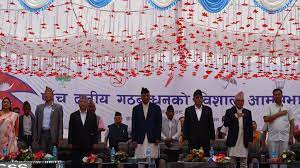
PM Deuba addressing an election rally
Political party leaders, candidates, government ministers and even media houses are found violating the election code of conduct massively this year.
Chief Election Commissioner Dinesh Thapaliya the other day said that the Election Commission was wasting papers seeking clarifications from the sitting ministers for violating the code of conduct.
The EC that already sought clarifications from Maoist chairman Pushpa Kamal Dahal, Minister Ram Kumari Jhakri, UML mayoral candidate of Kathmandu Keshav Sthapit and even the Gorkhapatra, the official daily, seems to have fed up with the increasing incidents of code violations.
Thapaliya, during a press meet on Tuesday, said that many of the ministers went outside the Kathmandu Valley without informing the EC. According to law, the ministers should seek permission from the EC before leaving the valley, but only one or two ministers have abided by the provision, according to Thapaliya.
Even Prime Minister Sher Bahadur Deuba toured the nation in an army helicopter and addressed election rallies asking the voters to cast votes for the candidates of ruling alliance. As the sitting PM. He cannot tour the country.
Moreover, many of the candidates are found flouting the code by using more vehicles and displaying more party flags and symbols than allowed by the laws. Different items like saris stocked to distribute to the voters were confiscated from the homes of candidates. The rich candidates re-found blowing money to win elections by going against the ceiling of expenditure fixed by the EC.

Login to add a comment