








By Pushpa Raj Pradhan
In a gap of two days, a senior Indian diplomat and a senior most Chinese minister with defence portfolio, who is also state counselor, visited Kathmandu. Both the dignitaries ensured increasing bilateral cooperation and giving a new height to the bilateral relations of the respective countries with Nepal.
Last week Indian foreign secretary Harsh Vardhan Shringla arrived here for a three-day visit. During his meetings with Nepali political leaders including foreign minister Pradeep Gyawali, Prime Minister KP Sharma Oli, among others, Shringla is learnt to have expressed serious concern on Chinese presence in Nepal. His diplomatic request was to curb the increasing presence of China in Nepal.
Understandably, India is worried about the increasing presence of China in the region at a time when the India-China border dispute has been escalated.
India is now trying to improve her relations with neighbouring countries except Pakistan. The foreign secretary visited Kathmandu to attend a bilateral meeting between the two nations which was stalled for years. Since Nepal published a new political map by including the Limpiyuadhara-Kalapani-Lippulekh territory — presently encroached by India — following an amendment on the constitution after India published a new political map included the territory, the Indian side had become furious from the Nepali leaders in the government. The Indian side deliberately cancelled Nepal’s proposal for bilateral talks. However, the Indian side finally reached to the conclusion that if she fails to engage Nepal, China will occupy India’s place. Therefore, the foreign secretary visited Kathmandu; he extended an invitation to foreign minister Pradeep Gyawali for a foreign minister-level bilateral meeting in December.
Earlier to the visit of the foreign secretary, Indian external intelligence organ Research and Analysis Wing chief Samant Goel and Indian Army chief Gen Manoj Mukund Naravane had visited Kathmandu. During their visits also, the Indian concern was about the increasing presence of the Chinese in Nepal.
Border dispute not in talks agenda:
Although the Indian side has shown keen interests for supporting Nepal, they have rejected to talk on the Kalapani dispute. The Indians don’t want to bring the Kalapani territorial dispute in the agenda of the formal talks. It makes clear that India is not ready to return the territory occupied by her even if Nepal will produce the necessary evidence.
Indian mission to topple down Oli government:
According to sources, the Indians have reached to the conclusion that PM Oli has betrayed Delhi. Therefore, although formally the Indians have shown goodwill towards the present Oli-led government, covertly, Indians are playing the game to topple down the government earliest as possible. It is said that there is an Indian role behind the present dispute between the party chairmen-duo.
Indians have felt that the present government is more closed with Beijing, said the source.
The Chinese gesture:
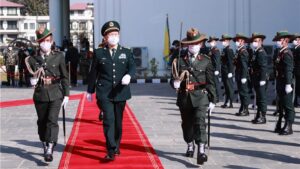
Senior Chinese minister and state counsellor Gen Wei Fenghle, who is looking after the defence portfolio arrived Kathmandu in a one-day-visit on 29 November. Coinciding the 65th anniversary of the establishment of the diplomatic relations between Nepal and China, at the invitation of the DPM and then Defence Minister Ishwor Pokhrel the Chinese minister had paid a one-day working visit.
After the Kathmandu visit, the Chinese minister went to Dhaka and Islamabad. The Chinese minister spent three hours at the Nepal Army headquarters. The minister reassured to resume support to the Nepal Army committed in the past. This is the gesture that China wishes to strengthen military to military relations.
The Chinese minister stressed on implementation of different impending projects in Nepal. He expressed the commitment to give a new height to Nepal-China relations.
The visit of the Chinese minister has intensified further the Indian worry as he paid a visit to Nepal, Bangladesh, and Pakistan, all the neighbouring countries of India

Login to add a comment