








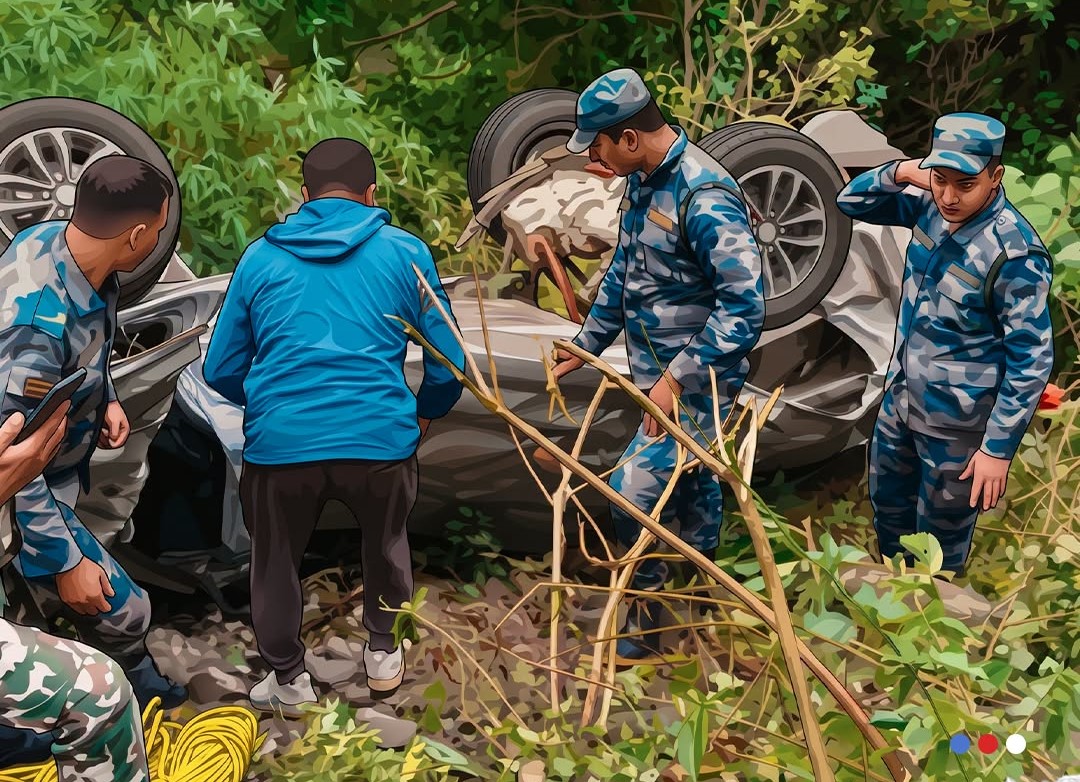
KATHMANDU, Nov 13: Families from Kathmandu were travelling to Sundarpur in Sarlahi to celebrate Chhath. What was meant to be a joyful family reunion ended in tragedy when an electric van crashed at Chisapani, Bhimphedi Rural Municipality-6, in Makwanpur on Thursday morning.
Fourteen people from the same village died, and six others were injured. The tragedy has raised serious questions about Nepal’s public transport safety system and the effectiveness of regulatory agencies.
The electric van, registration number Madhesh Province 03-001 Ja 0880, had left Balkhu in Kathmandu for Sarlahi. According to Krishna Kumar Yadav, chairperson of Chakraghatta Rural Municipality, the vehicle was carrying nearly twice its authorised passenger capacity.
More troublingly, it reportedly passed through around five security checkpoints on its journey. Why did none of them stop an overloaded vehicle? Did personnel fail to notice the excess passengers, or did they simply ignore the violation?
Checking vehicle documents, verifying passenger capacity and enforcing transport regulations are basic responsibilities of traffic police. The authorities must explain how such a clear violation went undetected at multiple checkpoints.
Responsibility cannot rest solely with the driver. The vehicle owner, transport operator, driver, licensing authorities and security personnel responsible for roadside monitoring must all come under investigation.
The government has formed an investigation committee. However, Nepal has repeatedly formed committees after major road accidents, only for their recommendations to remain unimplemented.
The Bhimphedi investigation must establish not only the immediate cause of the crash but also the regulatory failures that allowed the vehicle to continue its journey.
Investigators should identify which agencies operated the five checkpoints, what inspections were conducted, why passenger numbers were not verified and whether any violations were recorded. Previous accident investigation reports and the implementation status of their recommendations should also be made public.
In 2022, Makwanpur Police introduced a time card system under then Superintendent of Police Bamdev Gautam to help reduce road accidents. Checks against drunk and drug-impaired driving were also intensified. Gautam says these measures produced positive results.
The current accident raises questions about whether such measures are still being enforced. A time card can help regulate travel speed and journey duration, but it must be accompanied by checks on passenger capacity, driver fitness, rest periods and vehicle condition
Traffic enforcement cannot be limited to checking documents and collecting fines. Authorities must verify the number of passengers, the driver’s condition and the vehicle’s mechanical safety.
A proper passenger manifest and ticketing system is also needed. Recording passenger identities and destinations would improve accountability and help rescue and identification efforts after accidents.
The investigation must establish the vehicle’s authorised seating capacity, actual passenger count, ticket records, boarding points and checkpoint inspection logs.
The deaths of 14 villagers returning home for Chhath demand accountability. The government must publish the investigation findings, implement earlier recommendations and identify officials responsible for any regulatory failures.
Who is responsible for passenger safety: the driver, transport operator, traffic police or government regulators? Each has a defined role, and those who failed must be held accountable.
Having police on the roads does not guarantee safety. Preventing vehicles that violate passenger limits from continuing their journeys is what effective enforcement requires.
People’s News Monitoring Service

Login to add a comment