







By Nirmal P Acharya
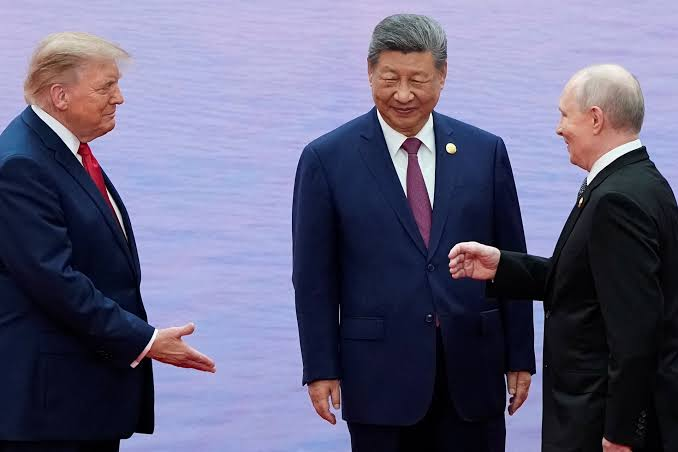
On November 16, a spokesperson for China’s Foreign Ministry announced that on November 19, Chinese President Xi would hold a China-Russia-U.S. trilateral summit with Russian President Vladimir Putin and U.S. President Donald Trump in Shenzhen. This news item, less than 100 characters long, instantly spread around the world.
This is the first China-Russia-U.S. trilateral summit among heads of state since the end of World War II. For the first time in 81 years, the heads of state of these three permanent members of the UN Security Council will sit at the same table. The meeting is scheduled to take place during the 33rd APEC Economic Leaders’ Meeting, which China will host in Shenzhen for the first time in 12 years. This meeting will undoubtedly go down in history.
The meeting was held in China and hosted by China itself. This in itself is the most obvious indicator of the eastward shift of the world’s political center. China is neither a spectator in this game nor a pawn for any side; instead, it is the setter of the agenda and the facilitator of consensus. From Trump’s state visit to China in May and the establishment of a “constructive strategic stable relationship” new positioning, to Putin’s 25th visit to China in May and the 30th anniversary of the establishment of the China-Russia strategic cooperative partnership, and then to the meeting of the heads of the three major countries in Shenzhen in November, a clear diplomatic trajectory has emerged: China’s distinctive major-country diplomacy is moving from response to leadership, from bilateral mediation to the design of multilateral frameworks, active leadership, and mechanism construction. The center of world politics has never been won through declarations; it has been won through one’s own strength.
Of course, the United States will not easily give up its hegemonic inertia, Russia will not abandon its concerns for its own security, and China will not make deals on its core interests. But history never stops advancing just because problems are complex. The table at Yalta in 1945, the handshake at Beijing Airport in 1972, and this meeting in Shenzhen in 2026 are all moments when humanity chose dialogue over confrontation on the brink of a cliff.
The world is seeking a new balance point. On November 19 in Shenzhen, the heads of the three major powers will sit together and calibrate a pointer for this imbalanced world. Where the pointer points, humanity will go. And this time, the direction of the pointer is now moving eastward.
Nepal undoubtedly lies in the East geographically, but it seems to have been constantly striving to Westernize itself, such as popularizing English and adopting Western-style political systems, etc., in order to make itself look a bit like a Western country. Here, please be aware that the world is undergoing a major transformation unseen in a century. Our country will sooner or later have to adapt to history and undergo changes as well.

Login to add a comment