








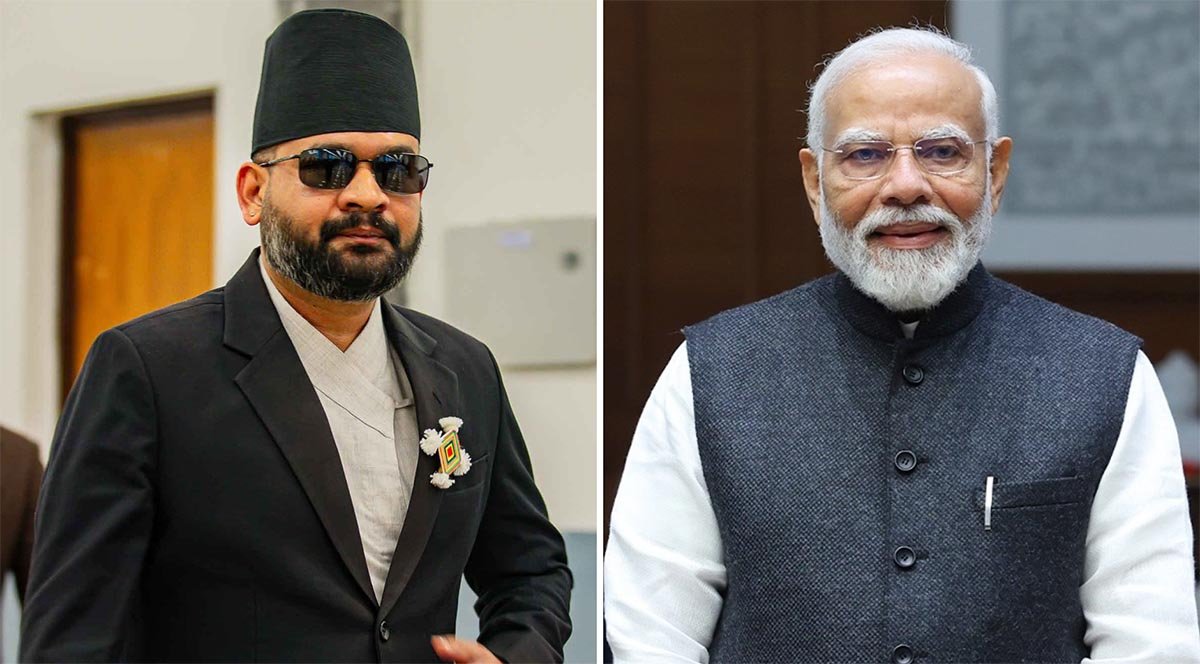
Kathmandu, Nov 14: Indian media have given considerable coverage to Prime Minister Balen Shah’s proposed visit to India, reporting on possible agreements involving hydropower, petroleum pipelines, infrastructure, trade and economic assistance.
Indian media reports say Shah is preparing to visit India from November 22 to 24. However, his press adviser Deepa Dahal said the dates have not been finalised. The visit could take place towards the end of the first week of Mangsir (mid-November).
This will be Shah’s first official bilateral foreign visit since becoming prime minister. Indian Prime Minister Narendra Modi had earlier invited him to India. Preparations gained momentum after Indian Foreign Secretary Vikram Misri visited Kathmandu on November 4 and 5 and held meetings with Shah and several ministers.
The Indian Express, The Times of India, Hindustan Times, NDTV, India Today and The Economic Times have reported extensively on the proposed agenda, including post-flood reconstruction assistance, energy cooperation, infrastructure, trade and longstanding disputes over borders and water resources.
A major economic agenda is Nepal’s request for approximately $2 billion in Indian assistance for post-flood reconstruction.
According to The Economic Times, Nepal is seeking a package comprising $1 billion in concessional loans for infrastructure development and another $1 billion in grants.
Three projects involving India’s state-owned NHPC are expected to feature in discussions. They include the 750 MW West Seti project in Sudurpaschim, the 480 MW Phukot Karnali project and the 450 MW Seti River-6 project. Together, they have a proposed capacity of 1,680 MW. However, construction agreements or final investment decisions are not confirmed.
The 900 MW Lower Arun Hydropower Project is also expected to feature prominently, with a possible joint launch of construction by the two prime ministers.
India is seeking greater investment in Nepal’s hydropower sector, alongside cooperation on electricity purchases and transmission infrastructure.
Potential projects for inauguration or construction launch include a petroleum pipeline connecting Siliguri in India to Charali in Jhapa, a joint launch of construction of the Lower Arun project and the integrated check post at Dodhara-Chandani.
The pipeline is expected to streamline petroleum imports and reduce dependence on tanker transportation. The Dodhara-Chandani facility aims to improve cross-border trade and customs operations.
Other possible joint inaugurations include the Nepal Police Academy in Panauti, a bridge in Darchula, the integrated check post in Bhairahawa and a motorable bridge over the Mahakali River.
Connecting Ayodhya in India with Janakpur in Nepal by rail could also feature in discussions.
During his Kathmandu visit, Misri reportedly informed Shah that preparations for the rail service had been completed and trial runs conducted.
The connection is expected to promote religious tourism between Ayodhya’s Ram Temple and Janakpur’s Janaki Temple, potentially benefiting local tourism and businesses.
Nepal is also seeking additional international air entry routes from India, a demand it has pursued since 2014. Such routes are considered necessary to expand international operations at Gautam Buddha International Airport and Pokhara International Airport. Technical discussions between the two countries’ civil aviation authorities are expected.
The Pancheshwar Multipurpose Project, agreed under the 1996 Mahakali Treaty, is another longstanding agenda item. Disagreements over cost sharing and the distribution of water and energy benefits have delayed its development.
Uttarakhand Minister Satpal Maharaj has said discussions will also cover the proposed dry port at Dodhara-Chandani in Kanchanpur.
Updating the Nepal-India trade treaty is another expected priority. Discussions reportedly include expanding the agreement to cover services, protecting foreign investment, facilitating profit repatriation, easing the movement of industrial raw materials and components, and improving cross-border trade and transit infrastructure.
India is Nepal’s largest trading partner, but Nepal faces a substantial trade deficit. Better market access for Nepali products and increased export opportunities remain key concerns.
New Delhi is expected to be Shah’s main destination, where he will hold bilateral talks with Modi. Indian media have also reported a possible visit to Ahmedabad in Gujarat, a state closely associated with Modi’s political career. However, Nepal has yet to confirm the Gujarat visit.
People’s News Monitoring Service

Login to add a comment