









By Narayan Prasad Mishra
I heard and read long ago that the Twelfth Canto, Chapters One and Two, of the Shrimad Bhagavata Mahapurana, the great sacred text of Hindus, contains an account of the Kali Yuga. These days, this subject is receiving considerable attention. Today, many also discuss the Hindu philosophical belief that the Kali Yuga began 3,127 years ago. Similarly, many religious and spiritual scholars now claim we are living in the transitional period between the end of the Kali Yuga and the beginning of the Satya Yuga.
According to Hindu philosophy, truth, compassion, morality, justice, and righteousness gradually decline during the Kali Yuga. Wealth, power, selfishness, and ostentation begin to dominate society. When unrighteousness reaches its extreme, Lord Vishnu is believed to appear as the Kalki Avatar to end unrighteousness and restore righteousness. Following the end of the old, unrighteous order, a new age based on truth, righteousness, virtuous conduct, and justice begins. In other words, the Kali Yuga ends, and the Satya Yuga begins.
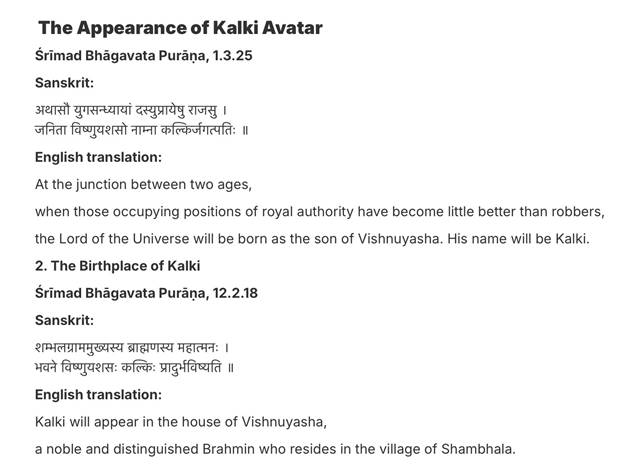
In this context, the Shrimad Bhagavata begins by describing the general decline in human character and spiritual awareness. According to this sacred text, before the advent of the Satya Yuga, or the appearance of the Kalki Avatar, the following undesirable, immoral, unpleasant, and distressing social and moral conditions will prevail on Earth—in other words, in human society.
1. The Decline of Truthfulness and Moral Values
Dishonesty and falsehood will increase day by day. The qualities that sustain a righteous society—religiosity, truthfulness, purity, tolerance, compassion, longevity, physical strength, and memory—will gradually diminish and become scarce. People will become increasingly intolerant of one another. They will gradually lose their ability to distinguish right from wrong.
2. Wealth and Power Will Determine a Person’s Social Standing
During the Kali Yuga, wealth will be regarded as the principal evidence of a person’s noble birth, good character, and virtue. Even the administration of justice and the enforcement of laws will increasingly depend on a person’s power and influence.
People will be judged not by their knowledge, honesty, wisdom, or moral character, but by their financial circumstances. A wealthy person may receive respect even after acting dishonestly, while an honest but poor person may be looked down upon. Similarly, a powerful person may receive favorable treatment despite committing injustice, whereas a weaker person will have to struggle to obtain justice.
3. Relationships Will Be Driven by Self-Interest
Relationships will increasingly be driven by self-interest. Relationships between men and women will become more dependent on physical attraction than on deep commitment and emotional intimacy. People will find themselves compelled to resort to deception and fraud to succeed in business. External religious symbols will be regarded as evidence of spiritual or intellectual achievement.
4. Outward Appearance Will Be Mistaken for Spiritual Attainment
A person’s spiritual standing will be judged not by genuine spiritual qualities but by external appearance, clothing, and attire. Eloquence and clever speech will be taken as signs of scholarship, replacing genuine knowledge and wisdom.
5. Poverty Will Be Seen as Failure, While Hypocrisy Will Be Rewarded
Poverty will be regarded as a sign of personal failure, while hypocrisy and deception will be treated as measures of success or virtue. A verbal agreement alone will be considered sufficient for marriage, and bathing will be regarded as enough to fulfill the daily requirements of purification.
6. Material Pleasure Will Become the Primary Purpose of Life
Material comfort and physical pleasure will become life’s principal goals. Places of pilgrimage will be valued merely as distant bodies of water. Physical beauty will be judged by hairstyle and outward appearance.
Filling one’s stomach will be regarded as the main purpose of life, fearlessness will be mistaken for truthfulness, and the ability to support a family will become the principal measure of a person’s worth. Increasingly, people will follow religious principles not out of genuine faith and conviction, but to gain social prestige.
7. Political Power Will Fall into the Hands of the Strong and Oppressive
Powerful individuals will hold political power and oppress others, rather than those who uphold religion and justice. Power, rather than moral responsibility and wisdom, will become the governing principle.
8. Rulers Will Exploit the People Like Bandits and Robbers
Rulers will exploit the people and behave like ordinary thieves and robbers. They will seize their subjects’ property and violate their rights. Under such circumstances, people will be forced to flee to find safety and protection.
9. People Will Suffer from Drought, Famine, and Heavy Taxation
People will endure drought, famine, and excessive taxation. Faced with such hardships, they will be compelled to survive as best they can by eating roots, leaves, fruits, flowers, seeds, and whatever other food they can find.
10. People’s Lives Will Be Filled with Hardship and Suffering
People will endure extreme cold, strong winds, heat, rain, and snowfall, along with quarrels, hunger, thirst, and disease. Their lives will be filled with suffering, hardship, and anxiety.
11. Human Life Will Become Short and Difficult
People will enjoy a satisfactory family life for no more than fifty years. In other words, human life will be shorter and harder.
When I compare the conditions described in the Shrimad Bhagavata with the present situation in Nepal — including governance and administration, corruption, mismanagement, injustice, oppression, the looting of cooperative funds, and the mass exodus of people to foreign countries — I cannot help feeling that many of the characteristics traditionally associated with the Kali Yuga are strikingly evident in our society. Only the three conditions described in points 9, 10, and 11 appear to remain unfulfilled.
In this context, I hoped our country was surely passing through the transitional period between the Kali Yuga and the Satya Yuga. However, I thought that the suffering might continue for a few more months or years. I also began to hope that the Satya Yuga would soon begin. I imagined that I might live to see the Satya Yuga with my own eyes.
In this connection, I watched and listened to numerous YouTube presentations by people who describe themselves as experts on God, the Supreme Lord, the soul, the Supreme Soul, the Kali Yuga, the Satya Yuga, Swamis, saints, divine souls, astrologers, and gurus.
Among them were Mitra Jeev Guruji (Divine Light, Maitri Dadashree); Dr. Sahadev Das Prabhuji (ISKCON); Dr. Chinmay Pandya (Gayatri Pariwar); Swami Vivekanandji Parivrajak (Adhyatma Yatra); Acharya Pramod Krishnam (Shri Kalki Dham); Swami Dr. Manoj Kumar Gupta (Sanatan Rishi); and Pandit Kashinath Mishra (Bhavishya Malika), among others.
Some of these prominent figures even claim to have met God in person and confidently specify the year 2032 as the definite beginning of the Satya Yuga. All of them appear to be knowledgeable in religious matters, well-versed in sacred scriptures, and accomplished scholars, researchers, and experts. However, I could not find any specific date or time in the Shrimad Bhagavata for the end of the Kali Yuga and the beginning of the Satya Yuga.
In this connection, I also came across extraordinary, unimaginable, and incredible claims concerning two different Maharajs. One is Akshaya Shri Maharaj, a self-proclaimed incarnation of God and Maharaj living in Nepal, who claims to be the Kalki Avatar, the supreme ruler of the universe, and occasionally appears on the program Churo Kuro, making all sorts of unusual statements.
The other is Arjun Prasad Regmi, on behalf of Gorakhnath Maharaj. I watched an extraordinary, unimaginable, and incredible interview with Regmi, chairman of the Gorakhnath Kalyan Kendra, Nepal, on Himal Online TV. Regmi claimed that Lord Shiva himself, as Baba Gorakhnath, descended to Earth in human form 19 years ago and has since been working as Gorakhnath Maharaj to bring about a change of ages. According to Regmi, the world operates, and will continue to operate, according to Gorakhnath Maharaj’s wishes.
Although in our country retired army generals are addressed as Jarsaheb and former Subbas as Subba Saheb, even revolutionaries who believe former King Gyanendra should not be addressed as a king apparently do not object to the self-proclaimed Maharajs mentioned above. That, at least, is something to appreciate about their new culture.
When I consider the conditions of the Kali Yuga described in the Shrimad Bhagavata, together with the present situation not only in Nepal but also in our neighboring countries, Europe, America, and several other parts of the world, I feel that the time has indeed come for the Kali Yuga to end and the Satya Yuga to arrive soon.
However, when I see so many self-proclaimed spiritual speakers making contradictory claims—some asserting that they have personally met and seen God, and others claiming to present the divine policies, plans, and implementation documents governing the operation of the universe—I begin to wonder whether some of the promises about the imminent arrival of the Kalki Avatar and the Satya Yuga are being used to mislead people rather than to guide them spiritually. Such thoughts dampen my hope of witnessing the Satya Yuga. Clouds gather over that hope, and I become disappointed.
Nevertheless, I firmly believe that those of us who have faith in truth, justice, and righteousness must not merely await the advent of a divine incarnation to restore these sacred values. Rather, we must all sincerely and wholeheartedly dedicate ourselves to reviving and re-establishing these principles in society.
If we devote ourselves to this noble endeavor with complete sincerity, giving our body, mind, heart, and soul to this righteous cause, I believe we may well witness and experience the dawn of Satya Yuga—the sacred Age of Truth—sooner than we imagine. Surely, such sincere and righteous efforts will please the Supreme Lord.
I humbly pray that the Almighty may bestow wisdom and right understanding upon all, inspiring everyone to reflect on these sacred values and dedicate themselves to restoring them.
About the author: A non-partisan writer of several books and numerous articles in Nepali and English; former Chief of the Office of the Tribhuvan University Service Commission, Nepal; and a senior citizen in his mid-eighties.

Login to add a comment