







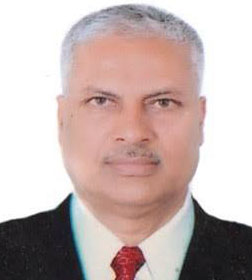
By Jagadish Dahal
“A scholar is worshipped everywhere.” This ancient proverb is a maxim I have revered all my life. Yet, a recent conversation with an intellectual friend gave me a fresh perspective on what it truly means to acquire knowledge.
We were sitting together over tea when my friend, holding a thick novel he had been engrossed in, paused and offered a thought:
“Jagadish ji, as I read this novel, a thought struck me. Which yields deeper truth: reading a complex book in isolation or travelling to a remote village, sitting down with a local farmer, and understanding their daily life through genuine conversation? Is direct human engagement not the purer form of truth?” He gently set his book aside and added, “Speaking with you right now gives me insights that no written page can match.”
His words left me deep in thought. They forced me to look back on my own long, winding journey from a remote corner of Nepal to the heart of the capital, a journey shaped by struggle, lived experience, and persistent learning.
From the Hills of Sankhuwasabha
My story began on Saturday morning, Baisakh 10, 2018 B.S., in Churungkhurung, a tiny, remote village in the Fivekhapan area of Sankhuwasabha District, far east of Kathmandu. I was born the third child of Shri Prasad Dahal and Bhim Kumari Adhikari Dahal into a modest family of nine.
Poverty was not just a condition; it was our everyday reality. As children, we wore simple loincloths (bhoto-kattu) and ate millet bread wrapped in banana leaves. To learn the alphabet, I walked two and a half hours each way to school, barefoot along muddy paths and rugged dirt tracks. Schooling had to be balanced with relentless household chores: collecting firewood and fodder, tilling the soil, and tending to cows and goats through scorching sunshine, pouring rain, and biting cold.
By the time I finally reached Kathmandu to pursue higher education, two decades of my life had already slipped by.
A Prolonged Academic Odyssey
Higher education in Nepal during the late 1970s and 1980s was unpredictable, to say the least. Completing my studies up to the S.L.C. level took nearly twelve years. Later, after enrolling in the Faculty of Law at Tribhuvan University, what should have been a two-year intermediate degree stretched into five long years because of frequent student protests, administrative delays, and overcrowded classrooms. My three-year bachelor’s degree took four years to complete, although I finished my master’s degree on schedule in two years.
Through no fault of my own, and partly because of the tumultuous state of the university system at the time, my academic journey extended over more than a decade. By the time I graduated, I was already in my mid-thirties.
Standing at a crossroads in my late thirties, I found myself uncertain about which career path to pursue. I experimented with university teaching and journalism, but the internal dynamics of both fields left me feeling out of place.
When I sought advice from mentors and senior scholars, their consensus was clear: the legal profession was my true calling. A few even suggested that I enter politics through the Nepali Congress, noting that my public-speaking skills, reasoning ability, and background made me well suited for leadership.
My philosophy, however, was practical: first, secure a stable livelihood; political engagement could follow once my life was on a firm footing.
Overcoming Obstacles and Building a Home
Entering the legal profession was far from smooth. Because of professional jealousy, prejudice, and petty rivalries, my licence was delayed for nearly three years. By the time I finally received my licence to practise law, I was already in my forties.
Yet, establishing a stable legal practice gave me the confidence I needed to move forward with my personal life. On Asar 19, 2060 B.S., I married Sushila Gautam, who also hailed from my home district.
Understanding the hardships I had faced, my wife never made demands beyond our means. Within our humble circumstances, we found contentment together. Over the years, we were blessed with three daughters: Bidushika, Samriddhika, and Nipunika. Today, our primary mission in life is to raise them well and empower them through quality education.
Reflections on the Journey
Coming from a geographically isolated, underdeveloped village and eventually settling in Anamnagar, in the heart of Kathmandu, has been an extraordinary journey. When I look back on the hardships, long delays, and obstacles I have overcome, I feel a quiet sense of peace and gratitude.
When my scholar friend listened to my life story that afternoon, he remarked that our simple dialogue over a cup of tea had offered him far greater wisdom than the novel he had been reading.
His reflection reminded me of an enduring truth: while books provide structure and ideas, lived human experience—our struggles, conversations, and shared stories—is what truly deepens our understanding of the world.
Knowledge is not just written on paper; it lives within us.

Login to add a comment