







By Our Reporter
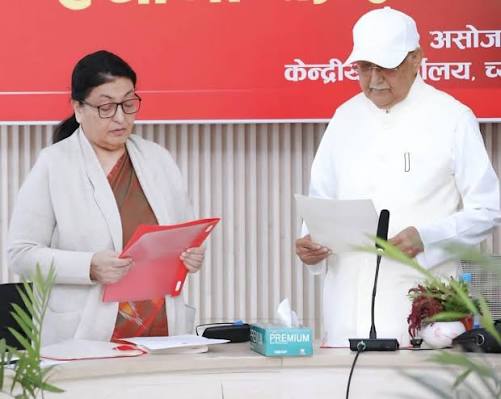
Bidya Devi Bhandari’s return to the UML raises a question bigger than her next political role: can citizens trust the presidency to stand above parties when its former occupant returns to partisan leadership? Her appointment as senior leader was reported on September 24. The latest remarks explain her decision, rather than mark its beginning.
Bhandari says she wants to defend democracy and the Constitution. Her experience could help the UML organise, mentor younger leaders and engage with women. Former presidents remain citizens with political convictions. Expecting them to withdraw from every public debate would waste experience and confuse impartiality with silence.
However, joining a party’s leadership carries a different meaning from speaking on national concerns. A former president can defend constitutional principles through public dialogue, mediation or civic work. Returning to one party places that accumulated authority behind an organisation competing against others. The country loses a potential bridge across divisions.
Within the UML, Bhandari’s presence could alter the balance of influence. Her stature may give members another centre of loyalty, whether she seeks a formal leadership contest or not. Supporters may see renewal; established leaders may see competition. Calling her a unifying figure does not settle how she will handle nominations, factional disagreements or succession.
Nor does her inability to become president again prove that she has abandoned personal ambition. The Constitution bars someone elected twice from seeking another presidential term. That restriction does not eliminate opportunities for party leadership or influence over government. Motives should be judged through conduct, rather than assumptions about the hierarchy of offices.
The deeper concern involves public memory. Her return may encourage critics to reinterpret contested presidential decisions through a partisan lens. Supporters describe her citizenship bill stance as proof of nationalism, but that is a political assessment, not an uncontested conclusion. Celebrating it as a party credential risks reinforcing doubts about whether she represented all citizens.
Nanda Bahadur Pun’s return to the Maoist Centre as vice-chairman in April 2025 creates a similar problem. Neither comeback proves that its protagonist acted improperly while holding constitutional office. Together, however, they risk establishing a pattern in which the presidency and vice-presidency appear to be temporary departures from party careers.
At home, reactions will follow political loyalties, but distrust could spread beyond opponents. Citizens already sceptical of institutions may conclude that neutrality lasts only until retirement. Abroad, observers may read these returns as evidence of blurred institutional boundaries. There is no basis to claim that foreign governments share one verdict, but Nepal’s reputation benefits when constitutional roles remain distinct from party competition.
India offers a useful comparison, though not an absolute rule. Its former presidents generally avoid returning to party command. Former vice-president Bhairon Singh Shekhawat nevertheless considered contesting the 2009 parliamentary election before withdrawing. The lesson is restraint through convention, rather than an assumption that every former officeholder permanently renounces politics.
Calling these comebacks a travesty may overstate what party membership alone establishes. Still, legal permission cannot resolve the ethical concern. Constitutional dignity depends partly on choices that protect confidence even when the law leaves room to act.
Nepal should develop a public code for former presidents and vice-presidents, including a reasonable cooling period before party leadership. Parliament should clarify how publicly funded facilities operate after political reentry. Necessary security can continue, but public staff, vehicles and residences should not support party work. Former officeholders must protect confidential information and avoid presenting personal views as national positions.
Bhandari and Pun can contribute to democracy. The strongest contribution would preserve the distinction between serving the republic and serving a party. They owe citizens that distinction in practice, through transparent choices and restraint. High office leaves a public responsibility behind: its credibility should never become a resource that one party alone inherits.

Login to add a comment