








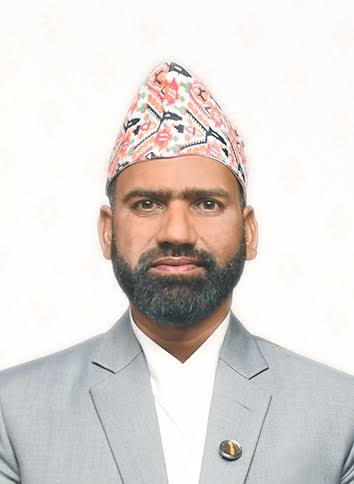
Kathmandu, October 26: The very person who rose to prominence by launching the “Ateri Campaign” against social ills, political syndicates and corruption is now seemingly reveling in the intoxication of power. Minister for Culture, Tourism and Civil Aviation Khadga Raj Paudel (Ganes) is a case in point.
Paudel entered politics with loud promises of ensuring transparency in public procurement, appointments and administrative affairs, as well as maintaining good governance. However, since taking charge of the ministry, he has become embroiled in one serious controversy after another.
Arbitrary Appointments at Nepal Airlines Corporation: A ‘Slap’ from the Supreme Court:
Minister Paudel, who advocates good governance, displayed extreme nepotism and arbitrariness in appointing members to the Board of Directors of Nepal Airlines Corporation (NAC).
A selection committee formed under the coordination of Ministry Secretary Mukunda Prasad Niraula had recommended Upendra Bahadur Karki as the top candidate on the merit list, with 36.625 points, based on academic qualifications, experience and interview performance.
However, on Baisakh 31, the minister bypassed the candidates ranked first and fifth and appointed individuals ranked second, third, fourth and sixth on the merit list—Dr. Deepak Prasad Bastola, Pravin Bhattarai, Maheshwar Bhakta Shrestha, Rupa Lamichhane and Lilaraj Dhakal—allegedly on the basis of political connections.
Hearing a writ petition challenging the opaque decision-making process, a bench of Supreme Court Justices Tek Prasad Dhungana and Shanti Singh Thapa ruled that the minister’s decision was directly contrary to the Good Governance (Management and Operation) Act, 2008.
Questioning the minister’s intentions, the Supreme Court overturned the arbitrary decision and issued a mandamus directing the appointment of Karki, who ranked first on the merit list, and Dr. Bhim Chand.
Criticism Over the Appointment of Ani Choying to Lumbini Development Trust:
Another highly controversial and widely criticised move by Minister Paudel was the appointment of singer Ani Choying Dolma as vice-chairperson of the Lumbini Development Trust.
According to the ministry, the Cabinet decided to appoint Ani to the position. The ministry stated that she had been nominated under Section 8(1)(b) of the Lumbini Development Trust Act, 1987. Under the Act, the vice-chairperson’s term is five years.
The post of vice-chairperson had remained vacant for a long time.
Born in Kathmandu, Ani entered Nagi Monastery in Shivapuri at the age of 13.
In 2019, approximately US$1.649 million (around Rs 2 billion) of unexplained origin was reportedly deposited into her bank account from Hong Kong. The suspicious funds, which allegedly arrived without prior approval from Nepal Rastra Bank, prompted the Department of Money Laundering Investigation to launch a serious investigation and freeze her account. However, it was alleged that the funds were subsequently released under intense political pressure at the time.
Paudel has come under sharp criticism for appointing a person accused of involvement in a serious financial offence such as money laundering to an institution in Lumbini, a globally recognised symbol of peace, transparency and purity. Critics argue that the appointment has tarnished Nepal’s image internationally.
‘Home-District Bias’ at the Academies:
The Nepal Academy, Nepal Academy of Music and Drama, and Nepal Academy of Fine Arts, which lead the country’s literary, artistic and cultural fields, had remained without office-bearers for a long time.
When Minister Paudel appointed 83 members to these institutions, academic excellence and regional balance were allegedly disregarded. Demonstrating an excessive attachment to his home district of Kaski, Paudel appointed eight academicians from that district alone.
Instead of ensuring that these national institutions represented the entire country, he allegedly turned them into centres for political power-sharing and the recruitment of loyalists. Even when questions were publicly raised about the conduct and intellectual credentials of some newly appointed office-bearers, the minister continued to defend his decisions.
The Minister’s Own House Is on Public Land:
It has already emerged that Minister Paudel’s own house stands on ailani land—public land without private ownership registration—even as he lectures others on good governance.
On the one hand, the government has been removing makeshift structures built on public land across the country, including those without land ownership certificates.
Questions have repeatedly been raised over Paudel’s house in Majheripatan, Ward No. 14 of Pokhara, which is reportedly situated on ailani land. Neither a land ownership certificate nor an approved building plan has reportedly been found for the property. Despite repeated public questions about the matter, Minister Paudel has not publicly responded.
Moreover, the minister has also been accused of sending his personal secretaries on trips to various tourist destinations at the expense of the Nepal Tourism Board without proper authorisation. He has faced severe criticism over allegations that taxpayers’ money and funds allocated for tourism promotion have been misused to benefit his associates.
Members of the Cabinet led by Prime Minister Balen Shah have, moreover, shown little inclination to respond when questions are raised about their conduct. Instead, they have tended to defend themselves. Ministers sitting in positions responsible for making and enforcing laws are themselves accused of occupying public land unlawfully.
The Unauthorised Rule of the Minister’s Secretariat:
Minister Paudel’s private secretariat appears to wield more power than the ministry itself and to operate above the law.
Government employees are reportedly dissatisfied with the minister’s chief personal secretary and personal secretary for independently corresponding with agencies under the ministry without any legal authority to do so. A deputy secretary at the ministry says civil servants have been informally protesting what they describe as the secretariat’s high-handedness.
In addition, Minister Paudel has been accused of sending his personal secretaries on trips to various tourist destinations at the Nepal Tourism Board’s expense without proper authorisation. He has faced intense criticism over allegations that taxpayers’ money and funds earmarked for tourism promotion have been diverted to benefit his associates.
A senior official who worked for a long time at the Ministry of Tourism said, “The controversies have continued to grow because one contentious decision after another has been made while disregarding the ministry’s institutional procedures and the advice of experts. Ministers have also turned a blind eye to the high-handedness of their personal secretaries.”
‘It Is Not Just the Minister; the Government Itself Is Not Accountable’:
Saroj Kumar Yadav, who is studying governance and corruption control at Tribhuvan University, argues that the problem extends beyond Minister Paudel to the government as a whole.
“Not only Minister Paudel, but the present government itself lacks accountability. This is not just about one minister,” he said.
Yadav said the entire Cabinet should bear responsibility for decisions proposed by ministers and approved by the Council of Ministers.
“The minister certainly did not make the appointments without the prime minister’s approval. But that does not mean the minister should not have to answer questions. Even when questions have been raised about the tourism minister, I feel he has treated them lightly. This is unfortunate.”
He argued that the government formed in the aftermath of the Gen-Z uprising was once again following the same path as previous administrations.
“The Gen-Z protesters took to the streets precisely against the lack of good governance and transparency and against nepotism. Yet the government is once again heading in the same direction. This is not about one individual; the system itself needs to be reformed. The questions are not directed at the tourism minister alone. They concern the entire Cabinet. The government should provide answers,” Yadav said.
According to a former secretary at the Ministry of Tourism, having court decisions overturned, misusing state funds, entrusting a sacred site to someone accused of involvement in financial misconduct, and facing questions about the legality of one’s own property are all part of a pattern of abuse of office and intoxication with power.
“The previous governments made similar mistakes, which led to the Gen-Z uprising. Those now in government are repeating the same mistakes,” the former secretary said.
According to the former secretary, decisions made by the ministry had also faced questions in the past, but ministers used to respond.
“It is not the first time a minister’s appointment has become controversial. In the past, ministers would answer questions, and if a decision needed to be corrected, appointments would sometimes be revoked. The present minister appears arrogant. He seems to be under the illusion that anything he chooses must be right. That attitude will eventually harm him,” the former secretary said.
“The minister should not make decisions single-handedly, but a negative mindset has also become dominant in society.”
Former Tourism Minister Jitendra Narayan Dev said ministers should not make decisions unilaterally or arbitrarily.
Recalling his own tenure, he said, “Speaking about my experience, before making any major decision, I would continuously consult the relevant ministry officials and experts. A minister cannot be expected to know everything,” he told Ratopati.
He stressed that, both in principle and ethically, ministers should consult the ministry’s various departments, directorates and relevant agencies before making decisions on matters they do not fully understand.
“Interacting with all the concerned agencies, holding discussions and making decisions accordingly is better for both the ministry and the country,” Dev said.
However, the former minister expressed concern that public perceptions of almost every decision and action in Nepal have become increasingly negative in recent times. Drawing on his 52 years of political experience, he pointed to the lack of a constructive approach in Nepali society.
“What I have observed in our country is that there is a negative mentality everywhere. The very foundation of society is negative,” Dev said.
“There is a difference between raising an issue positively and then examining its shortcomings, and approaching it negatively from the outset and ending with a negative conclusion. Unfortunately, the latter tendency has become increasingly prevalent here.”
Reproduced from Ratopati Online.

Login to add a comment