







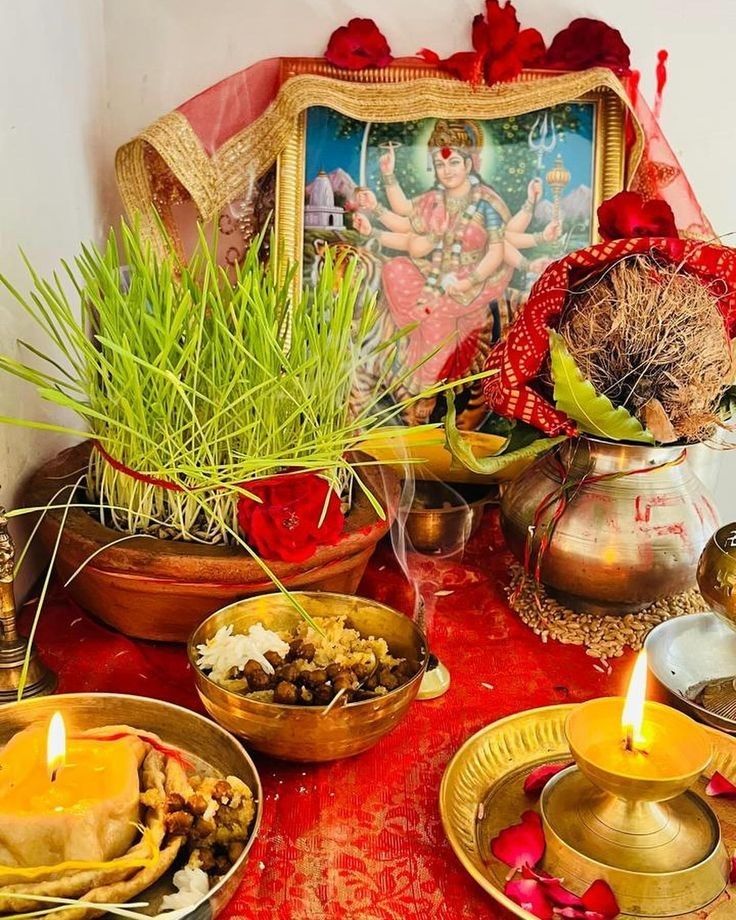
Kathmandu, October 11: Nepali’s greatest festival, Bada Dashain, which traditionally begins on the first day of the bright fortnight of Ashwin, starts today. The festival is celebrated with great enthusiasm for 15 days, until the full moon day of Ashwin. On the first day, known as Ghatasthapana, households perform rituals to establish sacred lamps, a kalash (holy water vessel) and Lord Ganesh. Worship begins in the prayer room or the designated Dashain worship room with the ritual invocation of Goddess Durga, the presiding deity of divine power, according to Vedic traditions.
Early in the morning, after completing their daily rituals, people collect sand or soil from a nearby riverbank or another clean place. They place it in the worship room or Dashain room, which has been purified and plastered with cow dung, and sow barley seeds in it. This ritual is known as Jamara planting.
As barley sprouts are considered dear to Goddess Durga, barley is sown on this day and offered to the goddess. On Vijaya Dashami, people receive the yellow Jamara, a symbol of prosperity, along with Tika and other offerings as blessings.
Prof. Dr. Ram Chandra Gautam, a religious scholar and former chairperson of the Nepal Panchanga Nirnayak Bikas Samiti (Nepal Calendar Determination Development Committee), said that religious scriptures do not prescribe sowing grains other than barley for Jamara. However, some families traditionally sow other grains alongside barley, according to their ancestral customs. Jamara is also used in Ayurvedic medicine.
Ghatasthapana Auspicious Time: 11:47 a.m.
The first day is also called Ghatasthapana because a sacred pot, or ghata, is ceremonially established and Goddess Durga, the embodiment of divine power, is worshipped above it. On Vijaya Dashami, devotees receive the goddess’s blessings through ritual consecration with water from the sacred pot established today.
According to the committee, the auspicious time for Ghatasthapana today is 11:47 a.m. As the Chitra Nakshatra prevails throughout the day, the committee has selected the Abhijit Muhurta around midday for the ritual, in accordance with scriptural prescriptions, said the committee’s chairperson, Associate Prof. Dr. Purushottam Bhattarai.
He explained that the committee designated today for Ghatasthapana in accordance with the traditional rule that the ritual should be performed on a day when the first lunar day, or Pratipada, prevails at sunrise. He also said that claims circulating on social media suggesting that Ghatasthapana should be observed on Monday are not supported by religious scriptures.
During Navaratri, the nine-night period of worship, devotees invoke and worship the three forms of Goddess Durga: Mahakali, Mahalakshmi and Mahasaraswati. A tradition dating back to the Vedic period regards Mahakali as the symbol of power, Mahalakshmi as the embodiment of wealth, prosperity and opulence, and Mahasaraswati as the goddess of knowledge and wisdom.
During Durga Paksha, special rituals and prayers are performed in honour of the nine forms assumed by Goddess Durga to destroy demons representing evil and demonic tendencies, including Chanda, Munda, Shumbha, Nishumbha and Raktabija. The 15-day period from the first day of the bright fortnight of Ashwin to its full moon is also known as Durga Paksha.
Worship of Nine Forms of Durga Over Nine Days
On the first day of Durga Paksha, devotees worship Shailaputri; on the second, Brahmacharini; on the third, Chandraghanta; on the fourth, Kushmanda; on the fifth, Skandamata; on the sixth, Katyayani; on the seventh, Kalaratri; on the eighth, Mahagauri; and on the ninth, Siddhidatri. These nine manifestations are collectively known as Navadurga.
According to religious scriptures, all humanity should worship Goddess Durga because she protects people from evil and demonic forces. Gautam, the religious scholar and former committee chairperson, said scriptural evidence shows that Durga Puja and Dashain do not belong exclusively to any particular caste or religion.
Dashain is celebrated as a symbol of the victory of truth over falsehood and divine power over demonic forces.
From today until Mahanavami, nine unmarried girls are also worshipped individually each day as manifestations of Goddess Durga. Religious prescriptions stipulate that the girls selected for this ritual must be at least two years old.
On the seventh day of Bada Dashain, flowers and sacred plants are ceremonially brought into homes and temples in a ritual known as Phulpati. On Maha Ashtami and Maha Navami, those who follow the tradition of animal sacrifice perform special worship, including sacrifices, at Dashain worship rooms, military shrines and Shakti Peethas, or temples dedicated to the goddess.
Throughout Navaratri, devotees recite the Durga Saptashati (Chandi), the Shrimad Devi Bhagavata and other hymns and prayers dedicated to the goddess. During this period, large numbers of devotees visit Shakti Peethas across the country, including Naxal Bhagwati, Shobha Bhagwati, Nala Bhagwati and Palanchok Bhagwati, to offer prayers and pay homage.
Vijaya Dashami Auspicious Time: 10:26 a.m. on Kartik 4
Dashain, also known as Navaratri, spans nine nights and ten days. The Goddess Durga invoked and worshipped in households today will be ceremonially bid farewell on Wednesday, Kartik 4, the day of Vijaya Dashami. On that day, people receive Tika, Jamara, flowers and other sacred offerings as blessings from their elders.
According to the committee, the auspicious time for the ceremonial immersion of the goddess on Kartik 4 is 8:49 a.m. For those seeking an auspicious time to receive Tika and other blessings, 10:26 a.m. is considered ideal.
According to religious tradition, the goddess’s blessings may be received from Vijaya Dashami until Kojagrat Purnima, when the prescribed rituals, including the offering of animal sacrifices where applicable, have been completed.
From Vijaya Dashami until Kojagrat Purnima, people receive sacred offerings and blessings from their elders. On the full moon day, devotees observe a fast in honour of Mahalakshmi, the goddess of wealth and prosperity, and remain awake through the night to perform worship and pray for wealth, fortune and abundance. Religious belief holds that Goddess Lakshmi blesses those who keep vigil that night with wealth and prosperity.
The Jamara planted during Ghatasthapana is ceremonially disposed of in a clean place on Kojagrat Purnima.
Special Worship at Hanuman Dhoka’s Dashain Shrine
In accordance with tradition, the ritual planting of Jamara and worship of Goddess Durga begin today at the Dashain shrine inside Hanuman Dhoka Palace in Kathmandu, following Vedic rites.
Jayanti Shrestha Pradhan, chief of the Hanuman Dhoka Palace Care Office, said that Chitra Nakshatra and Vaidhriti Yoga would be observed through the prescribed worship and fire rituals on Sunday morning, followed by Ghatasthapana at the auspicious time designated by the committee.
People who live away from their homes for employment, education or other reasons return to their ancestral homes during Dashain to celebrate the festival with their families. For this reason, Bada Dashain is also regarded as a festival of family reunions.
Most educational institutions begin their Dashain holidays today. Consequently, long queues of people can be seen leaving the capital and other urban centres to return to their respective hometowns and ancestral villages.

Login to add a comment