







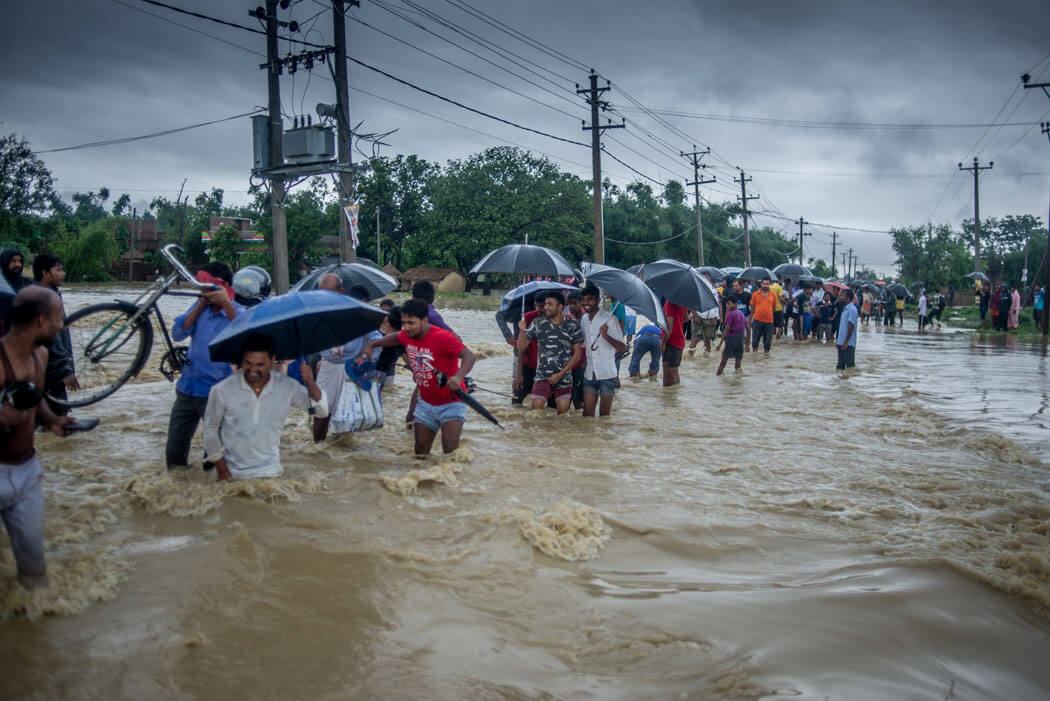
Kathmandu, Sept 14: Nepal’s economy has suffered repeated shocks from natural disasters, political unrest and other human-caused events over the past decade, raising doubts over the government’s target of 7 per cent economic growth in the current fiscal year.
The latest Bhotekoshi floods have caused damage estimated at more than Rs1 trillion, according to economists. The loss is equivalent to roughly 10 to 12 per cent of Nepal’s GDP, although it does not mean economic growth will fall by the same proportion.
Nepal’s economic growth has fluctuated sharply over the past decade. Growth stood at 6.01 per cent in fiscal 2013/14 before falling to 3.98 per cent in 2014/15 following the devastating earthquake. Growth later reached 8.98 per cent in 2016/17 as reconstruction gathered pace.
The COVID-19 pandemic pushed the economy into negative growth of 2.37 per cent in 2019/20. Growth recovered to 4.84 per cent in 2020/21 and 5.63 per cent in 2021/22 but slowed again in subsequent years.
Growth was limited to 1.98 per cent in 2022/23 following the Jajarkot earthquake. It stood at 3.68 per cent in 2023/24 amid weak investment and demand and rose to 4.43 per cent in 2024/25 despite heavy rains and flooding. Growth was estimated at 3.85 per cent in 2025/26 amid the Gen Z movement, political instability and damage to government and private property.
The government has set a 7 per cent growth target for 2026/27, but economists say the Bhotekoshi disaster makes the target difficult to achieve.
Economist Dr Dill Raj Khanal said the economy could return to its previous trajectory within four to five years if relief, rehabilitation and reconstruction are accelerated. He cited the post-earthquake period, when reconstruction activity helped drive high economic growth.
Economist Dr Ramesh Poudel estimated the latest disaster caused more than Rs1 trillion in economic losses. Around 700 to 800 MW of hydropower capacity has reportedly been affected, with reconstruction and replacement costs estimated at around Rs750 billion.
He said the economy cannot rely heavily on foreign aid because wars and higher fuel prices have strained global economies. Nepal must instead mobilise domestic economic activity, remittances, tax revenue, agriculture, industry and limited foreign assistance.
Economist Dr Kalpana Khanal said Nepal must reconsider its development model as disasters repeatedly consume resources that could otherwise finance development.
She urged the government to focus on risk assessment and preparedness rather than limiting its response to post-disaster reconstruction. Infrastructure, including hydropower projects, should be designed to withstand climate-related risks.
She also called for Nepal to secure international climate finance for loss and damage, adaptation and mitigation, and use those resources for safer settlements and disaster risk management.
She further urged the government to identify priority sectors and introduce policy measures to revive credit flows and attract private investment, which have remained weak since the COVID-19 pandemic.

Login to add a comment