







By Our Reporter
The Bhotekoshi–Trishuli flood has created one of the most serious consequences- the disruption of Rasuwagadhi, Nepal’s key northern trade gateway with China. If the border remains closed for an extended period while alternative transport routes are also damaged, what is now a regional disaster could quickly become a national crisis involving trade, supplies, prices, employment and foreign exchange.
That is why reopening Rasuwagadhi must now become a national priority. The encouraging part is that China appears to be moving quickly. Within days of the disaster, Chinese authorities reportedly restored a temporary road along roughly three kilometres of severely damaged terrain toward the Nepal–China border. The speed of the Chinese response shows that restoring connectivity is technically possible and that Beijing has an interest in bringing the trade route back into operation.
Nepal should immediately build on that momentum. The government should not wait for the entire damage assessment to be completed before beginning negotiations with China. A joint Nepal–China reconstruction task force should be established immediately, with authority to assess the damage, mobilise equipment, construct temporary crossings and determine the fastest route for restoring commercial movement.
There is already a useful precedent. After the July 2025 Lhende River flood destroyed the Friendship Bridge and major infrastructure on the Nepali side, Nepal and China moved within weeks to construct a temporary Bailey bridge. By the end of that year, a 91-metre bridge had restored movement. The lesson is clear: temporary infrastructure can reopen a vital trade corridor while permanent reconstruction continues.
This time, the scale of destruction may be greater. Nepal reportedly needs to rebuild around 20 kilometres of road and several bridges. That will be expensive and technically difficult. But Nepal should not approach China merely as a donor. Rasuwagadhi serves both countries. It supports bilateral trade, tourism and connectivity, while the road from Rasuwagadhi to Syafrubesi itself was developed with Chinese assistance. There is therefore a strong economic and strategic case for China to help Nepal restore the route.
Nepal should seek Chinese manpower, heavy equipment, engineering expertise and financing wherever possible. If Chinese machinery is already operating close to the border, arrangements should be made to deploy suitable equipment on the Nepali side rather than duplicate capacity from scratch.
But reopening Rasuwagadhi alone will not solve the immediate problem.
Supply crisis in Kathmandu: Nepal also faces a potential supply crisis because its alternative transport routes are under severe pressure. The destruction of the Rasuwagadhi route comes at a particularly sensitive time, with major festivals approaching and demand for food, clothing, household goods and other imports expected to rise.
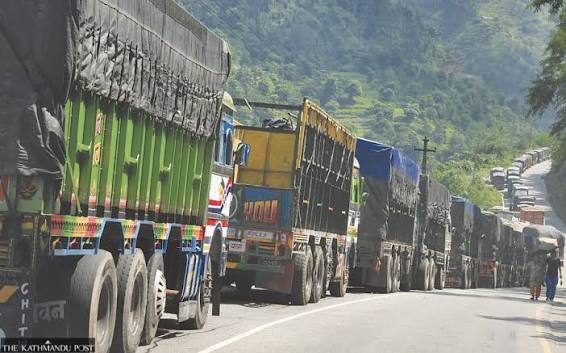
This creates a dangerous chain reaction. If Chinese imports cannot enter through Rasuwagadhi or Tatopani, they must come through another route. If supplies are redirected toward Korala in Mustang, or imported through India, the pressure does not disappear. It shifts onto Nepal’s already fragile road network. Ultimately, much of that additional traffic could converge on the Prithvi Highway.
The result could be higher transport costs, slower deliveries, shortages and rising consumer prices. The risk of artificial scarcity and black-market trading would also increase, particularly for fuel, food and festival-related goods.
The government therefore needs an emergency national supply plan, not simply road repairs. It should immediately identify alternative import routes, calculate the daily volume of essential goods required by Kathmandu Valley, establish temporary logistics hubs and prioritise food, fuel, medicines and other necessities. Private transport operators and traders should be brought into the planning process rather than left to respond individually.
Market monitoring must also become more aggressive. A disrupted supply chain can quickly become an opportunity for hoarding, price manipulation and black-market sales. Authorities need real-time information on inventories, wholesale prices, transport costs and the movement of essential commodities.
At the same time, Nepal should accelerate repairs on the Prithvi Highway and other strategic routes. Temporary bridges, one-way traffic systems, alternative tracks and controlled freight windows should be considered wherever permanent reconstruction will take weeks or months.
The government must also recognise the wider economic consequences of keeping Rasuwagadhi closed. The border supports thousands of businesses and jobs directly and indirectly. Hotels, transport companies, customs agents, wholesalers, retailers and local service providers all depend on cross-border movement. Every additional day of closure deepens their losses.
More importantly, the crisis exposes Nepal’s dangerous dependence on a small number of transport corridors. A country whose major trade routes can be simultaneously disrupted by floods, landslides or border closures is economically vulnerable even when there is no national shortage of goods.
If the government moves quickly, the current disaster can remain a severe regional crisis. If it moves slowly, a destroyed border and damaged highways could turn into something much larger—a crisis of trade, supplies, prices, employment and public confidence.

Login to add a comment