








By Our Reporter
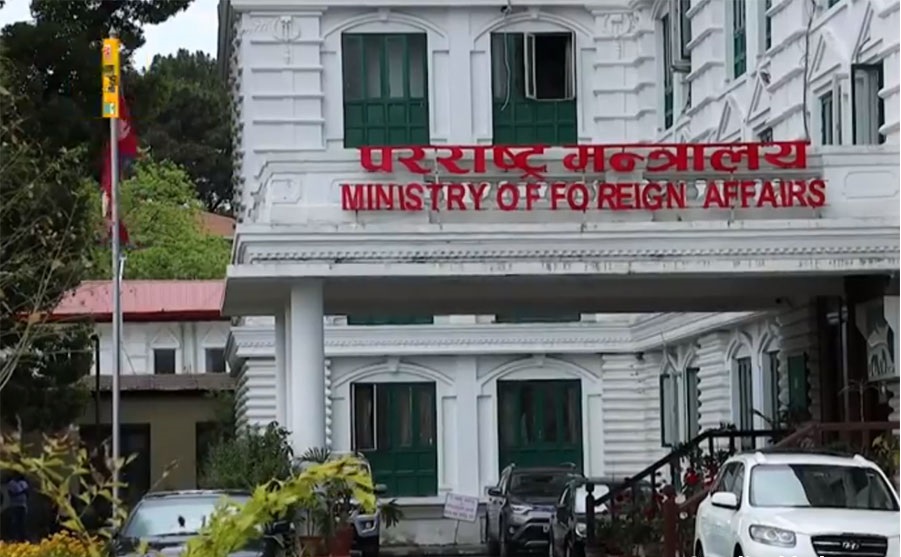
Foreign policy often becomes a serious subject once a party prepares to run the government. If the Rastriya Swatantra Party (RSP) forms the next government, it will enter office with strong public support and high expectations. Yet its leaders have limited experience in running the state. That mix of confidence and inexperience may shape how carefully the new government handles Nepal’s relations with other countries.
RSP chief Rabi Lamichhane has promised a balanced and independent foreign policy built around development diplomacy. On paper, that sounds reassuring. Nepal’s foreign policy tradition rests on non-alignment and careful relations with all major partners. The real test will come in how the new leadership handles three powerful actors around Nepal, India, China, and the United States.
Nepal sits between two large neighbors and also maintains strong development ties with Western partners. That geography leaves little room for ideological experiments. A new government cannot suddenly rewrite foreign policy without creating anxiety among partners. Former diplomats are already warning that priorities may change, but the basic direction of Nepal’s external relations cannot swing wildly with each election.
Managing ties with India
India remains Nepal’s closest and most sensitive partner. The relationship stretches across open borders, deep cultural links, labour migration, and trade dependence. Millions of Nepalis live or work in India, and a large share of Nepal’s imports move through Indian routes. At the same time, the relationship carries a list of unresolved issues. Border disputes remain unsettled. Hydropower cooperation moves slowly. Trade imbalances continue to worry policymakers in Kathmandu. Security concerns also shape New Delhi’s view of Nepal.
An RSP government will need to show early signs of stability in dealing with India. Lamichhane and his colleagues have already spoken about the importance of historical and cultural ties. That message will likely continue. The new government may focus on practical areas such as energy trade, cross border infrastructure, and smoother economic cooperation.
India generally values predictability in Kathmandu. If the RSP maintains a steady approach, avoids provocative rhetoric, and engages through regular diplomatic channels, relations can remain stable. A confrontational tone, often used by parties in opposition, tends to fade quickly once leaders sit in government offices. However, the RSP leaders must be cautious to keep the relations with Indian in a balance. A senior leader, Swarnim Wagle, has once said that the South Asia should be under India’s sphere of influence drawing parallel of Monroe Doctrine, raising political temperature. Such incidents should not come out in open now as the RSP is now a governing party.
Rebuilding trust with China
Relations with China will also require careful attention. Beijing has invested time and political capital in its engagement with Nepal, particularly through the Belt and Road Initiative.
The problem is that many BRI projects remain stuck in paperwork and political hesitation. Chinese officials often complain about delays and lack of clarity in Kathmandu’s decision making. Trust has also weakened in recent years due to political instability.
RSP leaders have indicated that they will assess BRI projects on a case by case basis. That approach could allow the government to move forward on projects that support Nepal’s development goals while avoiding debt risks or poorly planned investments.
At the same time, the party has reaffirmed support for the One China policy. This is an established part of Nepal’s diplomatic position and unlikely to change. Beijing mainly expects Kathmandu to maintain that stance and provide a predictable environment for cooperation. In the meantime, during the Gen Z protest in September volunteers and members of the Free Tibet Movement came out in the open, angering China and undermining Nepal’s One China Policy. Such sensitive issue should not be raised again.
The US and SPP debate
Relations with the United States present a different challenge. Washington is an important development partner and a major source of investment, aid, and educational opportunities for Nepalis.
The Millennium Challenge Corporation compact, worth $747 million, already reflects this cooperation. The RSP government will likely continue implementing the MCC projects because backing away now would damage Nepal’s credibility.
The more controversial issue is the State Partnership Program, or SPP. The previous government led by Sher Bahadur Deuba rejected the proposal in 2022 after strong domestic opposition. Critics feared that the program might open the door for a military presence in Nepal.
Rumors often circulate that the RSP leadership enjoys quiet support from the United States and might revive the SPP. In practice, the new government will probably avoid reopening that debate. Public suspicion remains strong, and any attempt to revisit the program could trigger political backlash.
A more likely approach would be to keep cooperation with Washington focused on development, education, climate work, and economic investment. That allows Nepal to maintain a healthy relationship with the United States without entering security arrangements that worry neighboring powers.
Walking a narrow path
Nepal’s geography forces every government to practice diplomatic balance. For the RSP, this balance will require discipline. Leaders who rose quickly through anti-establishment politics must now operate within the slower world of diplomacy. One careless statement can create misunderstandings across borders.
If the party follows its own manifesto, it will try to turn Nepal from a buffer state into a bridge between India and China through economic cooperation and connectivity. That idea sounds attractive. Turning it into reality will demand careful negotiation, strong institutions, and consistent policy.
In the end, the RSP government will not have the luxury of dramatic foreign policy experiments. Nepal’s location and economic needs leave little room for that kind of adventure. The new leaders will likely learn what many governments before them discovered, balanced diplomacy may sound boring, but in Nepal’s case it is usually the safest way forward.

Login to add a comment