







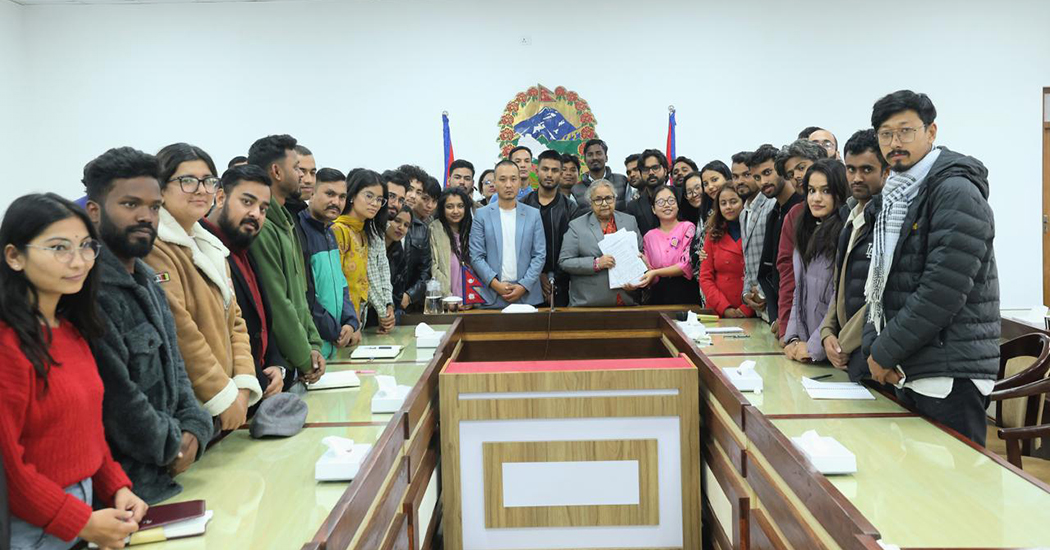
Kathmandu, Dec 11: Gen-Z representatives and the government have inked an agreement in which several of Gen Z youth protestors who toppled the KP Sharma government after the September 8-9 movement. As per the new accord, both sides have agreed that no one will face criminal investigation or prosecution solely for taking part in political activities related to the September protests.
This provision appears in the agreement reached on Wednesday evening.“The government will not carry out criminal investigation or prosecution against anyone solely for participating in political activities connected with the people’s movement of Bhadra 23 and 24, 2082,” the draft states.
The draft also includes a provision to bring a new law that limits top party leaders to two terms.
“A leader can serve as party president or chairperson for a maximum of two terms only,” the draft says.
The same provision appears again in the draft, making it clear that a law will be introduced to stop anyone from holding party leadership for more than two terms.
Key points of the agreement
The detailed agreement covers a broad set of issues related to the Gen-Z movement of Bhadra 23–24, 2082. It addresses the rights of those killed or injured, governance, judicial reform, electoral reform and constitutional changes. The main points are as follows:
1. Support for families of those killed or injured
• Fast-track the process of declaring those killed in the movement as martyrs.
• Form a high-level task force to provide long-term support to families of martyrs and the injured, covering interim relief, compensation, medical treatment, education, jobs, social security and memorial-building.
• Establish a constitutional commission to permanently handle issues related to martyrs and the injured.
2. Impartial investigation of movement-related incidents
• Identify those involved in extrajudicial killings, violence and human rights violations and recommend criminal accountability.
• Clearly distinguish between planned crimes carried out in the name of the movement and activities that were genuinely part of the movement.
• Screen all movement-related cases within 15 days, release those found innocent and withdraw their cases.
• Create a separate mechanism, including reforms in security agencies, to prevent future violence.
3. Control of political and policy corruption
• Form a high-level commission to investigate party-based capture of institutions, power-sharing arrangements, illegal wealth, and misuse of public office.
• End political capture of public institutions and dissolve foundations, funds or trusts created or operated improperly, transferring their assets to the state.
• Create a separate mechanism to recommend administrative reforms.
4. Free and safe elections
• Ensure voting rights for Nepalis living abroad.
• Make asset declaration mandatory for candidates.
• Improve laws to make party and candidate spending transparent.
• Add a “None of the Above” option on ballot papers.
• Require internal party primaries.
• Limit party presidents or chairpersons to a maximum of two terms.
5. Commission for constitutional review and reform
• Begin a public consultation process within three months to review the constitution.
• Provide detailed recommendations on proportional representation, corruption control, judicial independence, structural reforms, term limits and minimum age for candidates, which will be 21 years.
6. Full proportional inclusion
Ensure representation of women, Dalits, Indigenous nationalities, Madhesis, Tharus, Muslims, persons with disabilities, marginalized groups, farmers, laborers, backward regions and economically disadvantaged Khas Arya in all state bodies.
7. Openness and responsibility in governance
• Strengthen the system for making government decisions, spending and procedures public.
• Publish past investigation commission reports according to law.
• Apply a transparent and competitive process for appointments to public posts.
8. Freedom of expression and digital rights
• Improve laws and technology to protect expression and data security on digital platforms.
9. Formation of a Gen-Z Council
Create a “Gen-Z Council” to ensure youth participation in government mechanisms and to advance the goals of the movement.
10. Implementation of the agreement
• The agreement takes effect from the date of signing.
• Implementation will be carried out with mutual consent between the Government of Nepal and the Gen-Z group.
People’s News Monitoring Service

Login to add a comment