







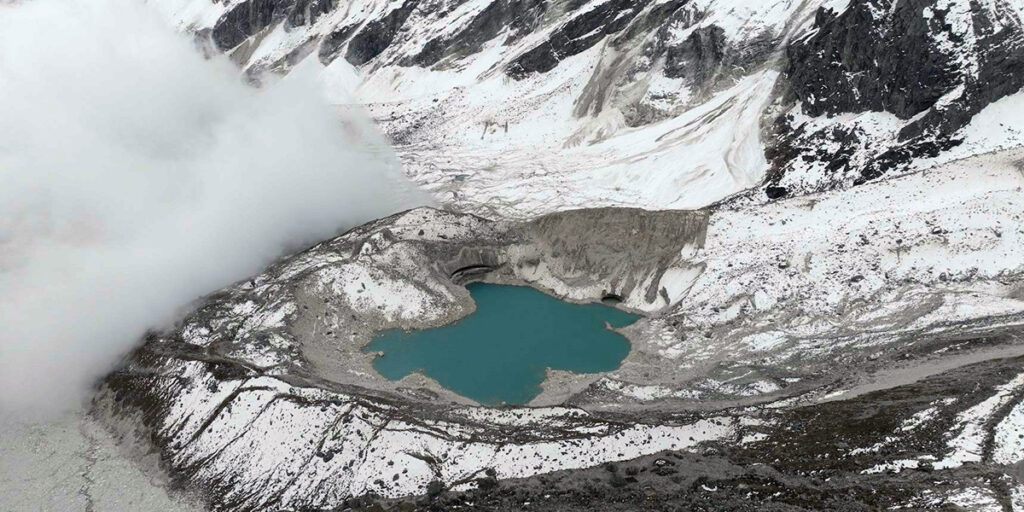
Kathmandu, October 27: A recent study has shown that due to the growing effects of climate change, the Hindu Kush Himalayan region faces increasing risks of glacial lake outburst floods (GLOFs), avalanches, and rapid snowmelt.
According to the study titled “Causes, Impacts, and Future Risks of Glacial Lake Outburst Flood in the Thame Valley” conducted by the International Centre for Integrated Mountain Development (ICIMOD), the average temperature in the region has been rising by 0.28°C every decade. The research was carried out by ICIMOD risk experts Sudan Bikash Maharjan, Tenzing Chhogyal Sherpa, and Arun Bhakta Shrestha.
The study indicates that the Sagarmatha (Everest) region is experiencing an unprecedented rate of glacier melt due to climate change—an increase of around 65 percent compared to previous decades. As glacier melt accelerates, over 25,000 glacial lakes in the Amu Darya, Indus, Ganga, Brahmaputra, and Irrawaddy basins are expanding, according to the report.
The findings confirm that the glacial lake outburst flood that occurred last year in Thame, Solukhumbu, resulted from these processes. The report explains that a combination of geological and geomorphological factors intensified the destructive power of the flood.
Sudan Bikash Maharjan, one of the study’s authors and a remote sensing analyst at ICIMOD, stated that with over 25,000 glacial lakes across the Hindu Kush Himalaya, the Thame incident highlights the urgent need to better understand and mitigate risks even from relatively small lakes. The study found that Thame experienced significant destruction due to climate-induced impacts.
The study revealed that when a large rock fell into a glacial lake located at an altitude of 4,900 meters, the natural dam burst, releasing about 156,000 cubic meters of water. When this water cascaded into another lake situated 120 meters below, it created a 22-meter-deep and 51-meter-wide breach, releasing an additional 303,000 cubic meters of water.
The combined outflow from both lakes generated a powerful torrent that carried massive boulders and debris as far as 80 kilometers downstream, damaging riverbanks along its course.
As the floodwaters passed through naturally narrow river sections and areas temporarily blocked by accumulated debris, the flood intensified, causing massive destruction. The Thame Valley, about half a kilometer wide near the village, was filled with debris.
The flood damaged private houses, a school, a health post, a bridge, and a hydropower project. Fortunately, since the event occurred during the daytime and the water flow was gradual, there were no human casualties. However, the disaster displaced 135 people and destroyed 25 houses.
Since the 1920s, Nepal has experienced more than 90 glacial lake outburst floods, with five major events occurring in the Sagarmatha region alone within the past 50 years.
GLOFs are among the most destructive and dangerous natural hazards in the high Himalayas. Such events can release millions of cubic meters of water and debris within hours, causing catastrophic damage to downstream areas.
Co-author and ICIMOD cryosphere analyst Tenzing Chhogyal Sherpa noted that as extreme climate events intensify, incidents like the Thame flood serve as stark reminders and moments for self-reflection. He said, “They show how mountain communities are enduring the brunt of climate-induced disasters. Studies like this help us understand the realities of climate change.”
ICIMOD senior advisor and co-author Arun Bhakta Shrestha explained that the Thame event underscores how the temperature in the Hindu Kush Himalaya is rising nearly three times faster than the global average, increasing the threat to glaciers in the region. “In just the past two years, we have witnessed several high mountain hazards, including GLOFs. Therefore, it is urgent to strengthen real-time monitoring systems, establish additional flood and weather forecasting stations, and construct engineering structures such as riverbank protection works to minimize future losses,” he added.
The Thame event has provided crucial lessons for understanding Himalayan disasters and developing actionable policies for the future. Recently, the Building Adaptation and Resilience in the Hindu Kush Himalayas project has focused on reducing disaster costs and risks in the region.
People’s News Monitoring Service.

Login to add a comment