







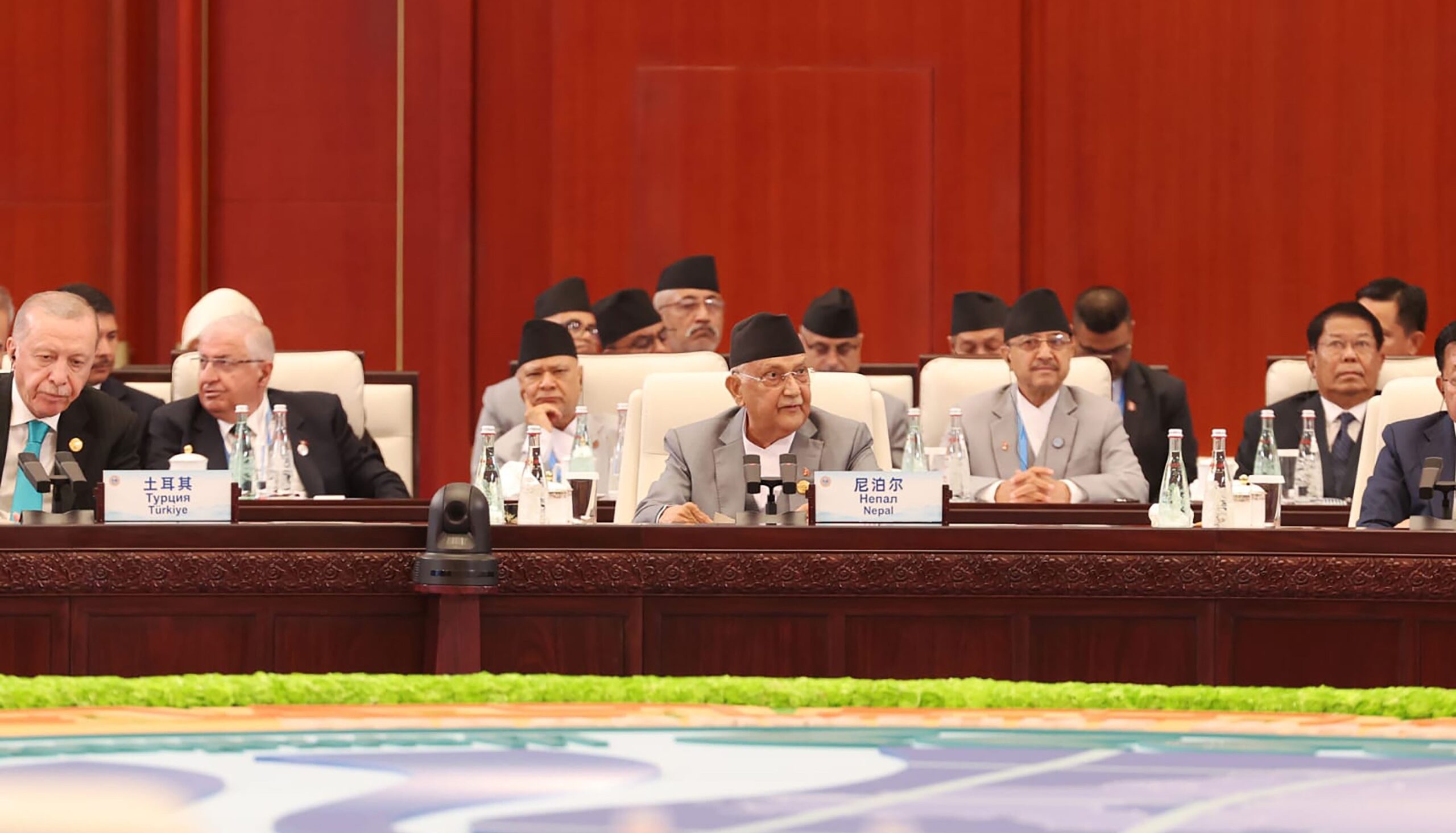
प्रधानमन्त्री ओली-सम्बोधन
प्रधानमन्त्री केपी शर्मा ओली शाङ्घाई सहयोग संगठन (एससिओ) प्लसको शिखर सम्मेलनलाई सम्बोधन गर्नुहुँदै ।तस्बिर सौजन्य : प्रधानमन्त्रीको सचिवालय/रासस
Tianjin, Sept 2: Prime Minister KP Sharma Oli has expressed optimism toward Chinese President Xi Jinping’s newly announced Global Governance Initiative (GGI), even as debate continues in Nepal over Beijing’s claim that Kathmandu supports other Chinese-led agendas like the Global Security Initiative (GSI) and Global Civilization Initiative (GCI). He made his remarks while addressing the Shanghai Cooperation Organization (SCO) Plus summit.
Xi unveiled the GGI during the SCO Plus summit in Tianjin. This is his fourth major global proposal after the Global Development Initiative, GSI, and GCI. Xi said the initiative rests on five principles: sovereign equality, international rule of law, multilateralism, a people-centered approach, and concrete action.
“Global governance has come to a new crossroads,” Xi told delegates, warning against Cold War thinking, hegemonism, and protectionism. He stressed that all nations must be equal participants in shaping rules for global order.
Oli quickly echoed Xi’s remarks. “We must make the global governance system more effective and efficient by placing the United Nations at its core,” he said. He argued that the GGI could strengthen multilateralism and create “a more just, inclusive, and equitable community with a shared future for humanity.”
His statement came even though the GGI’s details are still unclear and without consultation among Nepal’s political parties or state agencies. Observers noted that Oli’s endorsement was immediate and contrasted with controversy over China’s earlier claim that Nepal supported GSI and GCI—claims Nepali officials later denied.
In his address to the SCO, Oli emphasized the urgency of rebuilding trust in multilateral platforms. “Multilateral forums promise much. Too often, they deliver little. Promises without progress erode trust. But abandoning multilateralism is not the answer,” he said. He pointed to terrorism, climate change, cyber-attacks, pandemics, and ecological shocks as shared threats that no country can tackle alone.
Highlighting Nepal’s vulnerability to climate change, Oli warned: “While our mountains serve as global climate stabilizers, they are being stripped of their snow reserve endangering the lives of billions living downstream.”
The SCO will complement the spirit of revitalized multilateralism based on sovereign equality, he said, showing urgency for a revitalized SCO: more united, more integrated, and more resilient to tackle deepening geopolitical, economic, and ecological shocks that threaten our shared future.
Sharing Nepal’s pride as the Dialogue Partner since 2016, he said the nation is looking forward to getting admitted as a full member.
“We cannot speak of peace without addressing regional security. Threats cross borders every day. Terrorism robs societies of safety and opportunities. Climate change multiplies risk.
Nepal, with the Himalaya in its heart, feels its wrath directly”, he said, adding “While our mountains serve as global climate stabilizers, they are being stripped of their snow reserve endangering the lives of billions living in the downstream”.
Emerging threats such as cyber-attacks, pandemics, ecological shocks are not confined to borders, the PM viewed. “With just five years left to achieve the Sustainable Development Goals, we are clearly off-track”.
The PM went on saying that in these turbulent times, regional cooperation is a tool to tackle shared challenges in terms of economic, technological, and ecological fronts.
The executive head shared Nepal’s steadfast commitment to regional cooperation, and strong relations with SCO members.
PM Oli stressed the need to foster regional peace, progress and prosperity through enhanced physical, economic, digital, socio-cultural and people-to-people connectivity; step up dialogue and diplomacy to nurture deeper understanding and explore more partnership by building a just, inclusive, and resilient order and achieve sustainable development.
Such “whole of the world” coordination will ensure that no nation is left behind, the PM said, reaffirming Nepal’s commitment to enhance regional cooperation within SCO.
“We support a rules-based, inclusive multilateral system for a sustainable future”, he said, urging to strengthen friendships, partnerships, and good neighbourly relations.
He noted that a resilient and prosperous SCO region is within our reach, when we are committed to act together.
The PM also extended warm greetings and best wishes of Nepali people for the success of this Meeting as well as continued progress and prosperity of all SCO Member States.
The prime minister also signaled Nepal’s desire for deeper involvement in the SCO. “Nepal, a proud Dialogue Partner since 2016, looks forward to getting admitted as a full member,” he said. To gain full membership, Nepal must first be upgraded to observer status.
Oli presented what he called three “shifts” necessary for global peace and cooperation. “First, from isolation to connectivity,” he said, stressing physical, economic, digital, and people-to-people ties. “Second, from confrontations to consultations,” urging dialogue over disputes. “Third, from competition to cooperation, the world needs more partnership, not partition.”
The SCO will complement the spirit of revitalized multilateralism based on sovereign equality, he said, showing urgency for a revitalized SCO: more united, more integrated, and more resilient to tackle deepening geopolitical, economic, and ecological shocks that threaten our shared future.
Sharing Nepal’s pride as the Dialogue Partner since 2016, he said the nation is looking forward to getting admitted as a full member.
“We cannot speak of peace without addressing regional security. Threats cross borders every day. Terrorism robs societies of safety and opportunities. Climate change multiplies risk.
Nepal, with the Himalaya in its heart, feels its wrath directly”, he said, adding “While our mountains serve as global climate stabilizers, they are being stripped of their snow reserve endangering the lives of billions living in the downstream”.
Emerging threats such as cyber-attacks, pandemics, ecological shocks are not confined to borders, the PM viewed. “With just five years left to achieve the Sustainable Development Goals, we are clearly off-track”.
The PM went on saying that in these turbulent times, regional cooperation is a tool to tackle shared challenges in terms of economic, technological, and ecological fronts.
The executive head shared Nepal’s steadfast commitment to regional cooperation, and strong relations with SCO members.
PM Oli stressed the need to foster regional peace, progress and prosperity through enhanced physical, economic, digital, socio-cultural and people-to-people connectivity; step up dialogue and diplomacy to nurture deeper understanding and explore more partnership by building a just, inclusive, and resilient order and achieve sustainable development.
Such “whole of the world” coordination will ensure that no nation is left behind, the PM said, reaffirming Nepal’s commitment to enhance regional cooperation within SCO.
“We support a rules-based, inclusive multilateral system for a sustainable future”, he said, urging to strengthen friendships, partnerships, and good neighbourly relations.
He noted that a resilient and prosperous SCO region is within our reach, when we are committed to act together.
The PM also extended warm greetings and best wishes of Nepali people for the success of this Meeting as well as continued progress and prosperity of all SCO Member States. He closed his remarks with an appeal to collective action. “Let us uphold the Shanghai Spirit. Let us strengthen friendships, partnerships, and good neighborly relations. A resilient and prosperous SCO region is within our reach when we are committed to act together.”
People’s News Monitoring Service

Login to add a comment