







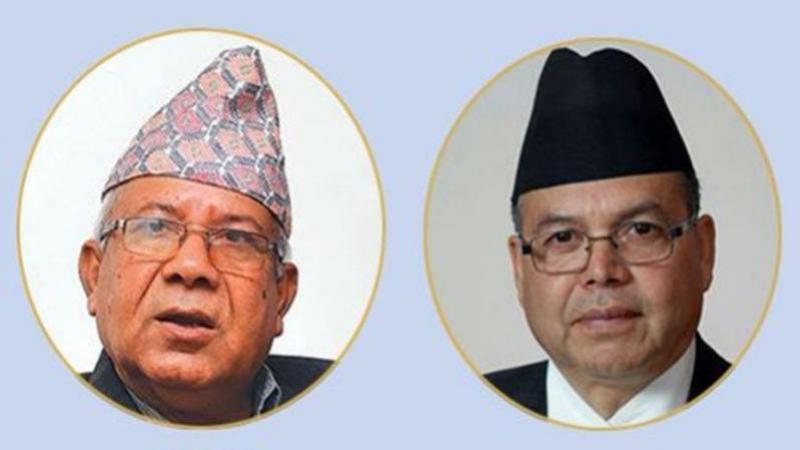
Kathmandu, Aug 2: A widening rift within the CPN (Unified Socialist) has burst into the open after senior leader and former Prime Minister Jhala Nath Khanal, in a television interview, criticized the party’s split from the UML, calling it a mistake. Party Chair Madhav Kumar Nepal responded harshly, suggesting Khanal should leave the party altogether.
Speaking on Image TV, Khanal said dissatisfaction was growing within the party and admitted that breaking away from the UML may have been the wrong decision. “I’ve come to believe that splitting from UML was a mistake. The rebellion we led hasn’t been justified,” Khanal said bluntly.
In response, Chair Nepal—visibly irritated—lashed out while speaking to reporters in Biratnagar. “These days, AI can mimic your voice and say things you haven’t even said,” he joked, before adding: “But if he really said that, he should leave the party. He has no moral ground to stay. He should resign and walk away.”
Khanal, stung by the remarks, didn’t hold back. “Bravo! What a thing to say. Not a small one either—a huge ‘bravo’,” he told Onlinekhabar, sarcastically hinting at the deepening divide. “If there’s a problem, there’ll be a solution too. Let’s see what kind of solution comes.”
The roots of this feud go back to 2021, when the Unified Socialist was formed. At the time, Nepal framed it as a “new party,” while Khanal called it a “rebellion from UML.” Eventually, the party adopted Khanal’s narrative. But the ideological battle never ended.
Khanal has long argued that Nepal completed its democratic revolution in 2006 and that a socialist revolution is now needed to establish scientific socialism. Nepal, on the other hand, insists on sticking to People’s Multiparty Democracy (PMD)—the UML’s long-standing political line.
Their disagreement also extends to political alliances. Khanal, who sees PMD as outdated, has been gradually warming up to the UML again, especially after the 2022 general elections. He’s even advocated for broader left unity that includes the UML. Meanwhile, Nepal has been pushing for closer ties with the Maoist Center, with talks of potential merger having surfaced more than once. A party dialogue committee had even been formed for that purpose—something Khanal openly opposed.
On July 28, at a meeting of the Socialist Front held at the party’s central office, Khanal was excluded altogether. Instead, Bamdev Gautam, a recent entrant, was invited in his place—an unmistakable message about Khanal’s diminishing role.
Personality and leadership styles have always set the two apart. Nepal is seen as more organizationally savvy, while Khanal is known for his ideological depth. Their rivalry has defined much of the party’s internal politics, from factional alignments to decision-making.
The divisions run so deep that in some student organizations, parallel committees have been formed. The most recent example is in the student wing ANNFSU, which now has competing leaderships. Amid the confusion and repeated internal disputes, several former members have already returned to the UML. In fact, some official decisions had to be reversed due to disagreements.
Now, what began as a power struggle within the party has turned into a public spectacle—one leader calling the party’s formation a mistake, the other asking him to quit. The clash has laid bare the fragility of a party born out of rebellion but still unsure of its future path.
People’s News Monitoring Service

Login to add a comment