







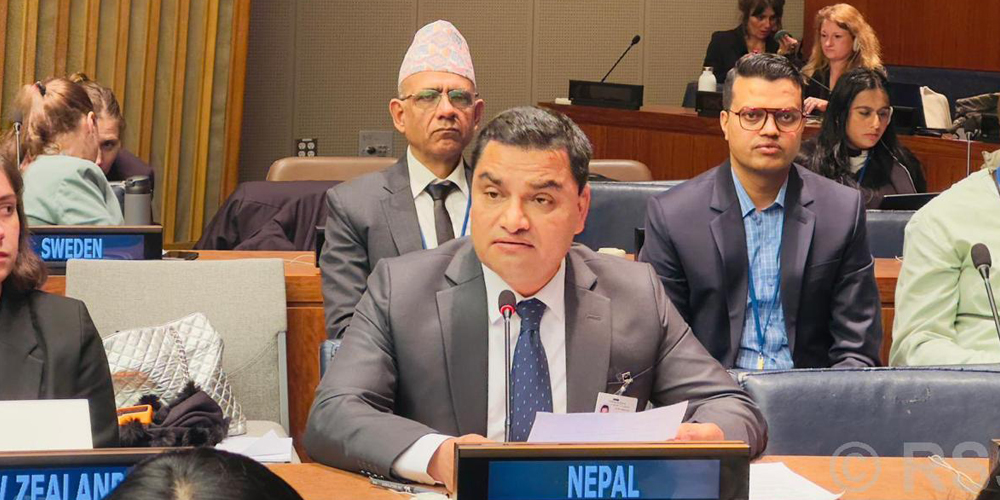
Kathmandu, July 22: Minister for Health and Population Pradeep Paudel on Monday unveiled his one-year progress report, highlighting key achievements in hospital service upgrades, policy reforms, and improvements in the national health insurance program. Speaking at a program at the ministry, Paudel claimed that initiatives ranging from enhancing federal hospitals to expanding free treatment for complex diseases had begun yielding visible results.
According to the 2081/82 fiscal year progress report, the government has begun providing free treatment for vulnerable patients suffering from conditions like sickle cell anaemia, haemophilia, childhood cancer, and hard-to-treat cancers with limited drug access in Nepal. The ministry has also ensured free burn care and vaccinations for Tharu patients suffering from sickle cell and thalassemia, with dedicated wards set up for them. Specialized services for cancer, cardiac issues, and organ transplants are being expanded to provincial hospitals beyond Kathmandu.
Minister Paudel said his priorities centered on upgrading services in federal hospitals and introducing systematic reforms. Measures include managing overcrowding through online ticket booking, upgrading hospital capacities, and repairing specialized medical equipment. Burn and heart care services were launched at Bharatpur and Bheri hospitals, respectively, as part of efforts to ensure such services across all seven provinces.
Health Insurance Reform
Paudel said a task force was formed to improve health insurance, whose recommendations are now being implemented to increase access and ease of service delivery. Under the new system, citizens can access services locally, and every administrative level will have a designated insurance point. Financial support for eight severe illnesses has been doubled, and the waiting time for insurance activation has been reduced from three months to one. Funds not used within a fiscal year will now roll over under new policies.
The insurance system is being expanded to cover all civil servants and workers in the organized sector, aiming to make the scheme financially sustainable. All public healthcare services are being gradually integrated under the insurance umbrella. Budget allocations this year have cleared all past dues in the insurance fund, the minister said.
Focus on Prevention
Alongside curative services, Paudel emphasized preventive healthcare through screening and vaccination campaigns. He cited the nationwide rollout of the HPV vaccine to protect girls from cervical cancer — a leading cause of death among women—and promised annual HPV immunization. A decision to recruit over 2,100 additional health personnel followed an organizational and management survey.
Government hospitals, widely relied upon by students from disadvantaged backgrounds, are set to receive increased MBBS quotas. Pokhara and Rapti health science academies have each added 50 MBBS seats, while the National Academy of Medical Sciences has been approved for 400 new postgraduate faculty positions. Free access to life-saving medicines — including those for stroke, hemophilia, and 37 rare and expensive cancers — has also been arranged through government hospitals.
Paudel unveiled the National Population Policy 2082 to tackle demographic concerns like negative population growth in 34 Himalayan districts, declining population density in the hills, and a shrinking fertility rate. The policy seeks to encourage replacement-level fertility without promoting child-number-based discrimination in state services or benefits, signaling a shift away from restrictive family-size policies.
People’s News Monitoring Service

Login to add a comment