







By Mitsu Baral
The conception of God and the conception of truth are not on the same level. The conception of God indicates the controller, whereas the conception of absolute truth indicates the ultimate source of all energies, as Shrimad Bhagavat states, “Summum Bonum“. No one knows the exact origin of Hinduism; nobody can tell the exact year, the place, or who found the religion. However, the evidence of a rich tradition of texts and practices dates to the 2nd millennium BCE or possibly earlier. If Hinduism was the earliest source of these traditions, as some scholars hold, then it is the oldest living religion on earth.
Since the mid-twentieth hundred years, reading material and textbooks on Hinduism have been written by Hindus themselves, frequently under the rubric of Sanatana dharma. The term Hinduism became comfortable with the distribution of books like Hinduism (1877) by Sir Monier-Williams, who wrote the book by closely observing the practices in India. At the beginning of the 21st century, about 80 percent of South Asia’s population followed Hinduism, which had nearly one billion adherents worldwide. Now many people all over the world follow this religion and contribute to its belief. Brahmins were assumed as a fundamental part of the improvement of the post-Vedic Hindu combination by spreading Vedic culture to the neighbourhood networks and coordinating nearby legalism into the trans-local Brahminic culture.
Moreover, Hindus acknowledge and for sure celebrate the natural, multileveled, and occasionally diverse nature of their practices. The widely held Hindu viewpoint that truth or reality cannot be summarised in any religious belief and formulation makes this expansiveness possible. This viewpoint is expressed in the Hindu prayer “May good thoughts come to us from all sides. “Therefore, Hinduism keeps up with the thought that reality should be looked for in various sources, not overbearingly announced.”
Five flexible strands in Hinduism give strength to this religion. These five components have given shape to the Hindu strict practice: regulation, practice, society, story, and devotion. These five components, to take on an ordinary Hindu illustration, are perceived as connecting as strands in an intricate braid. Besides, each strand is created out of a past filled with discussion, elaboration, and challenge.
The first one – regulation, as written and explained by the custom to Veda (“knowledge”), Regulation is the most established centre of Hindu strict expression and was coordinated during the time fundamentally by individuals from the learned Brahman class. The second is – practice, where numerous temples are made establishing a holy ground where people gather and sing praising the lord, following a ritual called a puja which honouring the deity. For Hindus, it is very important to thank the lord for all the generosity he has provided. The third is – society, which has served to organize Hindu life as one community. The fourth is – story, which is another aspect bringing Hindus into a solitary local area of talk. For something like two centuries, individuals on practically all sides of South Asia have answered accounts of heavenly play and associations among divine beings and people. Many tales focus in different degrees on genealogies of human experience, forms of love, and the struggle between order and chaos or between duty and play. In creating, performing, and paying attention to these stories, Hindus have often experienced themselves as members of a single imagined family. The fifth and last strand of Hinduism is devotion- bhakti (“sharing” or “devotion”), an expansive practice of a caring God that is particularly connected with the lives and expressions of the people following the religion.
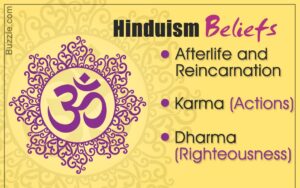
A “great life” as indicated by Hinduism is a significant one where you should seek to accomplish four things, these are: Dharma, Artha, Kama, and Moksha. First dharma, to accomplish dharma you should act ethically, morally, and equitably throughout life, however, you should likewise owe an obligation to both the divine beings and different people, and you should reimburse this obligation to any remaining types of life through custom and different means to accomplish dharma. The following is Artha, who mentions the moral and moral quest for riches and thriving throughout everyday life. The third is Kama, which is fundamentally tracking down delight and satisfaction in life using any means for however long they are moral and ethical and maintain different guidelines of Hinduism. The last is the recently referenced moksha alluding to illumination, solidarity with Brahma, and eventually breaking the pattern of resurrection.
However, Hinduism includes numerous convictions and divinities, most types of Hinduism are henotheistic, meaning they love a solitary god, known as Brahma, yet they perceive the presence of different divine beings and goddesses.
The writer is a student of BBA at KUSOM (Kathmandu University School of Management).
The views expressed in this article are the author’s own and do not necessarily reflect People’s Review’s editorial stance.

Login to add a comment